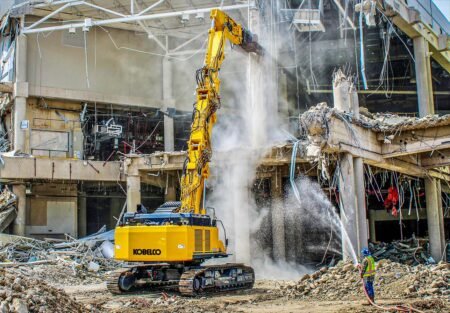
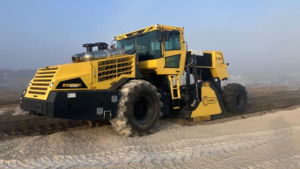



When an excavator as large as Caterpillar’s 352 fell into a hole recently, it took the world’s largest rotator recovery truck to help pull it out.
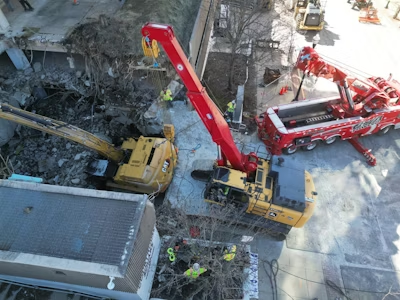
It also gave Bill’s Towing and Recovery a chance to use its new “470RR” — a John Deere 470G LC excavator equipped with a crane for heavy lifting. The 470RR, along with the company’s 100-ton Miller Century M100, billed as “the world’s largest rolling rotator,” helped rescue the 50-plus-ton excavator.
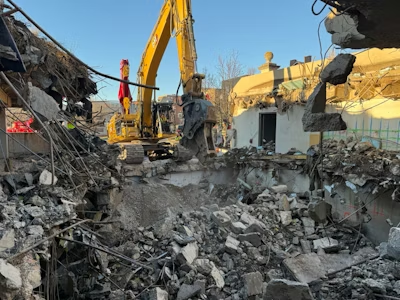
The recovery operation occurred March 3 in Washington, Pennsylvania, after the excavator toppled over during a parking garage demolition.
A video of the incident posted to Facebook shows the excavator gradually descending a slope amid the rubble of the partially demolished building. As its arm reaches out with its shears for another grab, the excavator topples sideways out of view. The hole was estimated to be about 15 feet deep.
The excavator operator reportedly emerged with no physical injuries.
“A few more inches and that guy might not be here,” Washington Mayor Jojo Burgess told observer-reporter.com. “And he walked away without a scratch.”
Bill’s Towing & Recovery was soon called out. Just a couple of days before, it had posted to Facebook that its new “470RR” had arrived.
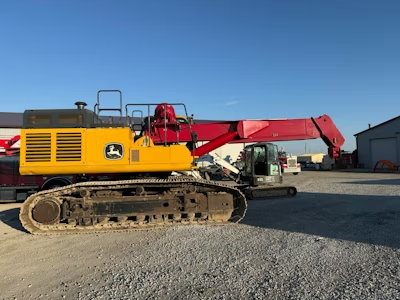

But it also comes in handy when recovering toppled excavators.
“This machine allows us to go places we wouldn’t even consider taking our wreckers,” the company’s post says. “When access is tight, terrain is rough, or the lift is extreme — the 470RR steps in.”
The M100, billed as “the world’s largest rotator” by its manufacturer Miller Industries, joined in the operation with its 200,000-pound lift capacity. The rolling rotator has a 48.5-foot reach and an elevated hook height of 53.4 feet.
The Cat 352 has an operating weight of 107,800 pounds to up to 128,100 pounds, depending on boom configuration, not counting attachments and other additional features, according to Caterpillar’s website. Bill’s Towing & Recovery estimated the toppled excavator weighed 135,000 pounds.
With the M100 and the 470RR, the recovery crew went to work. The task was going to be more complicated than simply hoisting the machine right-side up and pulling it out of the hole.
They first had to fill the large hole under the excavator’s right track to support the excavator near the top of the hole, according to a Facebook post by Bill’s Towing & Recovery.
Then they used an aerial work platform to attach rigging to the excavator’s boom.
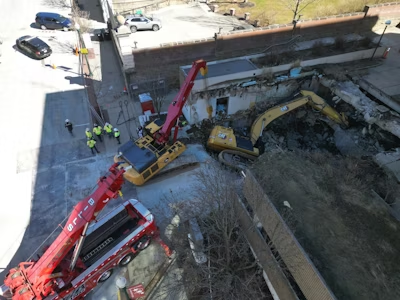
After a safety meeting, the crew lifted the excavator to an upright position inside the hole.
“The M100 then held the machine steady while the rigging was repositioned so the 470RR could lift the rear of the excavator and pull it toward the header wall.”
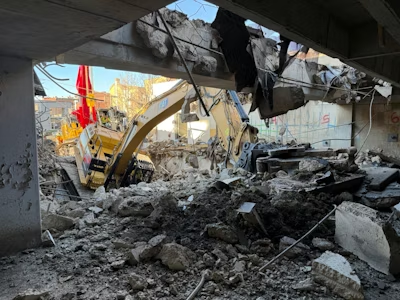
The crew paused the operation and held another safety meeting.
It then started up the excavator and retracted its boom to help free it. The crew was then able to lift the excavator and slide it back to where its tracks were on solid ground.
“Both machines then tracked backwards and safely out of the hole.”
The U.S. Occupational Safety & Health Administration is investigating the incident, and Washington County issued the following statement to observer-reporter.com:
“County leaders have requested a public safety incident report from the general contractor including the name of the operator and the company he was employed by as well as an update on the operator’s condition.”
Read the full article here