



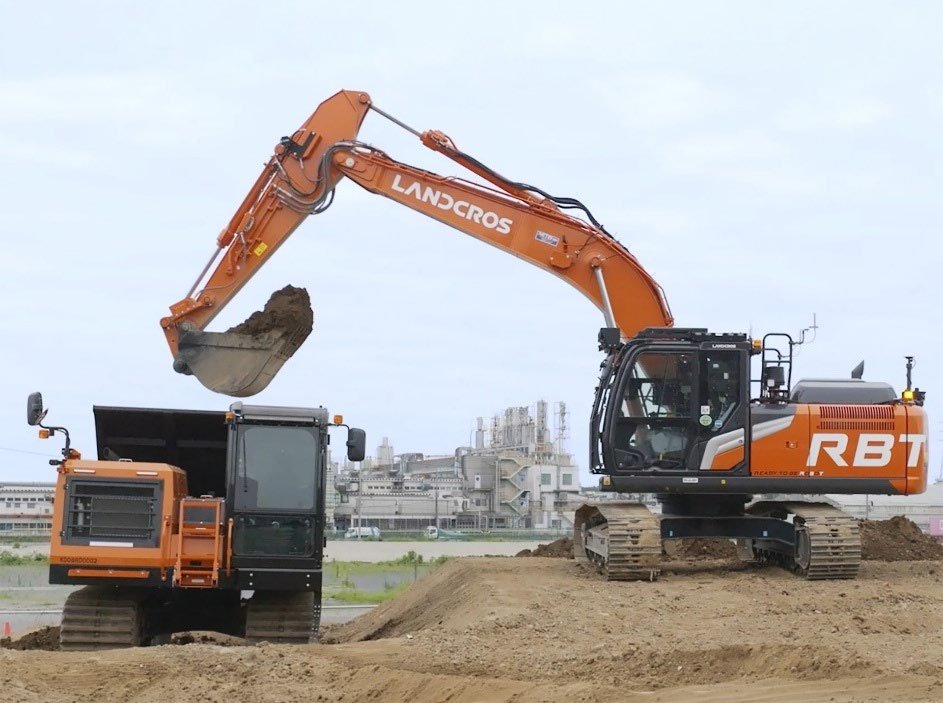
A GENIAC-backed R&D project will use operator data, camera images and work instructions to develop Physical AI for autonomous hydraulic excavator operation.
Hitachi Construction Machinery is preparing to take a new step in autonomous construction equipment by developing Physical AI that learns from the way skilled operators control hydraulic excavators. The project, scheduled to begin in October 2026, aims to bring human-like decision-making closer to machines working in disaster recovery, construction, mining and other demanding off-highway environments.
The initiative has been selected for GENIAC, the Generative AI Accelerator Challenge promoted by Japan’s Ministry of Economy, Trade and Industry and the New Energy and Industrial Technology Development Organization. For Hitachi Construction Machinery, the selection places excavator autonomy inside a broader national effort to strengthen Japan’s generative AI capabilities and accelerate real-world deployment.
Autonomous excavation is more complex than simply automating a repeated motion. The machine must perceive the environment, decide how to proceed and then execute the movement safely and efficiently. Hitachi Construction Machinery describes Physical AI as a technology that can recognise real-world conditions, make decisions and take action. In construction equipment terms, that means linking perception, work planning and machine operation into one autonomous process.
Under the project, Hitachi Construction Machinery will collect large volumes of operator work footage and machine operation logs. These data sets will be used to train AI on lever operations and site conditions, including normal work cycles as well as recovery processes after operational errors. The training data will also cover variations in weather, surrounding environment, machine condition and the position of objects being handled.
The goal is to develop Physical AI capable of making accurate operational decisions on actual jobsites, rather than only in controlled test settings. In future applications, Hitachi Construction Machinery sees the technology supporting debris removal at disaster sites as well as excavation and loading work in construction and mining.
The project will be carried out through industry-academia collaboration. Hitachi Construction Machinery will coordinate the programme, collect hydraulic excavator operational data and build and verify the R&D environment. Jizai, Inc. will research data utilisation technologies and the training environment required for AI development. The Nara Institute of Science and Technology will focus on research and development of a Physical AI foundation model for autonomous hydraulic excavator operation.
For contractors and fleet owners, the potential impact is practical. Autonomous capability could help maintain productivity where skilled operators are scarce, reduce exposure to hazardous environments and support more consistent work quality across demanding applications. For mining and quarrying operations, the technology could eventually contribute to safer material handling and loading cycles. For civil engineering and disaster response, it could allow machines to operate in areas where conditions are unstable or dangerous for people.
Beyond hydraulic excavators, Hitachi Construction Machinery says the project could support future deployment of Physical AI across a wider range of fields, including material handling, forestry, mining, demolition and civil engineering. That broader ambition reflects a shift in heavy equipment development: automation is moving from predefined machine functions toward systems that can interpret changing site conditions.
For now, the project remains at the R&D stage. But its direction is clear: as construction and mining sites become more complex, the next phase of machine intelligence may depend less on replacing operators and more on learning from their skills.
Read the full article here