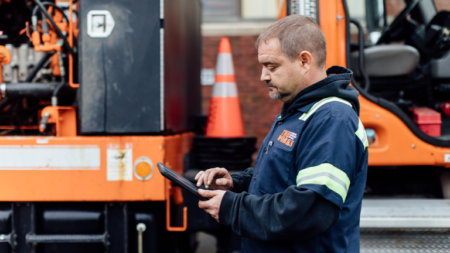



Compact track loaders can handle a variety of challenging terrains, making them ideal for early site preparation.
Bobcat Company
Match the machine to the job
Rather than assigning compact equipment based solely on job site size or surface conditions, contractors often achieve better results by aligning machines with how earthmoving work progresses across a project.
During initial site preparation, compact equipment often handles tasks that prepare the site for larger machines. This includes clearing access routes, staging materials, and supporting utility layout. Machines that offer stability, controlled digging performance, and attachment flexibility are particularly valuable during this phase.
As projects move into utility installation and foundation support work, space constraints may become more pronounced. Compact equipment frequently operates alongside crews working in trenches, around forms, or near existing structures. Machines that can manoeuvre precisely, work close to obstacles, and transition quickly between tasks help reduce congestion and keep workflows moving.
In later phases, compact machines shift toward grading, backfilling, material distribution, and surface maintenance. At this stage, efficiency often depends on cycle times and the ability to handle repetitive tasks without interrupting other crews. Selecting machines that match these workflow demands helps maintain productivity through project completion.
By understanding how compact equipment contributes within these workflows, contractors can select equipment that delivers flexibility and productivity throughout the project.
Compact track loaders and skid-steer loaders
Compact track loaders and skid-steer loaders share many of the same strengths. Both loader options feature a compact footprint, strong attachment compatibility, and the ability to turn within their own footprint, allowing operators to work efficiently in areas where space is limited.
Where the two loaders differ is in how they interact with ground conditions. Compact track loaders use a tracked undercarriage to distribute machine weight over a larger surface area, providing added stability and traction on soft, uneven, or changing terrain. This makes them especially effective during early site preparation, utility installation, and grading work where ground conditions may be less predictable.
Skid-steer loaders, by contrast, operate on tires and are best suited for firm or improved surfaces such as compacted soil, asphalt, or concrete. Their design allows them to transition easily between outdoor and interior work as projects progress and access conditions change.
Compact excavators
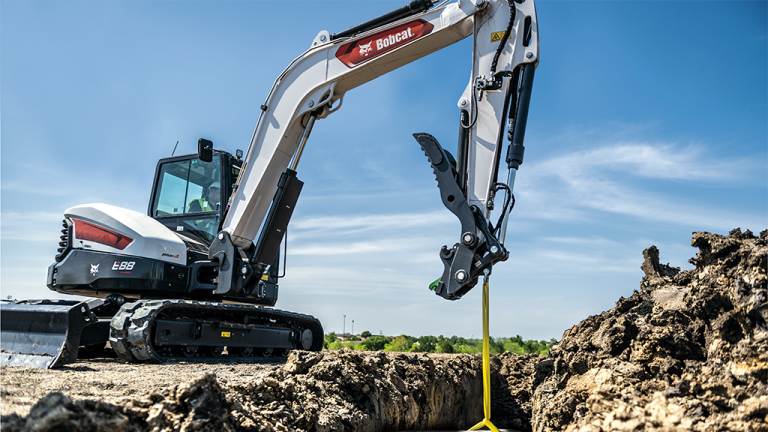
Compact excavators play a central role in earthmoving work that requires controlled digging in tight areas. Typical applications include utility trenching, drainage installation, footing preparation, and grading around curbs or foundations. Reduced and zero-tail-swing configurations allow operators to work close to structures, while attachments expand their capability for material handling and placement.
Mini track loaders
Mini track loaders contribute to earthmoving operations in areas that larger compact machines cannot reach. Their narrow footprint allows them to support material movement, light grading, and site preparation tasks in confined spaces while minimizing surface disturbance.
Compact wheel loaders
Compact wheel loaders support earthmoving operations where material must be moved efficiently across the site. Their carrying capacity and smooth travel characteristics make them effective for transporting aggregate, soil, and base material, supporting grading crews and loading trucks without disrupting surrounding activity.
Read the full article here