




Mini Excavator Attachments and Accessories: Everything You Need to Know Before You Buy, Rent, or Upgrade
There’s a conversation that happens on job sites constantly, usually between a contractor and someone who just watched a mini excavator finish a trench in 40 minutes that would have taken a crew half a day to do by hand. It goes something like, “What else can that thing do?”
The honest answer is—a lot. But this is not due to the machine itself. The answer is because of what you attach to it.
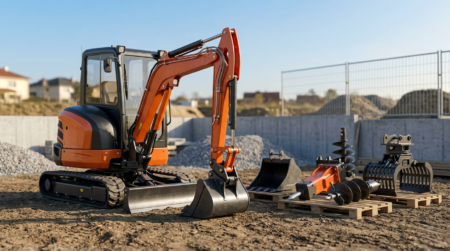
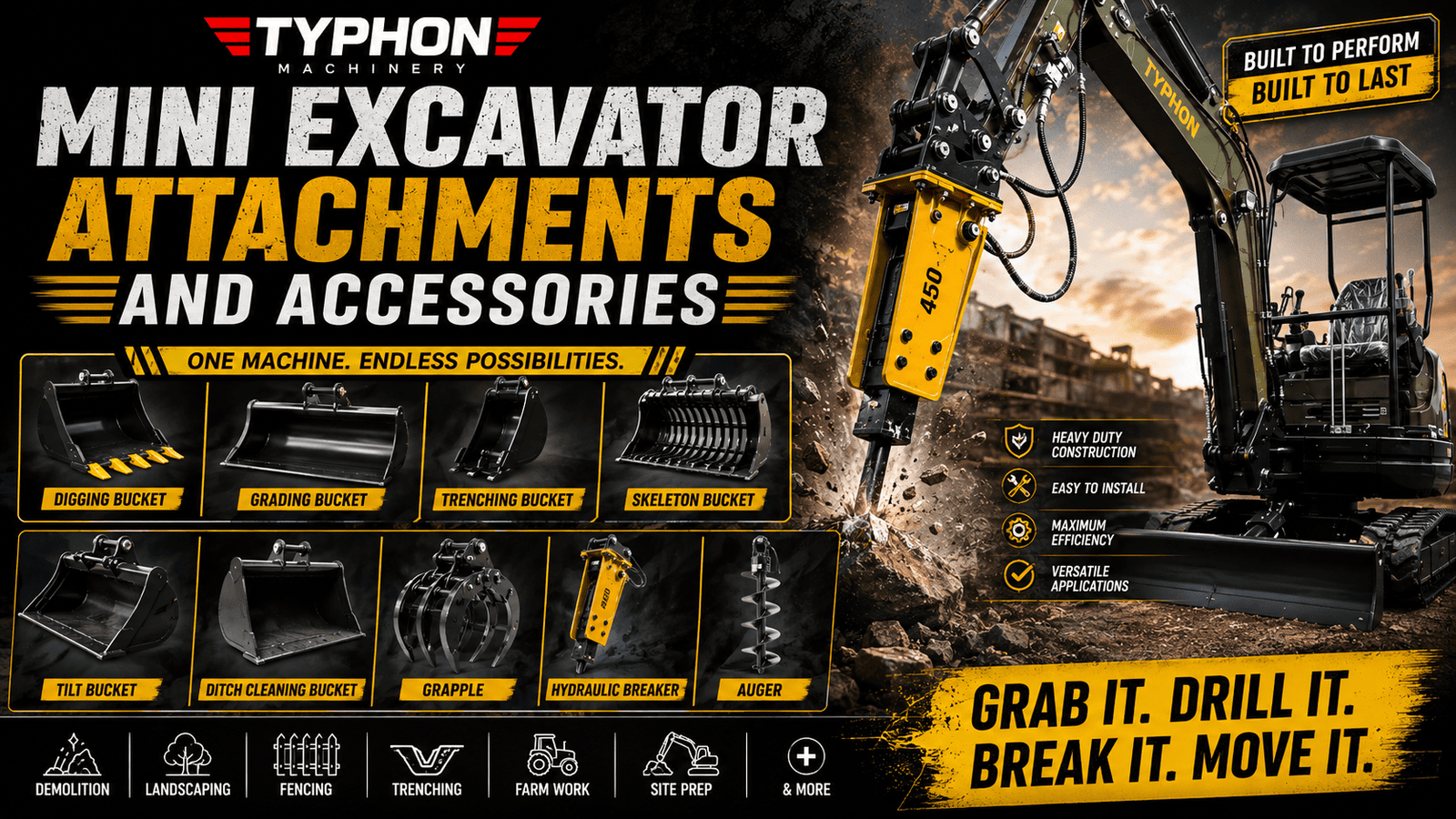
Mini excavator attachments and accessories are what take a capable but limited compact machine and turn it into something genuinely versatile. The base unit digs. Fine. With the right attachment library, that same machine can break concrete, bore fence posts, clear land, compact backfill, and grade finish surfaces—often on the same day and sometimes on the same job.
This guide covers everything: the attachment types, the compatibility issues that confuse people, which industries benefit most from specific tools, how to maintain what you own, and how to evaluate the ROI when deciding whether to buy, rent, or pass entirely. If you’re trying to get smarter about how your compact excavator earns its keep, keep reading.
First, Let’s Clarify What “Mini Excavator Attachments” Actually Means
People use the term loosely, and it creates confusion. So here’s a clean definition.
Mini excavator attachments are purpose-engineered tools designed to connect to the dipper arm of a compact excavator—typically in the 1 to 10 metric ton weight class—replacing the standard bucket configuration to perform a specialized task. Some of them are entirely mechanical, meaning they work through raw force and geometry. Others are hydraulic excavator attachments that tie directly into the machine’s auxiliary hydraulic circuit, using pressurized fluid from the host machine’s pump to power motors, cylinders, or vibration mechanisms within the attachment itself.
The accessories side of the equation covers support equipment—quick couplers, mounting hardware, pin kits, storage cradles, hydraulic hose kits—basically everything that makes an attachment system work as a system rather than just a collection of individual tools.
When both sides of that equation are handled well, a single mini excavator becomes one of the most cost-efficient pieces of equipment on any job site.
The Attachment Types Worth Knowing In Detail
Buckets — More Variety Than Most People Expect
Ask someone to picture a mini excavator attachment, and they’ll picture a bucket. Fair enough. But “bucket” isn’t one thing — it’s a whole category, and picking the wrong one costs time and money fast.
Standard digging buckets are the all-rounders. They handle loose to medium-density soil well, they’re durable, and they’re what most machines come with from the factory. If you’re doing general earthmoving in reasonable ground conditions, this is your everyday tool.
Rock buckets are built heavier—thicker steel, reinforced side cutters, often with bolt-on wear packages. They’re designed for exactly what the name suggests: rocky, abrasive ground where a standard bucket would get chewed up. The teeth are typically longer and more aggressive too.
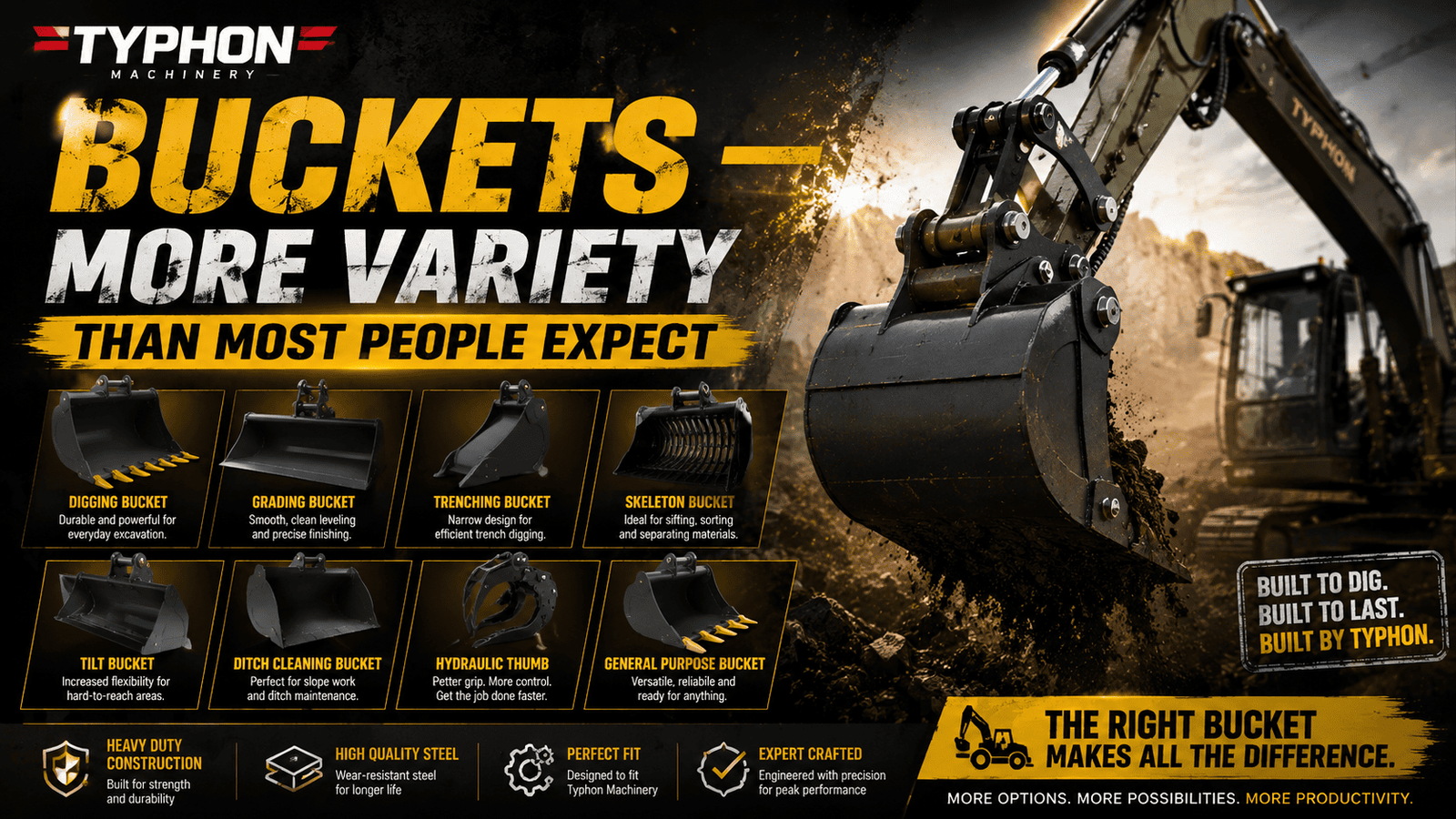

Grading or cleanup buckets go wider and lose the aggressive tooth profile in favor of a smooth cutting edge. When you’re doing finish work — slope grading, spreading topsoil, cleaning up a pad — a grading bucket gives you a much cleaner result than trying to finesse a standard digging bucket.
Ditching buckets are narrow and deep. The geometry is designed to produce a clean, consistent trench profile, which matters a lot when you’re laying pipe or conduit to a specified grade.
Tilt buckets deserve their own callout because they’re genuinely underrated. By allowing the bucket to tilt laterally—without moving the machine— they dramatically reduce repositioning time during grading work. Contractors who haven’t used one often underestimate how much time goes into shuffling a machine around to get the right angle. A tilt bucket eliminates a big chunk of that.
Skeleton or sorting buckets have an open-tine or bar construction that lets fine material fall through while retaining larger debris. Useful in demolition cleanup, root removal, and material sorting applications.
Mini excavator buckets range from about 6 inches wide up to 48 inches or more, and width selection matters. Match it to the task, not to what came with the machine.
Hydraulic Breakers — The Workhorse of Demolition and Site Prep
Hydraulic breaker attachments—sometimes called hammer attachments—are consistently among the most rented and most purchased mini excavator tools on the market, and for obvious reasons. Hard ground, concrete, asphalt, and ledge rock—these are materials that a bucket alone can’t effectively handle, and a breaker turns the same compact excavator into a viable demolition tool.
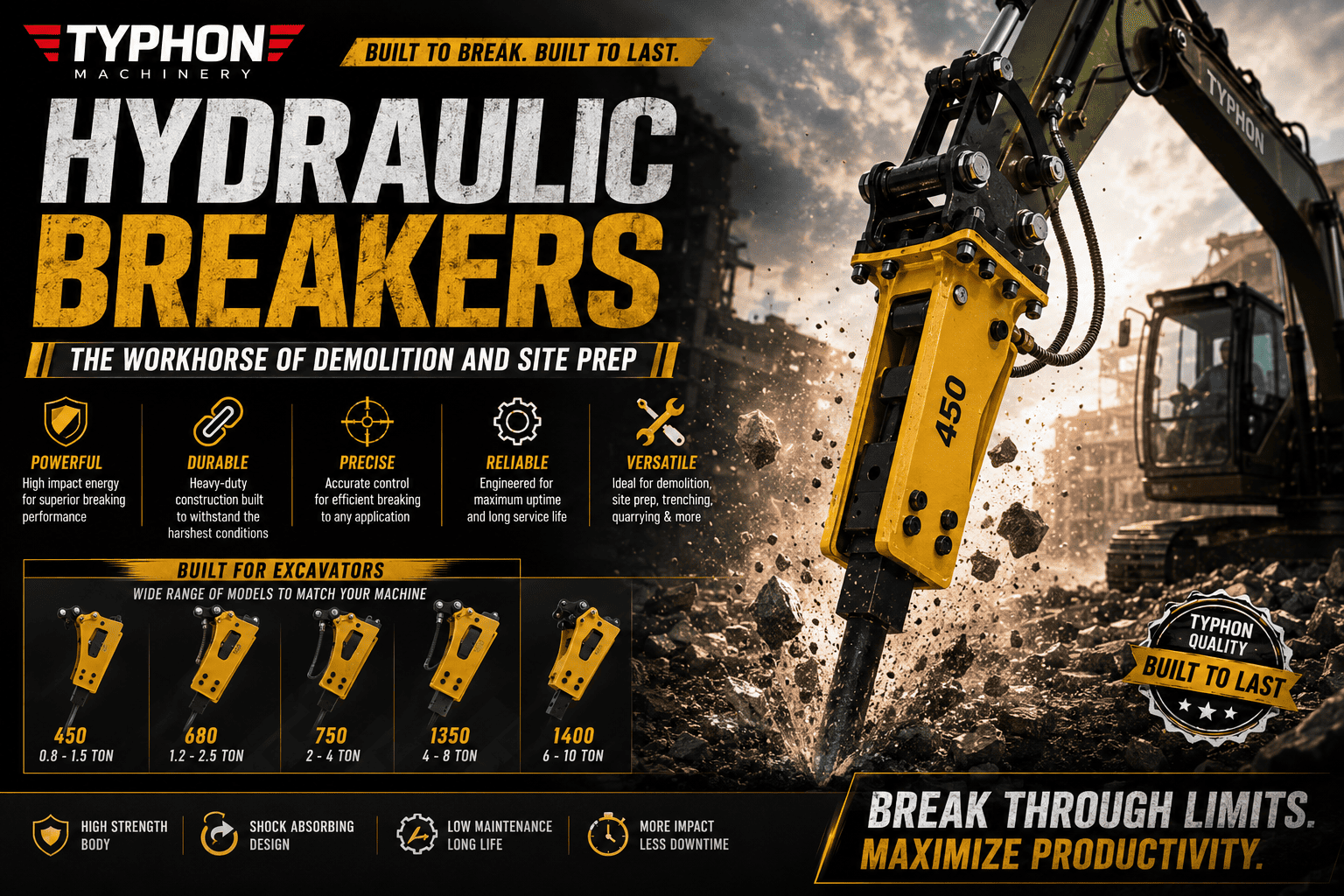

They work by using the machine’s hydraulic flow to drive a piston that delivers rapid, high-energy impacts through a hardened steel tool (the chisel or moil point). The frequency and energy of those impacts vary by model—lighter breakers designed for small mini excavators deliver lower impact energy but cycle quickly, while heavier units pack more punch at a lower frequency.
A few things to pay close attention to when selecting a breaker:
The impact energy (measured in joules or foot-pounds) needs to correspond to the material you’re breaking. Light concrete might be fine with a smaller unit. Reinforced structural concrete or granite ledges need significantly more.
The hydraulic flow requirement has to fall within your machine’s auxiliary output range. Running a breaker that demands more flow than the host machine can deliver is a frustrating and ultimately damaging experience.
Blank-firing—running the breaker with the tool not in contact with material — is one of the fastest ways to destroy internal components. It’s worth drilling into any operator who hasn’t used a breaker before.
Auger Attachments — Drilling Where Digging Doesn’t Make Sense
There’s a specific type of job where an auger attachment goes from “nice to have” to “only reasonable option,” and that’s anywhere you need a clean, precise cylindrical hole with minimal soil disturbance. Fence lines. Tree planting. Helical pier installation. Vineyard posts. Utility pole foundations.
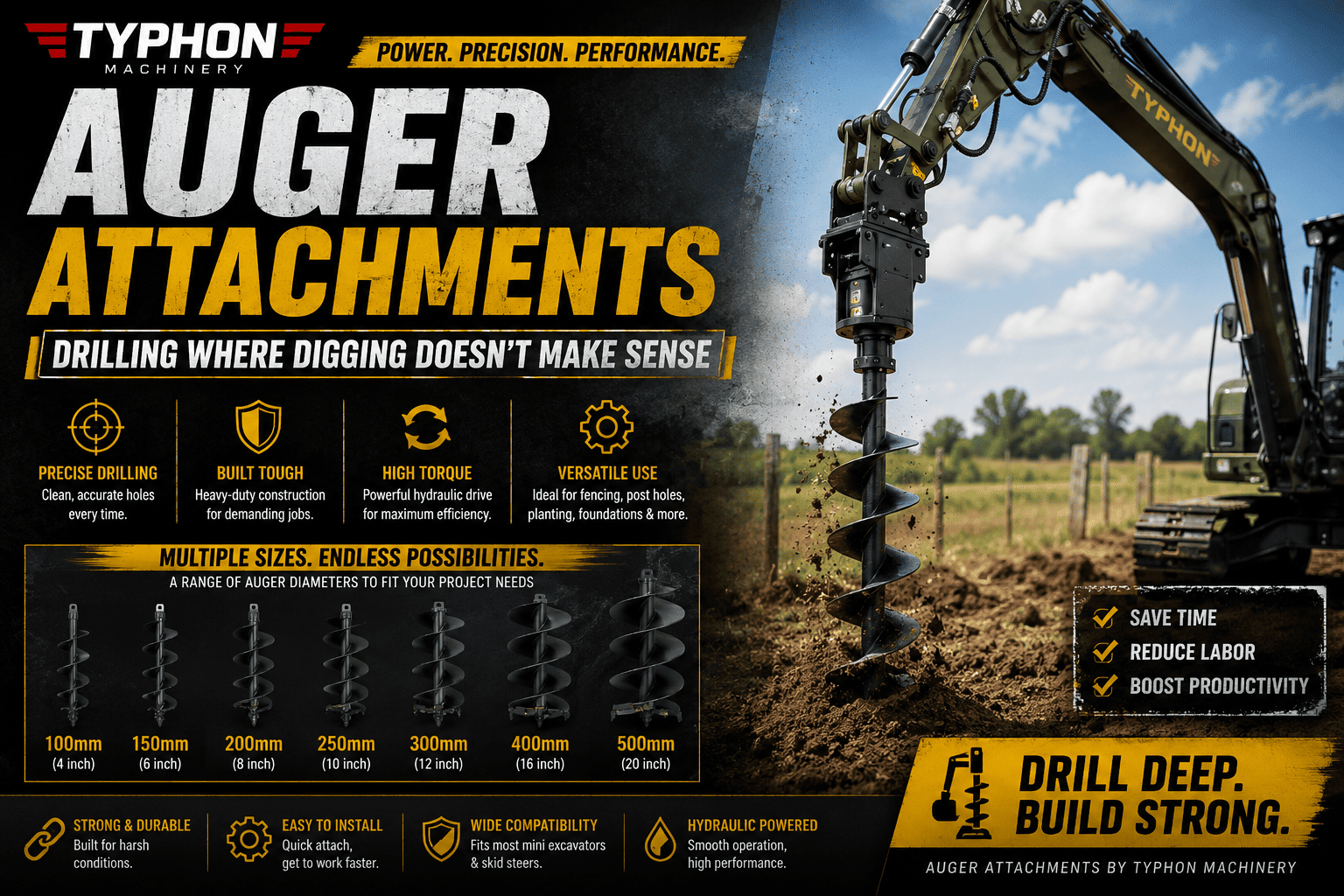
The setup consists of a hydraulic drive unit (the motor that provides rotation) and an interchangeable bit. Drive units are matched to the host machine by flow and pressure requirements and by the torque rating—more on why that matters in a moment. Bits range from a few inches in diameter for small posts up to 48 inches or more for foundation work, and they come in configurations suited for different soil profiles: clean earth, clay, cobble, or hard rock (with carbide-tooth rock bits).
The torque rating of the drive unit is something people frequently underspec. In soft loam, almost anything works. In compacted clay, caliche, or gravel-mixed fill, an underpowered drive unit bogs down, stalls, and eventually fails. When in doubt, go slightly heavier on the drive unit than you think you need — the extra capacity costs some money upfront and saves many headaches in the field.
Grapples — Grip, Sort, Move
A hydraulic grapple is a claw-style attachment that grabs, holds, and repositions material using opposing tines driven by hydraulic cylinders. The variety within the category is worth understanding because different grapple designs are genuinely optimized for different applications.
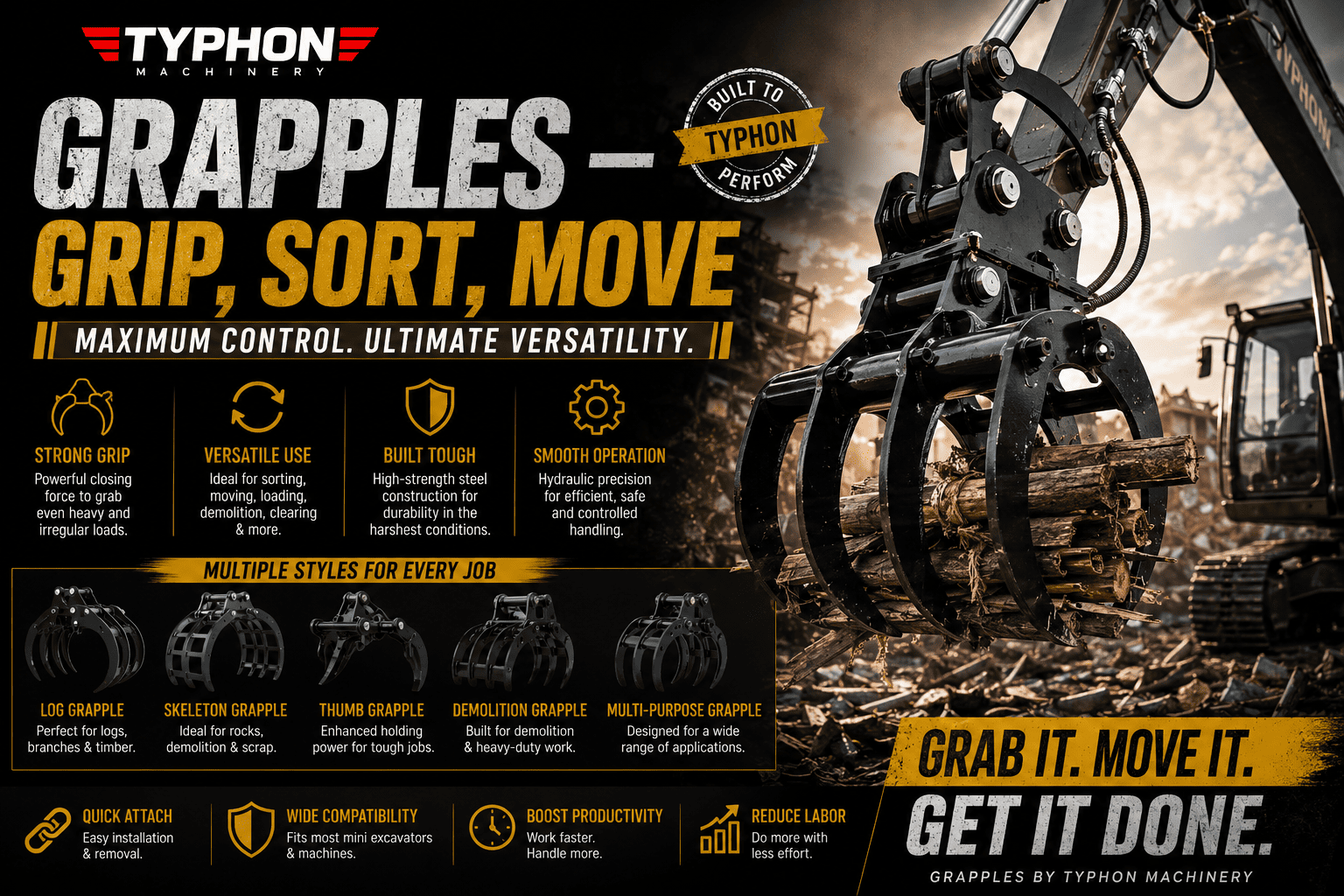
Root grapples have an open-frame design with wide-spaced tines, which allows soil to fall away while retaining organic material—stumps, root balls, slash, and brush. They’re the go-to tools for land-clearing operations.
Rock grapples use heavier, more closely spaced tines built to handle irregular, heavy material without flexing. Demolition sites, rip-rap placement, and boulder moving.
Rotating grapples add a hydraulic rotation motor to the assembly, giving 360 degrees of continuous rotation. This feature sounds like a luxury until you’ve watched an operator place a concrete pipe or a large stone into a precise location without moving the machine once. Then it starts looking like a necessity.
Demolition grapples are reinforced throughout for handling mixed debris—concrete chunks, rebar, structural steel, and masonry. They’re built to take abuse.
For any operation involving material handling rather than pure excavation, a grapple is often more practical than trying to improvise with a bucket and thumb setup.
Thumbs—Simple, Effective, Often Overlooked
A hydraulic thumb is one of the simplest attachments in concept and one of the highest-return additions you can make to a compact excavator. It mounts on the dipper arm opposite the bucket and works like a finger against a thumb—closing against the bucket to grip material that a bucket alone can’t hold.


Rocks, stumps, pipes, demolition debris, concrete rubble—anything that needs to be picked up and placed rather than just scooped gets dramatically easier with a thumb. Hydraulic versions are controlled from inside the cab and allow fine grip adjustment. Mechanical thumbs use a pin-adjustable design that’s less flexible but also less expensive.
If your work involves any material handling, debris clearing, or demolition cleanup, adding a thumb to your excavator is almost always a sound investment.
Compaction Attachments
Hydraulic compaction plates attach to the quick coupler and use the machine’s auxiliary circuit to create vibration, allowing the excavator operator to compact trench backfill or sub-base material without needing a separate walk-behind plate compactor. In tight trenches, this option is genuinely more practical than a standalone compactor — the arm reach lets you work the compactor into spaces that are awkward or unsafe to enter on foot.
Vibratory drum compactors are a step up from plate compactors in terms of coverage width and are used for broader sub-base and embankment work.
Rippers
Single-shank ripper attachments concentrate the crowd force of the entire excavator arm into a hardened carbide-tipped point. The application is preparation work—breaking up hardpan, asphalt, frozen ground, or heavily compacted fill ahead of bucket passes.


Running a bucket into ground that’s too hard to penetrate efficiently isn’t just slow—it’s hard on teeth, cutting edges, and eventually the attachment structure itself. A ripper pass first changes the economics of the whole dig cycle.
Tilt Rotators — The Premium Option That Changes How You Work
Tilt rotators are a newer category of mini excavator accessories that have gone from obscure specialty tools to serious professional consideration over the past decade, especially among grading contractors and utility installers.
Installed between the quick coupler and the attachment, a tilt rotator provides full 360-degree continuous rotation and lateral tilt in both directions—effectively giving the attachment freedom of movement that the excavator arm itself can’t provide. The practical result is that the operator can position a bucket, grapple, or other tool at any angle without repositioning the machine.
In Scandinavia and Northern Europe, tilt rotators are nearly standard equipment on professional excavators. Adoption in North America has lagged but is accelerating as contractors see the productivity difference firsthand. For finish grading, complex drainage work, urban utility installation, and landscaping in tight spaces, the machine repositioning time that a tilt rotator eliminates adds up to real hours over a project.
The entry cost is higher than most individual attachments—quality tilt rotators for mini excavators typically run $8,000–$20,000 depending on size and brand. For contractors with the right workload, the payback period can still be under two years.
Hydraulic Compatibility: The Part That Trips People Up
More attachment purchases go wrong because of hydraulic compatibility issues than for any other single reason. It’s worth spending time here.
Every hydraulic excavator attachment has a required operating range—minimum and maximum hydraulic flow (measured in gallons per minute) and a required pressure range (measured in PSI). The host machine’s auxiliary circuit has to deliver within those ranges for the attachment to function as designed.
Here’s what the key specs mean practically:
Flow (GPM) determines how fast the attachment operates. Too little flow, a hydraulic breaker hits slowly, an auger spins sluggishly, and a grapple closes with weak force. Too much flow can damage seals and motors designed for a lower operating range.
Pressure (PSI) determines the force behind the fluid. Most mini excavators deliver between 1,500 and 3,500 PSI on the auxiliary circuit—but specific models vary, and some machines in the lower weight classes are closer to the bottom of that range.
Circuit type matters too. Single-acting circuits deliver flow in one direction only—fine for basic tools. Double-acting circuits power movement in both directions, which is required for grapples, thumbs, and most compactors. Continuous rotation circuits are needed for auger drives and rotating grapples.
Before buying any hydraulic attachment, pull your machine’s spec sheet, find the auxiliary hydraulic specs, and verify them against the attachment manufacturer’s requirements. It takes ten minutes and prevents expensive mistakes.
Quick Couplers: Why They’re Worth Investing In
Running more than one attachment means dealing with attachment changes, and the quality of your quick coupler system determines how fast and how safely that happens.


Mechanical quick couplers are the entry point—they allow faster pin changes than the traditional method but still require the operator to exit the cab to confirm locking. Hydraulic quick couplers allow complete attachment changes from the cab, typically in under a minute. For contractors who switch attachments multiple times per day, the time savings are material.
The critical caveat with any quick coupler system: verify that locking is confirmed before loading the attachment. A partially engaged coupler under load can release, and an attachment drop from an excavator arm is a serious incident. Hydraulic quick couplers with automatic lock-indicator systems reduce this risk significantly.
Coupler compatibility with third-party attachments is also a real issue. OEM couplers from major manufacturers don’t always accept attachments designed around different pin spacings or lug geometries. When building an attachment library, standardizing on a well-supported coupler system makes procurement much simpler over time.
Who Uses These Attachments, and How
Landscaping contractors are among the heaviest users of compact excavator accessories. Tilt buckets for finish grading, augers for planting holes and post installation, thumbs for moving stone and root balls, and plate compactors for paving sub-base—a well-equipped mini excavator covers most of what a residential or commercial landscaping crew needs.
Utility contractors lean heavily on ditching buckets for clean trench profiles, breakers for cutting through existing pavement, and compaction plates for efficient backfill. The compact footprint also matters here — utility work often happens in streets, sidewalks, and developed areas where a larger machine creates too much disruption.
[ecwid widgets=”productbrowser categories” default_category_id=”149986084″ default_product_id=”0″ minicart_layout=”MiniAttachToProductBrowser”]
Demolition crews use a combination of breakers, grapples, and sorting buckets to break material, sort it, and load it efficiently. The three-attachment workflow is particularly efficient when a quick coupler allows rapid switching between them.
Agricultural operators—vineyards, orchards, tree farms—depend on auger attachments for planting operations and trenching for irrigation infrastructure. Mini excavators are attractive in these applications partly because their lower ground pressure causes less soil compaction than heavier equipment.
Pool and hardscape contractors have found tilt rotators and grading buckets indispensable for shaping excavations in residential backyards where access is tight and finish quality is expected to be high.
Buying vs. Renting: A Practical Framework
This is a question contractors wrestle with regularly, and the right answer genuinely depends on utilization.
A rough but useful rule: if you’ll use an attachment more than 15–20 days per year, ownership usually works out better than rental within the first two years. Below that threshold, rental economics are usually more favorable — you avoid carrying costs, maintenance responsibility, and storage requirements for a tool that sits idle most of the time.
The exception is when the rental market in your area is thin. In some regions, certain attachments—particularly tilt rotators and specialty auger configurations—aren’t readily available for rent. In those situations, ownership is often the only practical option, even if the frequency of utilization is low.
Resale value is also worth factoring in. Quality hydraulic excavator attachments from reputable manufacturers—Epiroc, Stanley, Engcon, Indexator, among others—hold value reasonably well. A hydraulic breaker or auger drive in good condition can retain 40–60% of its original value over five years of regular service, which changes the ownership math meaningfully.
Maintenance: What Actually Needs to Happen Regularly
Attachments are neglected. It’s a pattern that shows up across job sites because the machine itself gets scheduled maintenance attention while the attachments get used hard and put away dirty.
Greasing is the most basic and most commonly skipped requirement. Pin joints, pivot points, and bushings on mechanical attachments need grease at regular intervals—often every 8 to 10 hours in demanding conditions. Running without lubrication accelerates wear on pins and bores, leading to sloppy fit and eventual structural problems.
Hydraulic connections need a daily visual inspection—both the couplings and the hoses feeding them. A slow hydraulic leak that gets ignored can introduce contamination into the machine’s entire hydraulic system, which is an expensive problem to fix.
Bucket teeth and cutting edges need to be monitored for wear and replaced proactively. Worn teeth don’t just dig slower — they require the machine to work harder for the same result, burning extra fuel and putting added stress on the arm and hydraulic system.
Breaker tool paste (chisel grease) needs to be applied regularly to the tool shank. Breakers running dry develop accelerated wear at the bushing and can generate enough heat at the contact point to cause metallurgical damage.
Auger bit carbide should be inspected after each use. Carbide teeth are designed to be replaced when worn—they’re consumable components, not permanent ones. Running dull carbide puts dramatically more stress on the drive unit and the host machine.
Storage matters too. Attachments stored directly on ground contact accumulate moisture damage faster. Capping hydraulic ports when attachments are disconnected prevents contamination. These are small habits that extend service life considerably.
Safety: The Non-Negotiable Part
A few things worth stating plainly.
Always verify coupler engagement before loading an attachment. Every time. This is not a step to skip when you’re in a hurry.
Know your load chart. Adding a heavy attachment — a large rotating grapple, for instance — shifts your machine’s center of gravity and reduces safe working loads significantly. Operators who don’t account for this discover the limits the hard way.
Breaker work near underground utilities requires positive clearance confirmation beforehand. Breakers don’t discriminate between concrete and gas lines. Call 811 (in the US) to get locates done before you do any impact work in developed areas.
Trench safety rules apply regardless of how the trench was dug. An excavator can open a trench faster than shoring or sloping can be established if the crew isn’t disciplined. OSHA’s trench and excavation standards exist because trench collapses kill people—compact excavator efficiency doesn’t change that risk.
The ROI Conversation: Does an Attachment Library Actually Pay Off?
Almost always applies to contractors with consistent work. The math is straightforward.
Take a contractor running 10 or more auger days per year who’s been subcontracting that work at $500–$700 per day. A quality auger drive and a set of bits represents a one-time investment of roughly $3,000–$5,000. At that utilization rate, the attachment pays for itself within the first year — and after that, every auger day is pure margin improvement rather than subcontractor cost.
Multiply that logic across two or three high-utilization attachments, and the cumulative impact on job profitability is significant.
Beyond direct cost savings, there are softer benefits that matter in practice. Schedule control—you’re not waiting on a subcontractor’s availability. Bid competitiveness — you can take on more project types. Machine utilization—the excavator earns revenue across a wider range of jobs rather than sitting idle between purely excavation-heavy projects.
Contractors who build attachment libraries strategically—by acquiring tools that meet their most common job needs first—report better equipment ROI than those who either under-invest in attachments or buy tools without a clear plan for how to use them.

Frequently Asked Questions About Mini Excavator Attachments and Accessories
What attachments can you put on a mini excavator?
Mini excavators are compatible with a wide range of tools, including multiple bucket types (digging, grading, rock, and tilt), hydraulic breakers, augers, grapples, thumbs, plate compactors, rippers, and tilt rotators. What’s usable on a specific machine depends on its auxiliary hydraulic output, quick coupler type, and weight class. Heavier attachments may also affect machine stability and working load limits.
Are mini excavator attachments interchangeable between brands?
Generally, no — not without verification. Coupler pin diameters and pin-to-pin spacing vary between OEM systems, and hydraulic flow and pressure requirements vary between attachment models. Some aftermarket attachments are designed with multiple adapter options, but compatibility should always be confirmed against the host machine’s spec sheet before purchase.
How do I know if an attachment is compatible with my machine?
Pull your machine’s spec sheet and find the auxiliary hydraulic flow (GPM), pressure (PSI), and quick coupler specifications. Compare those numbers to the attachment’s stated requirements. When dealing with a dealer or attachment manufacturer, giving them your machine’s model number usually allows them to confirm compatibility directly.
What mini excavator attachment gives the best return on investment?
It depends on your specific work mix, but hydraulic thumbs and tilt buckets consistently rank highly for versatility-to-cost ratio. For contractors doing post-hole or planting work regularly, an auger drive pays back quickly. In demolition-heavy operations, the hydraulic breaker is often the first attachment worth having.
How often should mini excavator attachments be serviced?
Greasing intervals for most mechanical attachments are every 8–10 operating hours in normal conditions, more frequently in abrasive or wet environments. Hydraulic connections should be visually checked daily. Wear components like bucket teeth, cutting edges, and auger carbide bits should be inspected after each job and replaced when wear is visible. Breakers have specific tool paste requirements—follow the manufacturer’s maintenance schedule closely.
Can I add a hydraulic attachment to a machine that doesn’t have auxiliary hydraulics?
Occasionally. Many machines without factory-installed auxiliary circuits can be retrofitted with an auxiliary hydraulic kit—typically involving an additional control valve, plumbing, and cab controls. It’s worth getting a quote from your dealer before writing off an older machine as incompatible.
What is a tilt rotator, and is it worth the cost?
A tilt rotator is a device installed between the machine’s quick coupler and the working attachment that provides 360-degree continuous rotation and bilateral tilt. It allows the attachment to be positioned at any angle without repositioning the machine. For grading, utility installation, and complex earthwork, the productivity gains can be substantial. The cost — typically $8,000–$20,000 for mini excavator-class units — is significant, but for contractors with the right workload, the payback period can be under two years.
Wrapping Up
A mini excavator is a good machine. A mini excavator with the right attachment library is a valuable business asset.
The operators and contractors who consistently get the most out of their compact equipment are the ones who’ve taken the time to understand hydraulic compatibility, invest in a quality coupler system, choose attachments that match their real workload, and maintain what they own. None of that is complicated — it just requires treating attachments as the capital investments they are rather than afterthoughts.
Whether you’re evaluating your first attachment purchase or trying to figure out whether a tilt rotator is worth the investment, start with the fundamentals: know your machine’s hydraulic specs, know your most frequent job types, and let utilization projections drive the acquisition decision rather than what looks impressive in a brochure.
The right mini excavator attachments and accessories don’t just expand what your machine can do. They change what jobs you can take on, what you can charge, and how efficiently your crew works—and that’s a combination worth taking seriously.