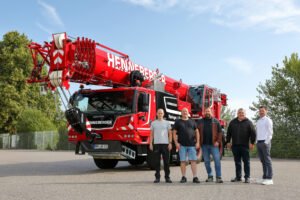



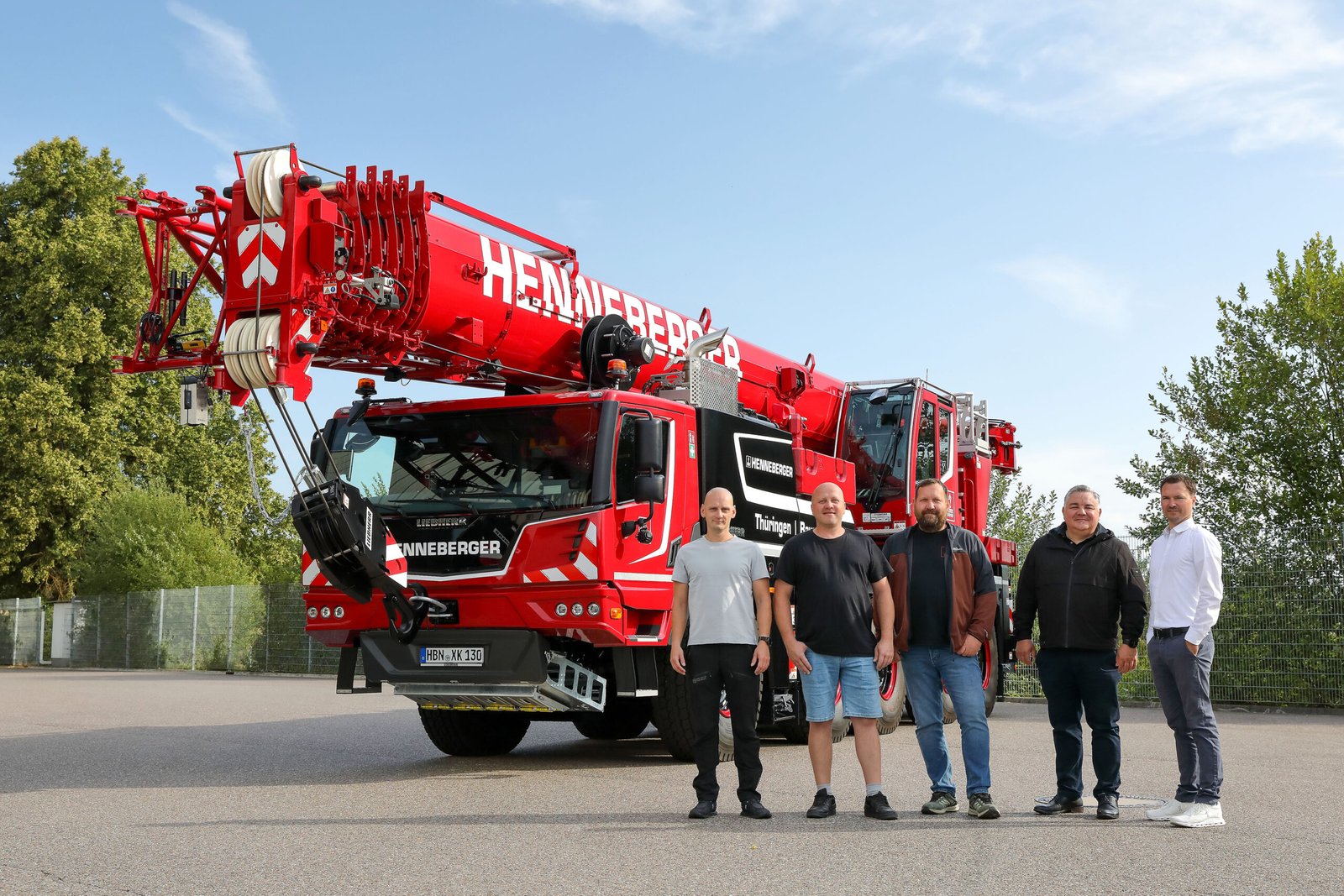
The Thuringian crane company’s new Liebherr LTM 1100-5.3 carries most of its ballast on board, which means fewer support trucks and easier permits
For a crane company working in rural Germany, the hardest part of a job is often getting there. Narrow village roads, tree-lined avenues and bridges with weight limits decide which crane can be sent, and how many trucks have to follow it.
That is the logic behind the latest purchase by Henneberger Schwerlast e.K., a crane and logistics company based in southern Thuringia. It has added a Liebherr LTM 1100-5.3 to its fleet, and two numbers made the decision: 16.9 tonnes of counterweight that can travel on public roads, and a vehicle width of just 2.55 metres.
A taxi crane that brings its own ballast
“We can use the LTM 1100-5.3 very flexibly as a ‘taxi crane’, as it can carry a large proportion of its counterweight whilst maintaining an axle load of 12 tonnes,” said company owner Mario Henneberger. “This means we can already take on many jobs without having to use a separate vehicle for transporting ballast.”
The light design also simplifies road permits, a real issue for a company that works across three federal states: Thuringia, Bavaria and Hesse. The ballast concept even allows axle loads below 9 tonnes and a gross vehicle weight under 45 tonnes. “This is sometimes an advantage, particularly on bridges with weight restrictions,” Henneberger said. “This issue is set to become even more acute.”
The width matters just as much on Thuringia’s country roads. According to Liebherr, the LTM 1100-5.3 is the only five-axle all-terrain crane on the market this narrow.
From roof trusses to radio masts
The crane will cover a broad spread of work: roof and hall construction, electricity and radio masts, machine relocation and precast assembly. “The 62-metre length of the telescopic boom is excellent in this class,” Henneberger said, pointing to the lifting capacities at long reaches.
It is also the first crane in the fleet with Liebherr’s LICCON3 control system. The switch worried the operators more than it should have: after training at the Ehingen plant, “the transition was easier than they had feared”, according to Henneberger.
Remote control as a safety tool
Two features stand out for the owner. RemoteDrive, which lets the operator steer the undercarriage by remote control, helps on tight building sites and adds a layer of safety. Radio remote control of the crane itself gives the operator a better view of the load. “The work becomes more precise and safer,” Henneberger said. “That’s why we also use boom cameras.”
The LTM 1100-5.3 is the company’s third crane with a boom camera, after an LTM 1250-5.1 and an LTM 1300-6.3. With bridge restrictions set to tighten, cranes that can reach the job with fewer axles and fewer escort trucks are likely to become a competitive edge for regional operators like Henneberger.
Read the full article here