


Schmidbauer’s Liebherr crawler crane spent 18 months on GICON’s 365-metre prototype in Brandenburg, from heavy steelwork to night-time blade installation
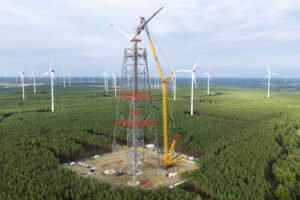
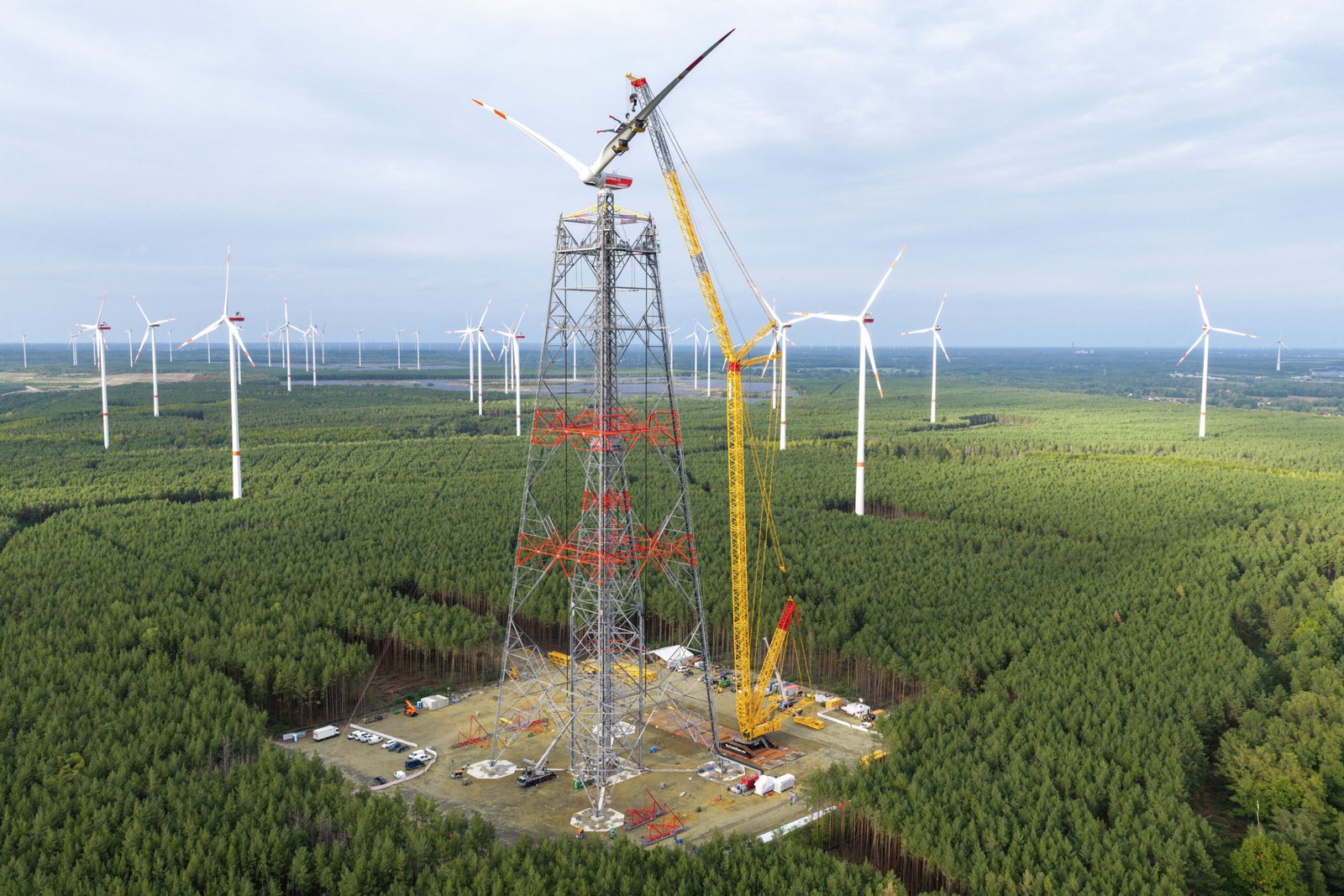
At the end of September, a prototype wind turbine in Lusatia, Brandenburg, reached a total height of 365 metres. That makes it the tallest wind turbine in the world and, after the Berlin TV Tower, the second-tallest structure in Germany. Behind it stood a single large crawler crane: a Liebherr LR 11350 operated by the Schmidbauer Group, on site since spring 2025.
The project shows what wind energy now asks of heavy-lift fleets. Taller structures mean heavier components, higher hook heights and long periods waiting for the right weather.
A different kind of tower
The so-called high-altitude wind turbine was developed and built by GICON-Großmann Ingenieur Consult, a Dresden-based engineering company. The idea is to reach the stronger and more consistent winds found higher up, opening new options for onshore wind. The rotor measures around 126 metres in diameter and drives a 3.8 MW turbine.
Instead of a conventional tubular tower, GICON uses a large steel lattice structure. An inner tower was fabricated inside the outer steelwork and, once the rotor blades were fitted, telescoped upwards with an integrated system to reach the final height. The prototype was built within an existing wind farm between Berlin and Dresden.
The 375-tonne lift
For most of the steel erection, the LR 11350 worked with Liebherr’s PowerBoom parallel boom system, designed for particularly heavy loads. The largest and heaviest single component was a tower section of around 40 x 40 x 40 metres with a gross weight of 375 tonnes. The crane placed it on the 50-metre-high base structure at a reach of around 44 metres.
To do so, the crawler crane had to travel with the load along a purpose-built track of steel plates and bongossi timber, laid to give a stable footing on the sandy ground. Up to a provisional tower height of around 160 metres, the crane was rigged with the PowerBoom and a jib tip up to 84 metres long, with up to 850 tonnes of ballast on the crane and on the derrick ballast platform.
Re-rigged in six days
Blade installation called for a completely different configuration. Thanks to the LR 11350’s set-up concept and enough skilled personnel on site, the switch from PowerBoom to a 104-metre lattice boom took just six days. With an 84-metre luffing jib, the crane reached a roller head height of 200 metres.
Then came the waiting. Fitting three blades at around 170 metres requires a long window of very low wind. After several days, the teams found it and installed all three rotor blades within twelve hours, partly at night.
For crane owners, that is the practical lesson. On projects of this scale, the speed of a reconfiguration and the ability to strike quickly when the weather allows can matter as much as raw capacity.
“During its approximately 18-month period of operation, my LR 11350 performed with absolute reliability and without any faults,” said crane operator Fabian Ueck once the work was complete. Over a job lasting a year and a half, uptime on the main crane decides whether the whole site keeps moving.
Several other Liebherr mobile cranes supported the project, helping to rig and ballast the crawler crane and working on the base structure and the pre-assembly of the lattice tower segments.
What comes next
The Lusatia turbine is a pilot plant, built to test whether lattice-tower designs can make very tall onshore wind commercially viable. If the concept scales, crane fleets will need to plan for more lifts of this kind: heavier, higher and more dependent on long weather windows.
Read the full article here