



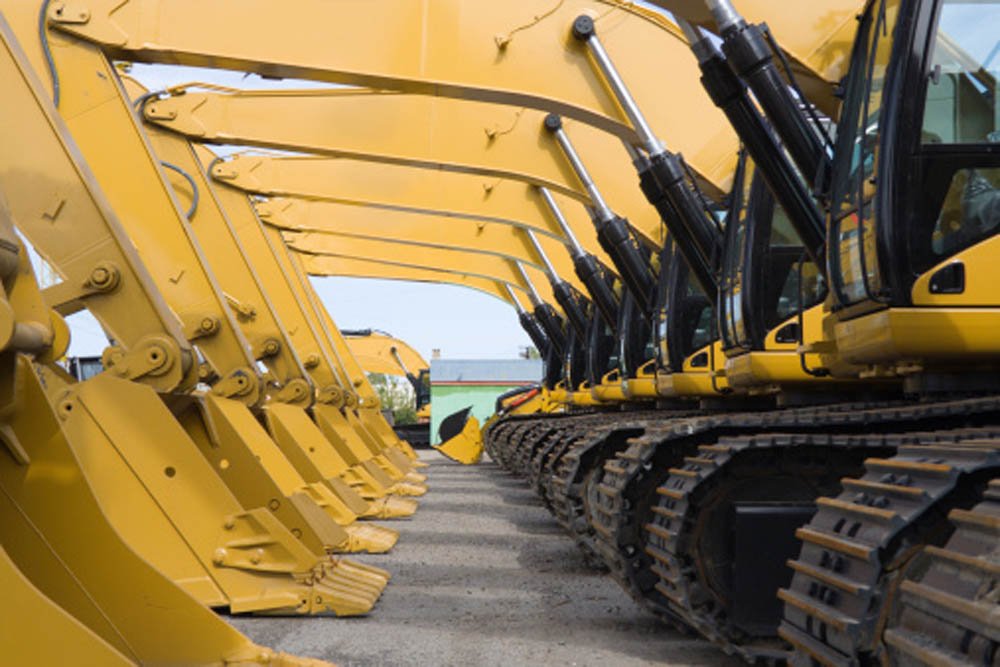
Interact Analysis has the off-highway market climbing to 7.8 million units by 2030, but with patchy growth
The off-highway vehicle market has come out of its 2024-2025 trough. Volumes moved from 5.8 million units in 2024 to 6 million in 2025, and Interact Analysis now forecasts 7.8 million by 2030, an average annual growth rate of 5.3 per cent. For manufacturers who have spent two years managing down, that is the first forecast in a while that points in one direction.
The headline number, though, hides a split that matters more than the average. Growth is not distributed evenly, and one of the world’s largest markets is forecast not to participate in it at all.
Europe and North America up, China down and staying down
After a slump in 2025 and moderate growth expected through 2026, construction vehicle production in North America and EMEA is forecast to grow strongly in 2027, at 13 per cent and 9 per cent respectively. Those are recovery numbers, not incremental ones.
Asia-Pacific goes the other way. China’s construction vehicle industry is projected to shrink by roughly 9 per cent in 2027, and the rest of APAC by 3 per cent. The rest of APAC recovers: 352,000 units in 2026 becomes 362,000 by 2030. China does not. Interact Analysis has Chinese production falling from a projected 474,000 units in 2026 to 455,000 in 2030, with no recovery inside the forecast window. The firm attributes this to weak private sector investment on the back of policy uncertainty, compounded by a manufacturing slowdown that suppresses demand.
For European and North American OEMs, a Chinese domestic market that shrinks and stays shrunk has a second-order consequence worth watching: Chinese manufacturers with capacity built for a larger home market look harder at export.
The volume is in Small Machines
Small machines dominate the market to a degree that shapes everything downstream. Forty-three per cent of units fall below 18 kW, and 63 per cent below 35 kW. That drives engine displacement demand, component sizing and the realistic size of the electrification opportunity. The reason is machine mix: lift trucks have the largest share of any vehicle type, and 72 per cent of them sit under 18 kW.
Agriculture and material handling together are projected to account for 83 per cent of all off-highway units by 2035, which is a useful reminder for anyone reading construction equipment cycles as a proxy for the whole off-highway market.
Electrification is concentrated
Battery electric vehicles are forecast to rise from 33 per cent of units in 2025 to 44 per cent in 2035, with internal combustion falling from 66 to 55 per cent. But 94 per cent of BEV off-highway units today are built for material handling, and BEV penetration in that sector is projected to reach around 83 per cent by 2030. Indoor, low-duty operation with predictable cycles suits batteries. Very little else in off-highway does yet.
Chloe Mason, Market Analyst at Interact Analysis, put it plainly: “BEV’s relevance is bimodal and concentrated overwhelmingly in material handling at present. Our research indicates the only currently meaningful growth frontiers are compact urban construction in the West and large machines in China. Agriculture, road building, dozers, and forestry are structural diesel markets for the duration of our forecast.”
That is a more sober read than most electrification forecasts offer, and it lines up with what fleet owners report. The firm sees potential for higher electrification rates later in the decade in the 36 to 100 kW segment, and describes the 100 kW-plus segment as a more strategically interesting and higher margin frontier.
What to do with it
For dealers and rental companies in Europe and North America, the planning signal is 2027 rather than 2026: order books should firm up a year out, and fleet acquisition decisions made now land into a rising market. For anyone weighting a product roadmap toward electrification outside material handling, the forecast counsels patience on the heavy end and attention to compact urban machines, where the duty cycle and the emissions rules both point the same way.
Read the full article here