


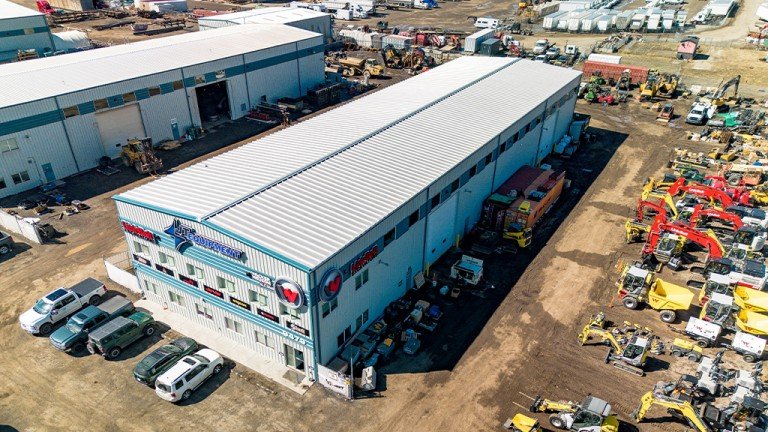
JT Equipment also offers in-house fabrication capabilities, allowing the company to respond quickly to specific customer needs and develop customized solutions.
Tomas Kraus Photography
The cost gap
According to Cox, one of the most significant challenges facing contractors in this region is the widening gap between equipment costs and what they can charge for a project.
“I don’t necessarily feel that the price of equipment today is reflected in what contractors are able to charge,” Cox says. “You have to pay more to do the same job and bill it at the same rate.”
This pressure is influencing purchasing strategies, with some contractors turning to used equipment or rentals, while others focus on maximizing output from existing fleets.
Relationships deliver solutions
As the industry continues to navigate labour constraints, the dealer plays a greater role in helping contractors find the right combination of machines, attachments, and technology to get the job done.
“They’re going to try to have more efficient machines and different attachments . . . to complete jobs with fewer people,” says Cox, noting that how that shift plays out is still evolving.
That uncertainty is shaping how both contractors and dealers approach the market in Alberta, with greater emphasis on flexibility and practical problem-solving.
For JT Equipment, that includes its in-house fabrication capabilities, which allow the company to respond quickly to specific customer needs and develop customized solutions. “What we’re trying to do over there . . . is be flexible and build different things and think outside the box,” Cox says.
In a market defined by changing demands and tighter operating conditions, service, adaptability, and hands-on support are expected to play an increasingly important role — and relationships remain a defining factor.
“I feel, truthfully, that this is one of the last industries where a relationship actually matters,” Cox says. For JT Equipment, customer loyalty is built on trust, service, and long-term support. “I don’t think you’re necessarily loyal only to the brand,” he adds. “I think you’re loyal because of those other factors.”
Read the full article here