

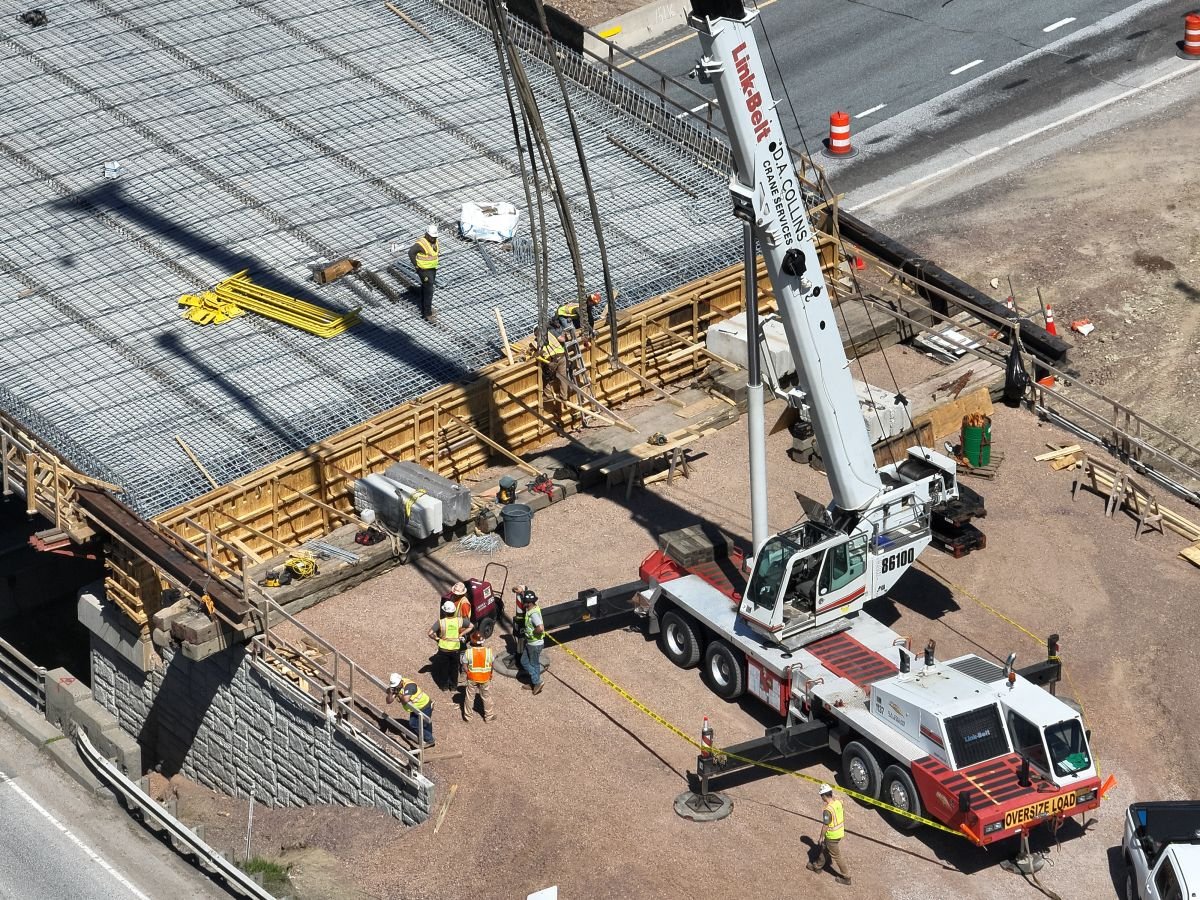
The Vermont Agency of Transportation’s (VTrans) $31,760,442 Colchester Exit 17 project, awarded to Kubricky-Jointa Lime LLC, is improving the interchanges at Interstate 89 Exit 17 and the Chimney Corner intersection of U.S. Route 2 (U.S. 2) and U.S. Route 7 (U.S. 7) to enhance safety and mobility in Colchester.
Work began in spring 2024 and is expected to wrap up in early July, in accordance with the contract completion date.
Funded entirely by the U.S. Department of Transportation Federal Highway Administration’s programs, the project includes several key elements: replacing aging and deteriorating infrastructure through the full replacement of the existing U.S. 2 bridge over I-89; extending the deceleration lane of the I-89 northbound off-ramp; reconstructing the I-89 southbound off-ramp to make space for a new I-89 southbound on-ramp for U.S. 2 westbound traffic; eliminating the left-turn conflict point for westbound vehicles accessing I-89 southbound; reducing queuing and backups on U.S. 2; improving the intersection of the I-89 northbound off-ramp at U.S. 2; adding a U.S. 2 eastbound left-turn-only lane to increase capacity; and widening the roadway to accommodate additional turning lanes on U.S. 2 eastbound and U.S. 7 northbound.
The project area includes the segment of U.S. 2 beginning just east of Jasper Mine Road and extending just under a half-mile east to its intersection with U.S. 7 at Chimney Corner; the segment of U.S. 7 beginning just south of the Shell gas station/Simon’s Chimney Corner Store and extending just over a half-mile north to Wiley Road; and the Exit 17 interstate ramps and the portion of I-89 bound by them.
The project offers numerous benefits.
“Extending the I-89 northbound off-ramp and improving its intersection with U.S. 2 will help reduce queuing, particularly during evening peak hours,” according to VTrans. “Widening the roadway on U.S. 2 and U.S. 7 near the Chimney Corner intersection will create additional turning lanes, enhancing overall traffic flow and mobility. The project also addresses high-crash locations along U.S. 2 by constructing a new I-89 southbound on-ramp, eliminating conflict points for westbound vehicles. In addition, designated bicycle travel lanes along U.S. 2 will improve mobility for alternative transportation. The project will maintain efficient and reliable connections between U.S. 2, U.S. 7, and I-89.”
The Chittenden County Regional Planning Commission released a project scoping study in December 2014.
“The U.S. 2 bridge over I-89, built in 1964, was in poor condition and deteriorating,” said a VTrans project representative, noting that approximately 16,000 vehicles per day travel through the intersections. “The interchange is critical infrastructure connecting northern Chittenden County and the Lake Champlain Islands to the interstate system.”
VHB designed the project.
“Maintaining traffic while constructing new lanes and a bridge with varying grade changes — while accommodating high traffic volumes — was a major challenge,” said VTrans Resident Engineer Chris Lavalette. “Soil stability was also a concern. Foamed glass aggregate was incorporated to reduce loads on existing surfaces.”
The new infrastructure is expected to have a lifespan of 75 years.
The traffic management plan relies on temporary shoulder and lane closures, as well as detours, with the goal of minimizing impacts during peak commuting hours. VTrans implemented an extensive public outreach campaign with consultant WSP USA, including a project website, e-mail updates, and social media posts to inform motorists about lane closures and construction activity. Flaggers, uniformed traffic officers, and temporary traffic signals have been used to guide travelers safely through the work zone.
“Traffic experienced some delays,” a VTrans representative said, “but was generally maintained safely. VTrans worked closely with Kubricky to phase construction and minimize impacts to the traveling public.”
Kubricky-Jointa Lime was awarded the project on Feb. 22, 2024, and had approximately four months to establish a six-phase construction schedule.
In 2024, Phase 1 included widening U.S. 7 and portions of U.S. 2, constructing a new I-89 southbound off-ramp, and reconstructing acceleration and deceleration lanes.
Phase 2 (2024–2025) included construction of a gravel wetland, removal of the existing southbound off-ramp, and construction of a new southbound on-ramp.
Phase 3 (completed in 2024) involved substructure work for the new 204-ft., four-lane U.S. 2 bridge, including pile installation, abutments, piers, and geotechnical work.
Phase 4 (2025) focused on completing the bridge superstructure, including the concrete deck.
Crews also worked night shifts and reconstructed roadway segments, including a 2,500-ft. realignment of U.S. 2.
Phase 5 (2025) included reconstruction of I-89 northbound ramps, installation of permanent traffic signals, and opening of the new U.S. 2 bridge, followed by closure of the old bridge.
Phase 6, the final phase, began ahead of schedule in August 2025 and continues through spring and summer 2026. Work includes demolishing the old bridge, final paving and striping, and site restoration.
Day shifts run from 6 a.m. to 8 p.m., Monday through Friday, while night shifts run from 7 p.m. to 6 a.m., Sunday through Friday.
The 2025 construction season achieved several milestones, including major bridge work, ramp reconstruction, paving, and signal installation.
By December 2025, Phases 2 through 5 and most of Phase 6 were complete. Crews had opened the new bridge, demolished the old structure, reconstructed ramps, widened intersections, installed signals, completed paving and striping, and installed drainage and erosion control systems.
The 2026 construction season began in early April, focusing on final signage, lighting, and signal adjustments.
Project officials credited strong collaboration between VTrans and Kubricky for keeping the project on schedule.
“Consistent coordination and forward planning — looking six to eight weeks ahead — were critical,” said Kubricky Project Manager Dustin Franke. “With more than 20 subcontractors, communication and scheduling were essential to avoiding delays.”
Both teams overcame challenges, including elevation differences, soil conditions, and the use of foamed glass aggregate — a first for both VTrans and the contractor.
“The foamed glass aggregate was a new process for us, much like VTrans,” said Franke. “So, there were some learning curves at the start. Once we were able to refine our process, the installation progress became easier. Working with the FGA as backfill to our retaining wall created some challenges regarding surcharge loads when discussing steel erection and overlay placement. We utilized our engineering partners to develop methods that we put into place to overcome the difficulties and made it feasible to complete our work on the lightweight fill material.”
Construction occurred day and night throughout 2024 and 2025, with up to 30 workers on site during peak activity.
The project involved significant material quantities, including more than 62,000 cu. yds. of excavation, 55,000 cu. yds. of subbase, 21,000 tons of asphalt, more than 900 cu. yds. of concrete and 225,000 lbs. of reinforcing steel.
The project’s subcontractors include A&K (slipforming), American Flagging, CCS, D.A. Collins, Delta Electric, ECI, Electric Light, FWW, Geocomp, Granite State Curb Setters, L&D (line striping), L.M. Sessler, F. R. Lafayette, Maine Drilling and Blasting, Nicom, Penhall, Precision Trenchless, Ralph Darrah Welding, Seaboard, United Steel and Waters Excavation.
Despite the scale of the project, equipment issues were minimal, according to Franke, with routine maintenance and coordination helping avoid delays.
Read the full article here