

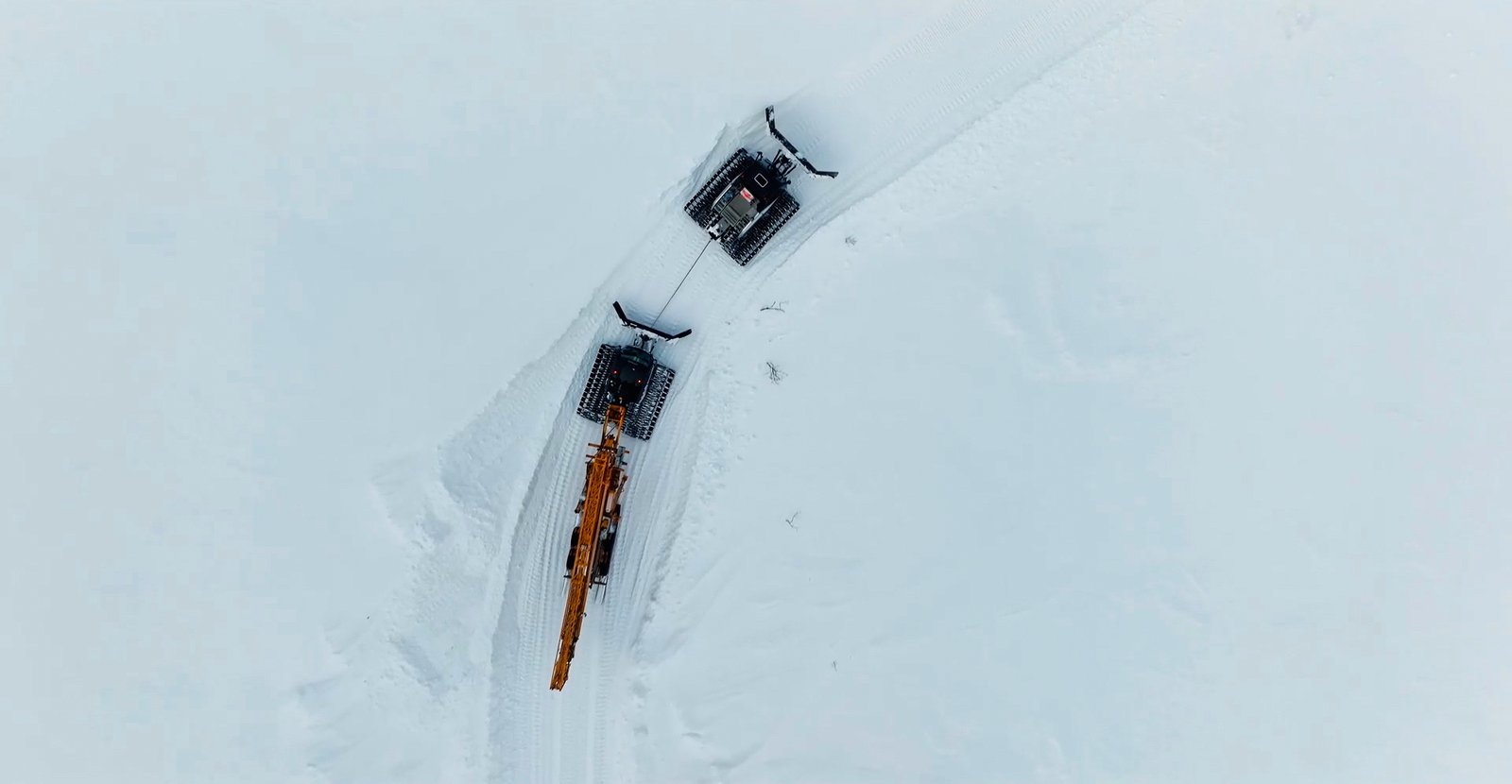
On Fløya, the mountain overlooking Tromsø in northern Norway, contractor Hent faced a more unusual challenge: how to get a tower crane to a jobsite that sits beside the summit station of the Fjellheisen cable car, 421 m above sea level.
The project involves the construction of a new three-story restaurant at one of Tromsø’s most visible tourist destinations. Designed to be three times larger than the previous structure, the building will include an outdoor skywalk with views across the fjords and Arctic landscape, while also serving visitors looking to experience the Northern Lights. Construction began last year and is scheduled for completion in 2027.
The location created a demanding set of requirements. The crane had to be versatile, quick to install and capable of operating in an exposed mountain environment where weather, access and wind can complicate every phase of the job. Norwegian Potain dealer Kranor recommended the Potain HDM 40, a self-erecting crane with a 35 m jib, 4 t maximum capacity and the ability to lift 1 t at the jib end.
Those specifications made the crane suitable for handling timber sections and concrete slabs on the project. But the more complex question was how to move a 14 t crane to the top of Fløya when conventional transport was not an option.
The answer was a piece of site logistics more often associated with Arctic expeditions than construction equipment. Kranor and the project team fitted the crane chassis with custom-built twin-tip skis, then used two powerful snow groomers to pull the machine up the mountain. Once it reached the summit, the crane was fixed to the jobsite’s concrete foundation to provide stability in an area exposed to strong winds.
“The only solution was to put the crane on two large skis and pull it up Fløya mountain with the support of two powerful snow groomers. Custom-built twin-tip skis were fitted to the crane’s chassis, allowing it to be pulled into position. Once in place, the crane was secured to the jobsite’s concrete foundation to ensure working stability in an area of strong winds. Getting the crane to the mountaintop is a truly unique logistics achievement,”
Said Andreas Jensen, regional manager at Kranor.
The HDM 40 gives the Fløya site a fixed lifting solution for materials that are otherwise delivered by helicopter. That combination, aerial material delivery and on-site crane handling, helps reduce the need for repeated manual movement in a difficult mountain environment. It also gives the contractor more control over lifting operations once materials arrive at the summit.
The project also reflects the continued role of older, proven crane models in specialist applications. First manufactured in 2005, the Potain HDM 40 remains in service on jobsites where compact self-erecting cranes are valued for transportability and practical lifting reach. Kranor, based in Tromsø, operates a fleet of more than 150 Potain cranes, including self-erecting and top-slewing units, with some machines still working after more than two decades in service.
Beyond the unusual image of a crane being pulled up a mountain on skis, the Fløya project is a reminder that construction equipment often has to be adapted to the geography of the job. In northern Norway, where tourism infrastructure meets Arctic terrain, the success of a lift can begin long before the first load leaves the ground.
Read the full article here