



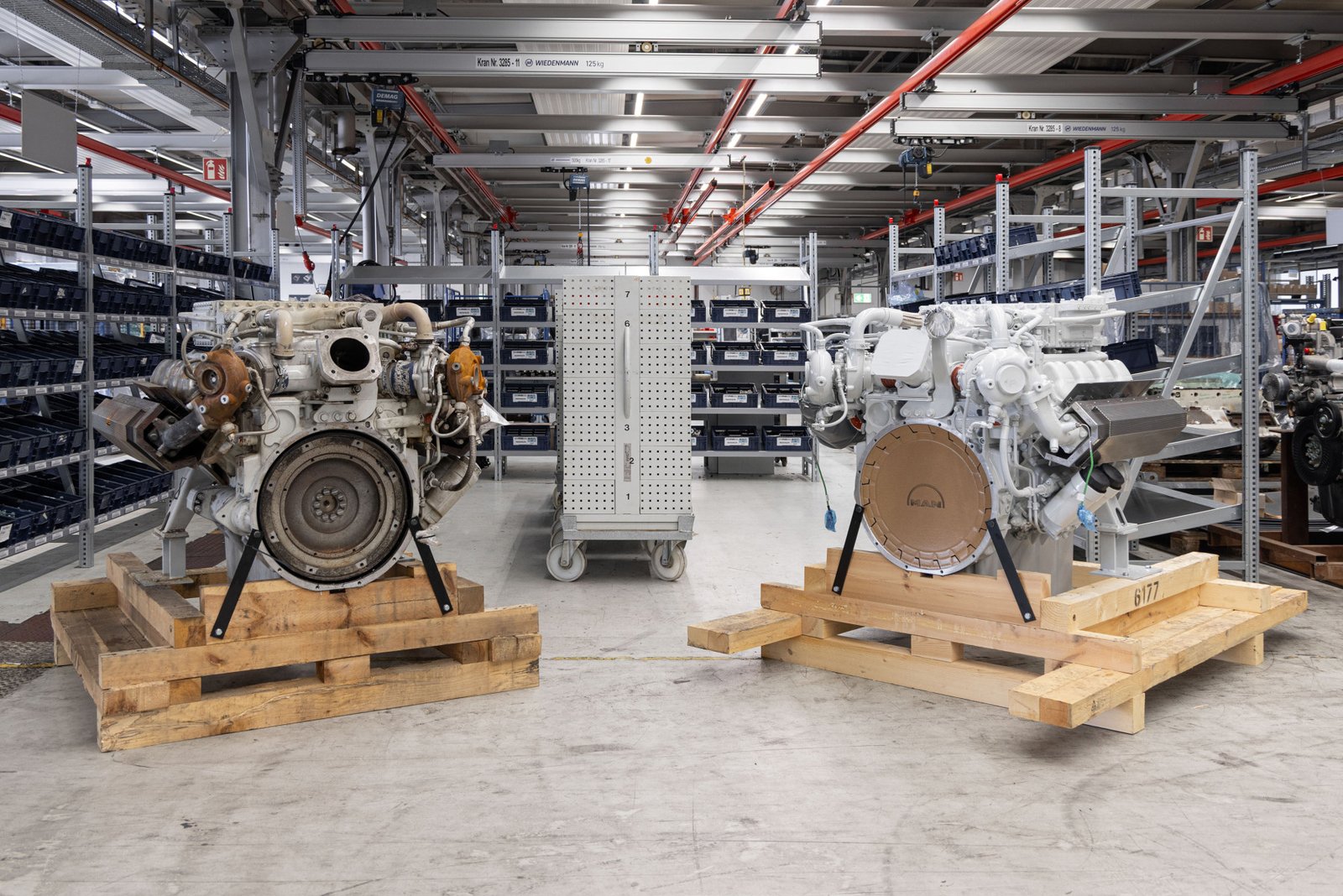
An independently validated life cycle assessment puts a rebuilt MAN engine at 2,355 kg of CO2 equivalents against 8,320 kg for a new one. The interesting part is what happens on the second and third cycle
Everyone in the aftermarket has argued that remanufacturing is better for the environment than building new. Until now that argument has mostly rested on intuition, because the accounting is genuinely hard: you have to allocate the burden of the original manufacture, count the energy in the rebuild, and follow the logistics of getting cores back to a plant. MAN has now had it done properly.
A life cycle assessment carried out by the University of Bayreuth, validated by an independent expert on behalf of DEKRA Assurance Services GmbH, compared a newly manufactured MAN D2842 LE622 rail engine against a MAN Genuine Remanufactured Engine of the same type. Production and delivery of the new engine came to 8,320 kilograms of CO2 equivalents. The remanufactured engine, within the same scope, came to 2,355 kilograms. That is a reduction of 5,965 kilograms, or 72 per cent.
Beyond the carbon number
Greenhouse gases are the headline, but two other figures in the study speak more directly to cost. New material use falls by 80 per cent compared with new production. Transport performance falls by 87 per cent.
Those are the numbers a service manager can act on. Material and logistics are the two lines where remanufacturing shows up on a balance sheet as well as an emissions ledger, and an 87 per cent reduction in transport is not a marginal efficiency.
The compounding effect
The study did not stop at one comparison. It also modelled scenarios across multiple life cycles, and this is where the case gets stronger rather than weaker.
Remanufacture an engine once after its first working life, and greenhouse gas emissions fall 33 per cent against a scenario using two new engines. Remanufacture it again, and the reduction rises to 45 per cent against three new engines. Material use and transport costs keep falling alongside. In other words the environmental case for remanufacturing improves the longer a component stays in the loop, which is the opposite of how most efficiency measures behave.
“The results show the enormous potential of extending product life cycles,” said Josef Lukaschtik, Head of Remanufacturing at MAN Truck & Bus. “For applications in which combustion engines are still needed, MAN Genuine Remanufacturing can be a way to use existing resources for longer and reduce production-related environmental impacts.”
MAN is careful about scope, and the scoping is the honest part of the release. Combustion engines will still be needed where high output is required in a tight installation space, where machines and vehicles stay in service for a long time, and where no suitable alternative drive currently exists. Rail applications, particularly dual-mode operation, commercial shipping and power generation are the examples given.
That description covers a good deal of off-highway and heavy-duty work too. Machines that run for fifteen or twenty years, in duty cycles that batteries do not yet serve, are exactly the population where extending a powertrain’s life is the available decarbonisation lever rather than replacing it.
Alongside remanufactured engines, MAN’s portfolio includes remanufactured components and parts under the MAN Genuine Parts ecoline line. “Remanufactured components help to keep resources in the cycle for longer and offer customers cost-effective solutions with high availability,” said Vanessa Reinarz, Head of Product Management Genuine Parts at MAN Truck & Bus.
The caveat that matters
The assessment was carried out to DIN EN ISO 14040 and DIN EN ISO 14044, and MAN states plainly that the results apply exclusively to the D2842 LE622 examined and to the framework conditions described in the study. That is a real limitation, not boilerplate. A single engine family in rail service is not a proxy for every remanufacturing programme in the industry.
What it does provide is a validated methodology and a reference point. Fleet owners weighing a rebuild against a replacement have had nothing but supplier assertion to work with. They now have a number, a scope, and an independent validation to argue from.
Read the full article here