


The CARS system combines ultrasonic and LiDAR sensing to slow and then stop the platform before the operator hits an overhead obstacle
Crushing against an overhead structure is one of the main risks on a scissor lift, and single-sensor protection systems have well-known weaknesses: blind spots, false alarms and poor adaptability to different sites. Sinoboom says its new Collision Avoidance Radar System (CARS) for scissor lifts and mast lifts is designed to address all three.
How it works
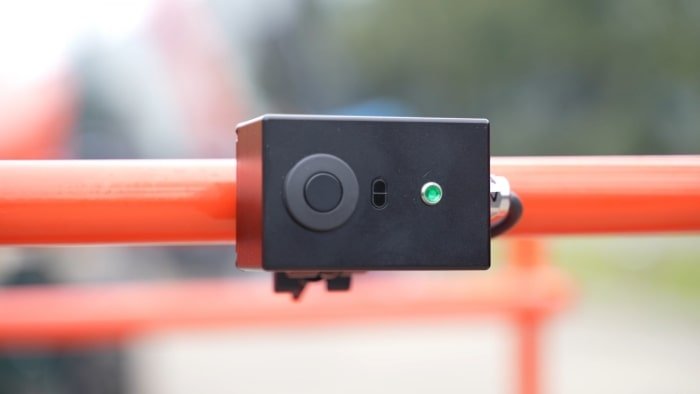
CARS uses multiple sensors in a compact housing mounted on the platform rail, connected to the control unit. It reacts in two stages:
- 1 to 2 metres overhead: the CARS unit flashes and sounds a buzzer, and the lift’s own alarm also sounds. On machines with newer control systems, lifting and driving are automatically slowed.
- Less than 1 metre: lifting and driving movements are automatically restricted, with audible and visual alarms.
Sinoboom points to three technical features. The system pairs an ultrasonic sensor with ±20° coverage and a LiDAR sensor covering 0 to 3 metres, which the company says cuts short-range measurement errors by 50%. A one-button calibration lets the primary alarm distance be set between 0.6 and 2.5 metres to suit the operator’s height, useful when shifts change. An emergency override button allows operations to continue temporarily, with protection restored as soon as it is released.
Built for existing fleets
CARS works with both older and more recent Sinoboom scissor lift control systems, so rental companies can retrofit it across existing fleets. The main difference is that only newer controls add the automatic slow-down in the first stage.
Because it relies on sensors rather than physical guards, the system avoids the clearance problems that bars and cages can create in tight spaces. CARS for scissor lifts follows the version for boom lifts that Sinoboom launched in 2025.
Read the full article here