

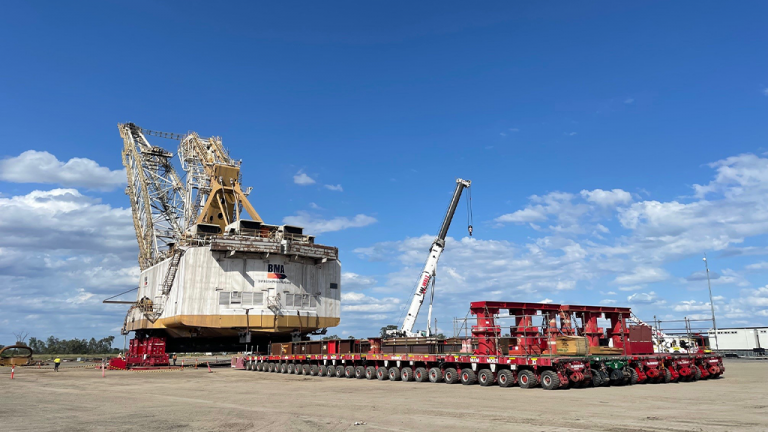
Mammoet used eight JS500 towers underneath the dragline to elevate it to 2.5 metres before positioning the modular transportation system.
Mammoet
Jacking and carrying a 3,100 tonne dragline
Eight JS500 towers were set up underneath the dragline for the jacking operation. Once it was elevated to 2.5 metres, a configuration of 5×28 lines of SPMT were positioned underneath the load to transport it.
For the jacking stage, it was vital that the engineers understood the weight and centre of gravity of the machine. Due to the dragline’s age, information about it was limited, so they worked from a starting point of what was available for machines of a similar age.
While there were some nuances, the dragline was safely and efficiently lifted. Its weight was evenly distributed across 560 tires, resulting in a ground bearing pressure of less than 9t/m².
BMA constructed a new route for the dragline to take. Where there were soft areas in the soil, steel mats were used to prevent the SPMTs from digging in and getting stuck.
Due to the distance and intense Queensland heat, a canopied seat was installed on the deck of the front SPMT. This meant the control box could be mounted instead of carried, and the driver could be shielded from the sun.
The team had a 72-hour window for the railway line closure. In that time, they had to construct the temporary ramp over the track, make the crossing safely, and return everything back to its original state.
“In the past, dragline jacking in Australia has been performed using climbing jacks, which require manual handling of timber stacks to gradually lift the load,” explains Jack Whittaker, project manager at Mammoet.
“One of the key reasons that BMA reached out to us was because the Aurizon rail crossing is a critical line, transporting coal from different mines in the region to the coast for exporting,” adds Laura Ewen, branch manager at Mammoet.
Setting a new benchmark for dragline relocation
Using SPMTs not only reduced risk for the project and got the dragline to the site safely, on time, and without incident, but it also reduced wear and tear on the machine and its mechanical parts.
The other benefit of this method was logistical; the ancillary equipment required to move a dragline, along with a portable substation connected via a long ‘umbilical’ cable linked directly to overhead power cables on site, was not needed because everything was powered by the SPMTs.
Typically requiring over a month to transport, Mammoet has now set a new benchmark for dragline transportation by relocating this unit 27km to Peak Downs Mine in just 10 days, achieving 8km per day and significantly minimizing downtime for the Marion 8050.
Read the full article here