



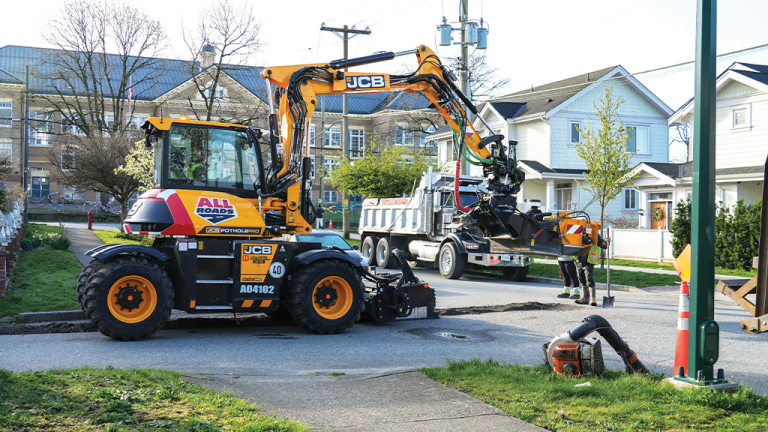
The JCB Pothole Pro is outfitted with a cold planer, cropping tool, rotary broom, and debris collection system.
All Roads Construction
An unprecedented urban patch program
The city’s utility patch backlog wasn’t just large, it was historic. Some work orders dated back to 2008, a 15-year accumulation of unaddressed road repairs following utility tie-ins from various developments. The scope and age of the backlog were so extensive that the city created a five-year patching program, with the year-one contract covering 1,800 patches. Projected annual value was $5.4 million.
All Roads Construction secured the initial 2025 contract with the understanding that they could become the long-term partner if they delivered results.
But this wasn’t typical resurfacing work. The patches were scattered across Vancouver’s most densely populated neighborhoods, with work zones squeezed between parked cars, bike lanes, and narrow rights of way. Each site required a full workup: pre-marking, no-parking signage, photographic documentation, and traffic coordination. Every patch had a unique work order number that had to be tracked and documented independently.
“The scale of the paperwork alone was intense,” Labelle says. “But the real challenge was logistics. How do you bring in a fleet of equipment when you’ve got no space to operate?”
The city’s initial expectations reflected a conventional approach. They envisioned using two paving teams, each with a half-metre milling machine that would require a full-size lowbed for transport and take up nearly a full lane width on site. In a typical set-up, the dual crews would also need a skid steer for cleanup, an excavator to remove concrete patches, and a separate sweeper to finish the job.
To accommodate all of that, All Roads estimated they would need to cordon off an entire city block, sometimes even two, just to fit equipment and staging areas. This was an unrealistic demand in a city with tight curbs and minimal off-street parking. Even then, work could be delayed by vehicles parked illegally despite posted signage.
And the patches weren’t clustered. “This isn’t linear highway work,” Labelle says. “You might do three patches on one block, then move five blocks away to do one more. Multiply that by 30 active job sites a day, and you begin to see the scale.”
The city’s towing policy added further complexity. If a vehicle remained in the zone after signage was posted, the crew had to skip the patch and return the next day. If the vehicle was still present on the second attempt, only then could a tow be requested — adding days to the process.
“If we used the city’s model, we’d be stuck waiting, moving, and coordinating more than we’d be patching,” Labelle says. “And every move costs money, especially when you’ve got to load and unload a milling machine on a lowbed just to go five blocks.”
That operational burden prompted All Roads to rethink the entire approach. Rather than scale up crews and equipment, they aimed to scale down in size, footprint, and complexity. The solution came in the form of a machine that didn’t exist in the local market yet.
Enter the JCB Pothole Pro
While discussing the purchase of an additional skid steer with All Roads’ JCB dealer, Labelle was introduced to a machine that wasn’t even available in Canada at the time: the JCB Pothole Pro.
The Pothole Pro is a fully integrated, self-contained road repair unit designed specifically for urban patching. At a glance, it resembles a compact wheeled excavator, but instead of a bucket, a 47.2-inch-wide (1.2-metre) planer is mounted on a hydraulic arm. The planer is capable of milling up to 6.7 inches (170 millimetres) deep in a single pass. Behind that sits a 23.6-inch (600-millimetre) cropping tool that precisely squares patch edges — eliminating the need for separate saws or cutters.
At the rear, a rotary broom and integrated debris collection system allow operators to sweep up material immediately after milling. A 16-gallon (60-litre) collection bin holds the reclaimed asphalt, making cleanup a seamless part of the workflow. This innovative set-up allows crews to repair a pothole in under 8 minutes, according to the company.
What truly sets the Pothole Pro apart is its mobility. With a top speed of 25 mph (40 km/h), it doesn’t require a trailer for transport. It simply drives from one patch to the next, even across neighbourhoods. That feature alone saved All Roads an estimated $1,000 per day in mobilization costs.
“Everything about the machine is purpose-built to reduce disruption,” Labelle says. “It mills, it cleans, it drives. It doesn’t need a separate crew to square up edges or sweep behind. It just gets it done.”
Because of its compact size, the Pothole Pro can operate on tight residential streets without requiring full-lane closures or sprawling job zones. Crews even park the machine overnight at the next day’s starting point, which eliminates morning mobilizations and improves daily output.
Read the full article here