



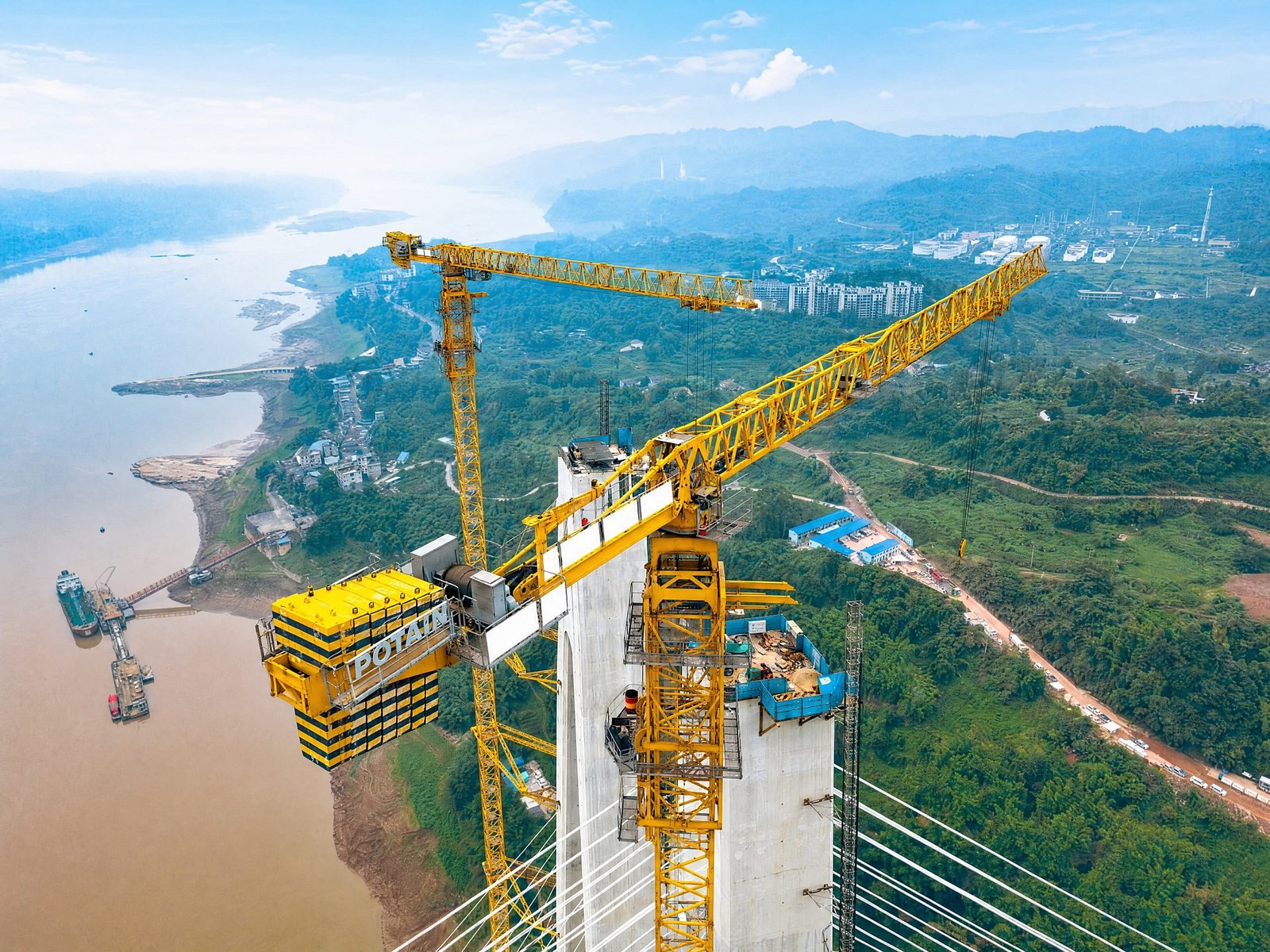
The MCT 560 M25 topless cranes are building the south tower of a road-rail bridge set to claim four world records
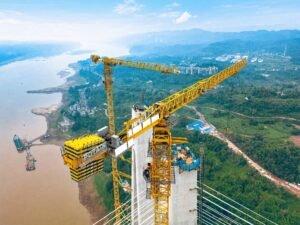
Some tower crane jobs are defined by what they lift. This one is defined by how high they have to keep climbing. Two Potain MCT 560 M25 topless tower cranes are building the 253 m-tall south tower of the Shituo Yangtze River Bridge in Chongqing, China, working about 285 m above the river.
A bridge of records
Once complete, the bridge will carry the Chongqing-Wanzhou High-Speed Railway and, according to Manitowoc, set four world records: the tallest twin-connected towers on a bridge; the first twin-tower cable-stayed bridge carrying road and rail traffic; the first split main-beam bridge at the same deck level; and the longest span for a road-rail cable-stayed bridge with a split main span. The 30-month construction schedule is demanding, and opening is expected at the end of 2026.
What the cranes are doing
The cranes handle steel reinforcement, formwork and other large components. The MCT 560 M25 has a maximum capacity of 25 t and lifts 4 t at the tip of its 80 m jib. It can climb beyond 200 m, which lets the cranes rise with the tower rather than being dismantled and reset as it grows. That helps limit disruption and keep the programme on track, including in winds of up to 20 m/s.
“The Potain MCT 560 M25 delivers outstanding performance at height, climbing to over 200 m with a 25 t maximum capacity,” said Leo Qian, marketing manager for Manitowoc China. Backing the cranes is Manitowoc’s customer support centre in Zhangjiagang and its national network of technicians for parts and maintenance.
A fleet owner’s bet
The two cranes belong to Chongqing Haohai Construction Equipment Leasing, which bought them in 2020. Before this job they worked continuously on the Taiziping Wujiang River Bridge project from 2020 to 2024. That record shaped the decision, according to general manager Jin Zhongxue: “We believed that the cranes would be particularly well suited to the Shituo Yangtze River Bridge because of their high working height and their ability to continue climbing beyond 200 m.”
For rental companies and contractors, the story is a reminder of how a crane’s second and third projects can matter as much as the first: a unit that proves itself on one bridge earns its place on the next.
Read the full article here