



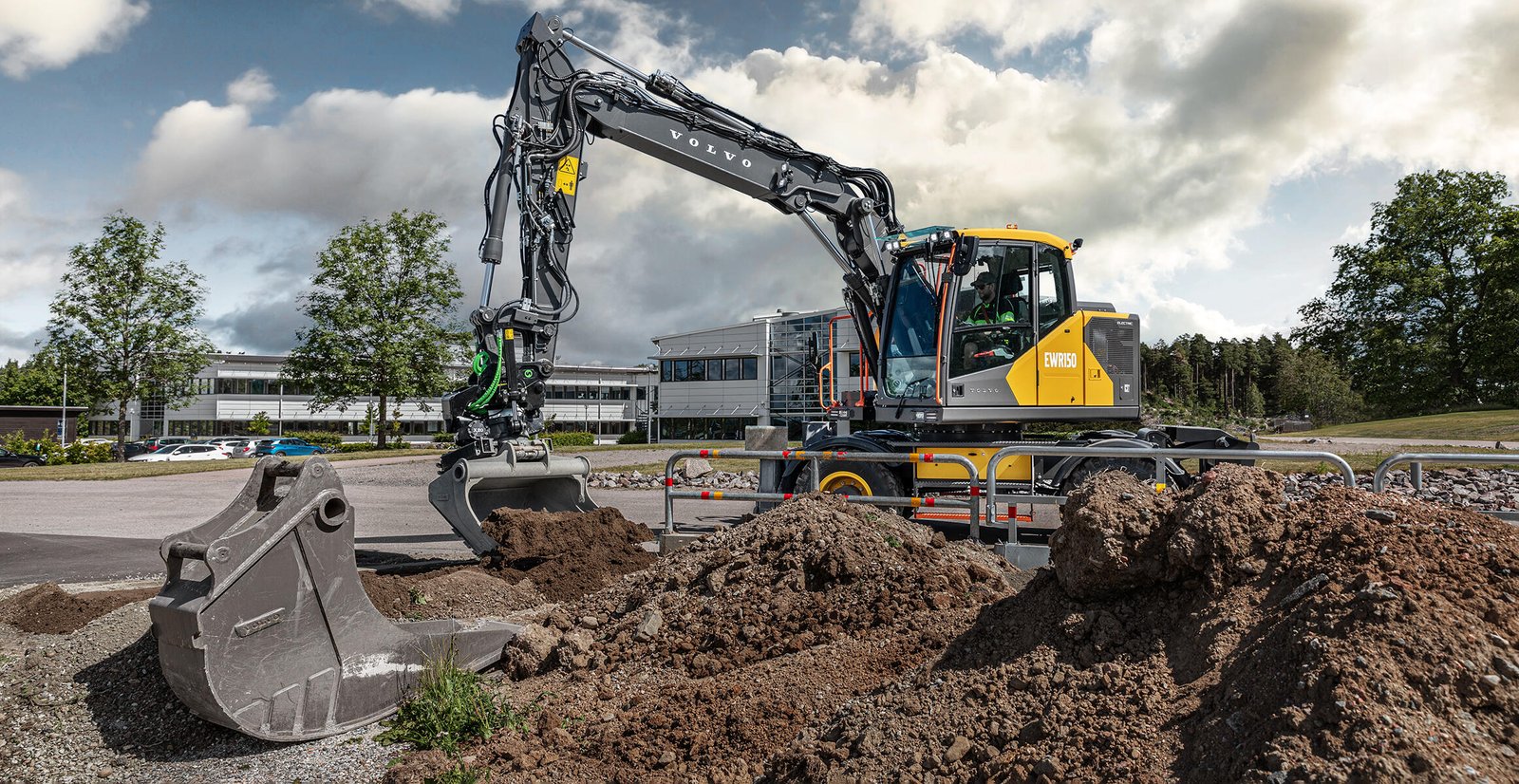
Volvo Construction Equipment (Volvo CE) is bringing the EWR150 Electric to the European market, introducing its first fully electric wheeled excavator to a segment still largely associated with diesel-powered models.
With an operating weight between 16,600 and 17,900 kg, the EWR150 Electric has been developed to deliver operating capabilities comparable to its diesel equivalent, while eliminating exhaust emissions during use.
The machine is designed to travel independently on public roads, without requiring a transport trailer. This feature, combined with zero local emissions, makes it particularly relevant for urban jobsites, where space constraints, noise limits and environmental requirements increasingly influence how work is organised.
The EWR150 Electric adopts a new drive architecture based on an electric travel motor and a hydraulic boom energy recovery system. According to Volvo CE, this configuration enables an indicative operating time of up to 8-10 hours, depending on the application and duty cycle. On the charging side, the EWR150 Electric can be connected to DC charging systems of up to 150 kW, useful for reducing downtime or carrying out partial recharges during work breaks. It also features onboard AC charging of up to 22 kW, mainly intended for overnight battery replenishment. These options allow energy management to be adapted to different jobsite operating cycles.
After its preview at Volvo Days 2024, the EWR150 Electric returned to Volvo Days 2026 in its production-ready configuration, marking the transition from product presentation to commercial launch.
“With the EWR150 Electric, we’ve applied electric technology to the wheeled excavator segment without changing how customers use the machine. By bringing this machine to market in Europe first, we are responding directly to customer demand for solutions that can operate efficiently in urban and noise-sensitive environments, without compromising productivity or capability.”
Said Marc Engels, Global Product Manager at Volvo CE.
Operating Applications, Maintenance and Fleet Impact
Zero tailpipe emissions and lower noise levels broaden the field of application for the EWR150 Electric, particularly on urban job sites or in areas subject to acoustic restrictions. In these contexts, the machine can provide greater flexibility in work planning, including the ability to operate outside standard working hours. Volvo CE also indicates potential applications in agriculture and landscaping, forestry, building and demolition, road construction, utilities, waste handling and recycling.
The electric driveline reduces the number of components requiring maintenance compared with a conventional diesel machine. For fleet managers and contractors, this can translate into fewer scheduled interventions, higher machine availability and a potential reduction in total cost of ownership over the machine’s lifecycle.
The reduced tail swing radius facilitates the use of the EWR150 Electric on jobsites with limited space or restricted manoeuvring areas. According to Volvo CE, the model maintains values in line with the diesel version for reach, travel speed, lifting capacity and operating weight range.
Specification:
| EWR150 Electric | ||
|---|---|---|
| Operating weight | kg | 16.600 – 17.900 |
| Battery capacity | kW/h | 270 |
| Battery voltage | V | 600 |
| Bucket capacity | m³ | 0,67 |
| Lifting capacity, along undercarriage | kg | 5.600 |
| . . . at reach/height | m | 6 / 1,5 |
| Max. digging reach | mm | 8.960 |
| Max. digging depth | mm | 5.230 |
| Breakout force, ISO (Boost) | kN | 108.5 |
| Max speed | km/h | 35 |
| Tail swing radius | mm | 1.720 |
| Connector type | CCS2 |
With the EWR150 Electric now available in Europe, Volvo CE adds a new segment to its electric machine range. The launch forms part of a broader strategy to expand low- and zero-local-emission solutions for jobsites, fleets and operating environments facing increasingly strict environmental requirements.
Read the full article here