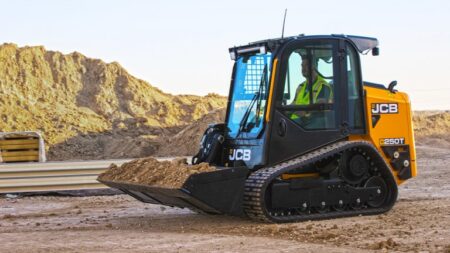


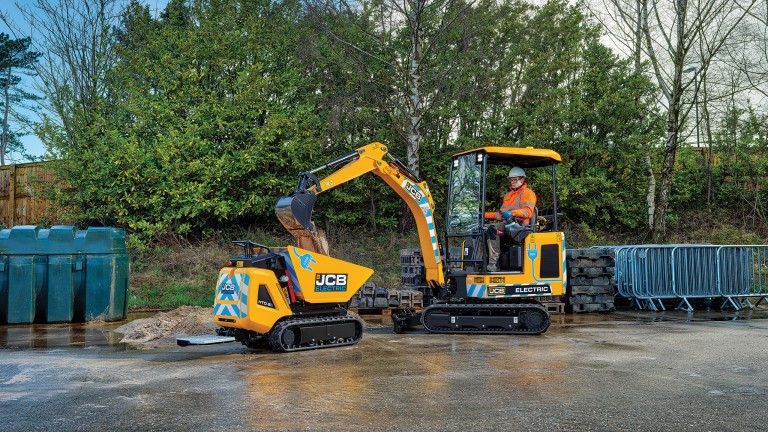
Rather than building to theoretical extremes, manufacturers are designing compact battery-electric equipment for what’s typical in its application.
JCB
Expanded operations, greater opportunities
What really sets electric compact equipment apart is how it expands a contractor’s reach. These machines open up new job site possibilities by eliminating some of the biggest limitations tied to diesel: noise, fumes, and operating hour restrictions.
With near-silent operation and zero emissions, crews can work in noise-sensitive zones like residential neighborhoods or around hospitals. Jobs can start earlier, run later, and be done indoors without the need for ventilation. That level of flexibility helps contractors secure more bids, meet stricter project specs, and reduce downtime waiting for access windows.
In practice, that could mean a crew pouring a foundation next to a school during class hours or finishing landscaping in a park over a weekend without disturbing the public. Electric compact machines make these types of jobs not just possible, but practical.
And it’s not limited to traditional construction. Sectors like food production, event venues, and equestrian facilities are embracing electric machines for their clean, quiet, and low-disruption operation. Whether it’s preparing a show arena, working inside a warehouse, or supporting maintenance at a processing plant, compact electric equipment extends its value well beyond the standard job site.
Charging that makes sense in the field
Charging infrastructure has long been seen as a barrier to electric adoption, but that’s changing fast, especially in the compact space. Manufacturers are standardizing inputs and cable types across product lines, making it possible to run multiple machines on a single charger. No guesswork, no multiple systems — just plug and go.
These machines are designed to recharge overnight, keeping job site downtime to a minimum. And because they’re built from the ground up for electric, component placement and access are optimized for ease of maintenance and service. They are not crammed in wherever space was available.
The proof point for the future
There’s a lot of talk about the future of construction equipment, but compact electric machines are already proving what’s possible. They’ve become a practical entry point into alternative energy without requiring a complete rethink of operations.
They’re not a compromise. They’re a solution backed by job-tested performance, operator familiarity, and growing demand in sectors that need clean, quiet, capable machines.
For anyone still on the fence about electric construction equipment, compact machines make the strongest case yet: it’s not about if, it’s about where to start — and this is it.
Read the full article here