

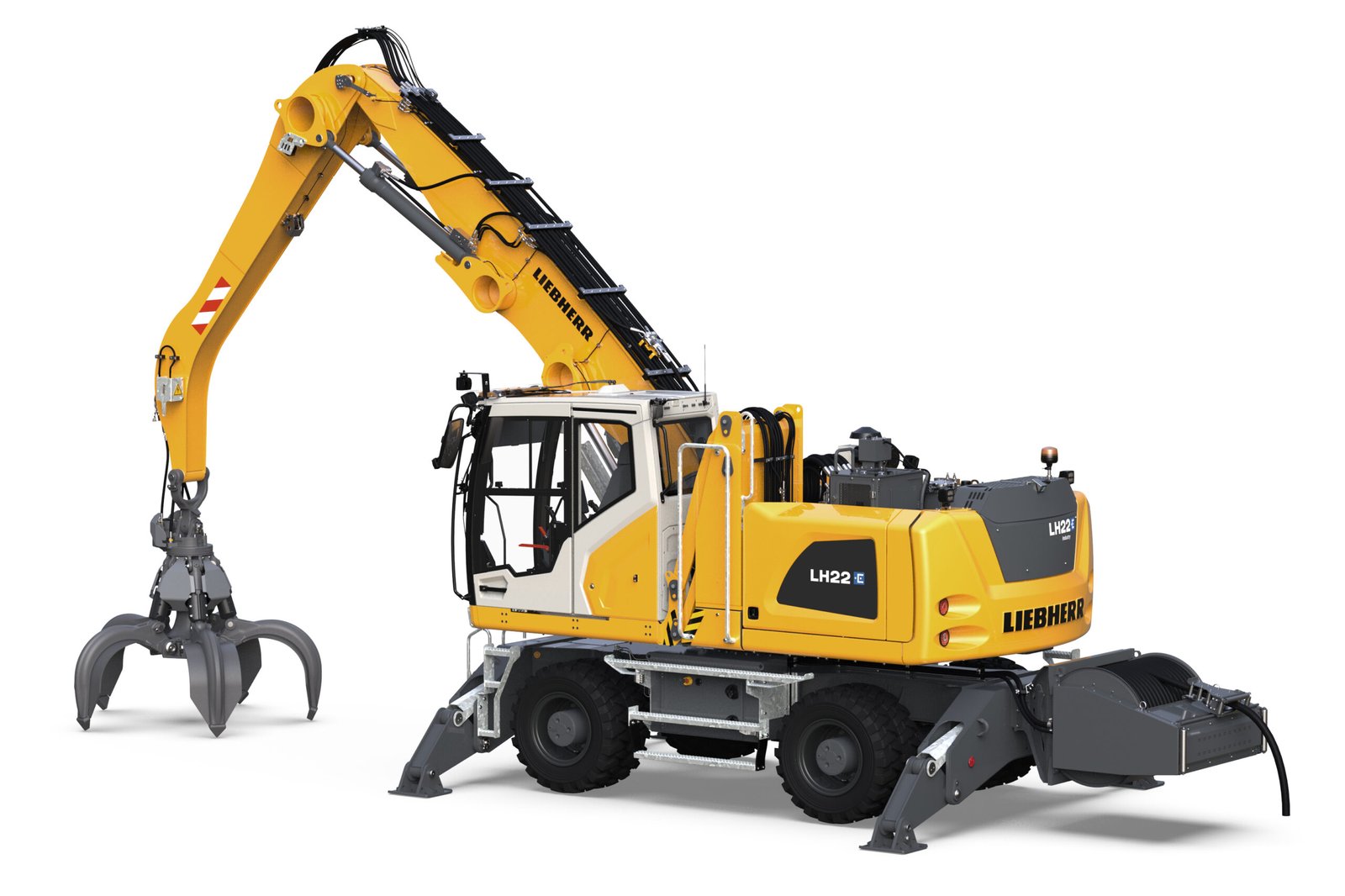
The LH 18 M Industry and LH 22 M Industry E made their world premiere at IFAT 2026 in Munich, introducing Liebherr’s Generation 8 approach to recycling and waste handling.
Liebherr’s latest material-handler made a broader point about where the recycling and waste sector is heading: higher handling output still matters, but so do operator visibility, intuitive controls, service access and the flexibility to choose the right powertrain for the job.
The company unveiled its new Generation 8 material handlers with two prototype machines: the conventionally powered LH 18 M Industry and the electrically powered LH 22 M Industry E. Both were developed for demanding waste-management, recycling and industrial handling applications, where machines must combine long reach, lifting capacity and fast cycle times with reliable performance over long shifts.
From a technical perspective, the two Generation 8 machines were designed around improved kinematics and a robust structure, supporting high loads and long reach. Safety features were also integrated into the new design. Pipe-burst protection on the lift and stick cylinders was included to support safer operation in demanding handling environments. Meanwhile, a new electric servo control system in the uppercarriage allowed operators to adjust machine settings to their preferred operating style. The system also enabled end-of-travel damping for the equipment, helping improve control during repetitive work cycles.
For fleet owners, one of the more practical changes may be the focus on maintenance access. Liebherr reorganised service-relevant components to make them easier to reach, with the aim of reducing downtime and simplifying routine maintenance. Both machines were also introduced with a sliding cab door and a fully glazed cab floor as standard, features designed to improve access and visibility around attachments, containers, trucks and stockpiles.
The new Liebherr emCAB was central to the operator-focused redesign. Its structure featured 15% more glass surface, giving operators a wider view of the work area. In waste and recycling applications, where machines often work close to people, vehicles and moving materials, that additional visibility can have a direct effect on both safety and cycle efficiency.
Liebherr also increased legroom and headroom in the cab, while adding adjustable control elements, upgraded seats and electro-hydraulic settings that operators could tailor to their own preferences. The goal was to reduce fatigue during long shifts while maintaining precise machine control.
The digital side of the update came through INTUSI, Liebherr’s new Intuitive User Interface. Integrated into the emCAB as standard, the system organised machine functions into configurable widgets and allowed operators to customise function mapping, save personal settings across user profiles and store priority functions for direct access.
For contractors and recycling operators, that level of personalisation could reduce familiarisation time and make increasingly complex machine functions easier to manage. It also underlined a wider shift in material handling: productivity is no longer defined only by hydraulic performance, but by how effectively the machine supports the person operating it.
With Generation 8, Liebherr positioned the material handler as a more adaptable platform for the next phase of recycling and waste operations, one where electric power, better ergonomics and simplified machine control are expected to become part of the daily productivity equation.
Read the full article here