

Dieci’s after-sales manager Giancosimo Burti explains how telematics, a longer warranty and the dealer network fit together
For anyone running telehandlers every day, the real cost of a breakdown is not the spare part. It is the hours a machine stands idle on a jobsite or a farm while a crew waits. That is the problem Dieci’s after-sales organisation is built around, and the Italian manufacturer says it wants response time to become its main competitive weapon.
“The time between a fault being reported and the service intervention is what sets us apart on the market, and is what we want to make our greatest strength,” said Giancosimo Burti, After-Sales Manager at Dieci.
Eight units behind every machine
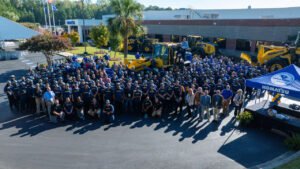
Dieci’s after-sales department has 35 people organised in eight units: service and technical support, training at headquarters and at dealers, the warranty office, technical documentation for parts catalogues and manuals, spare parts order processing, warehouse and dispatch, a Dieci Service unit for minor repairs and modifications, and parts purchasing.
For customers, the entry point stays simple. The nearest authorised Dieci dealer or service centre has access to the parts catalogue and technical tools to identify the right component, check availability and place the order, and can support installation if needed.
From 12 to 36 months
One of the clearest signals is the warranty. Dieci has extended it from 12 to 36 months, which Burti describes as a statement of confidence in the reliability of its machines.
“Whether under warranty or not, every customer is always provided with the highest level of support: a vehicle that is out of service, regardless of the reason, must be returned to operation as quickly as possible,” he said.
Telematics as an early warning system
The most interesting part of the strategy is DTS, the Dieci Telematic System, in which the company says it continues to invest heavily. DTS gives Dieci and its dealers remote access to operating data and parameters, error messages, geolocation and usage patterns. When a reading falls outside standard values, the system flags it for a preliminary check.
Burti is careful not to oversell it. Telematics does not replace a technician, he says, but it lets the service team arrive at the diagnosis with more information and prepare a faster, more targeted response.
He gives two practical examples. In one case, an operator accidentally struck the area around a stabiliser leg sensor on a telehandler, damaging a cable without noticing. The fault was not visible, but DTS alerted the dealer, who intervened before it could cause serious damage. In another, coolant temperature monitoring can send an alert to authorised contacts when the temperature rises above a set threshold and the operator misses the on-board warning, so the service team can call the customer and guide them through the checks.
For fleet managers and rental companies, that is the practical value: problems caught early tend to be cheaper, shorter and less disruptive.
Three priorities for the next phase
Dieci says its after-sales development now focuses on three goals: faster spare parts delivery, a more responsive service department for both dealers and end users, and wider use of DTS through training for dealers and operators.
The last point may prove the most important. Telematics only pays off when the people on the network actually use the data, and that is where Dieci is now putting its effort.
Read the full article here