

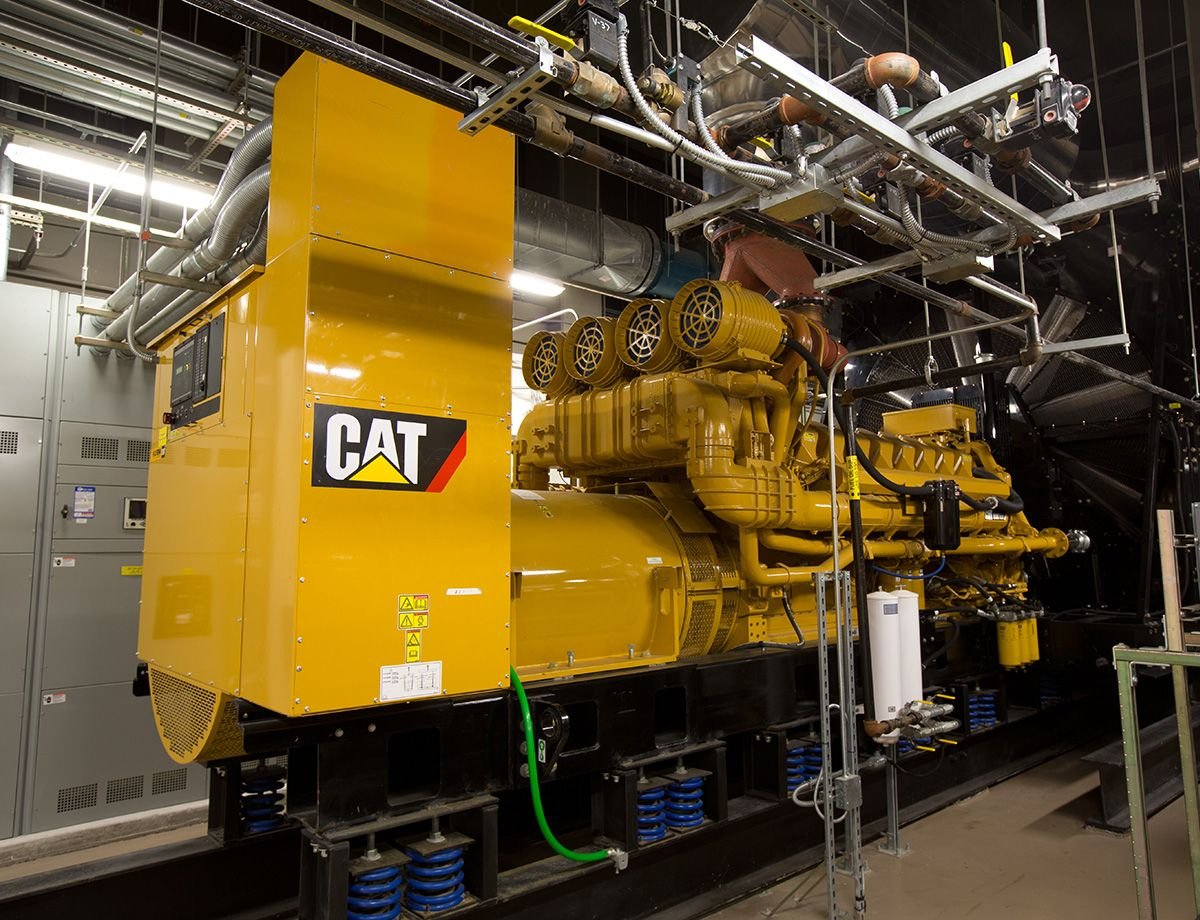
As data centers race to secure megawatts, Caterpillar is turning engines, turbines and dealer service into critical AI infrastructure.
The artificial intelligence boom is no longer just a story about chips, servers and software. Increasingly, it is a story about megawatts, and that is pulling Caterpillar into one of the fastest-moving corners of digital infrastructure.
Best known to many contractors for excavators, dozers, mining trucks and engines, Caterpillar is now positioning its Power & Energy business around a problem data center developers cannot afford to ignore: how to secure reliable, scalable power quickly enough to bring AI capacity online. In the first quarter of 2026, Caterpillar’s Power & Energy sales rose 22% to $7.031 billion, while Power Generation sales increased 41% to $2.817 billion. The company said the increase in Power Generation was driven by large reciprocating engines, turbines and turbine-related services, primarily for data center applications.
The bottleneck for AI infrastructure is shifting. For years, the industry focused on compute capacity, but now the availability of power is becoming just as critical. The International Energy Agency estimates that global data center electricity consumption will more than double by 2030, from 415 TWh in 2024 to around 945 TWh. In the United States, data centers are expected to account for nearly half of electricity demand growth through the end of the decade.
Caterpillar is building a broader data center energy proposition that combines gas and diesel generator sets, gas turbines, switchgear, controls, inverters, battery energy storage, aftertreatment, engineering design, monitoring and lifecycle service. In a company article published in 2026, Caterpillar described its advantage as “speed to power,” saying it is delivering gigawatts of natural gas generator sets to data centers and enabling power generation to begin in less than a year from the initial order.
Several recent agreements show how far this strategy now extends:
In Utah, Caterpillar, Joule Capital Partners and Wheeler Machinery announced an agreement to power Joule’s high-performance computing data center campus. The project uses Caterpillar G3520K generator sets and support equipment, with an integrated system that includes controls, switchgear, inverters, energy storage, CCHP and service support. Joule says its Central Utah campus spans 4,000 acres and is set to launch with gigawatt capacity in 2026, aimed at AI-driven workloads and high-density computing.
In Texas, Caterpillar and Hunt Energy signed a long-term strategic collaboration to deliver independent energy production for data centers. Caterpillar said it will provide a portfolio that includes natural gas and diesel generation equipment, gas turbines, switchgear, controls, aftertreatment, engineering design, monitoring and service. The first project is expected to launch in Texas as part of a multi-year initiative to deliver up to 1 GW of power generation capacity for data centers across North America.
The company is also addressing another pressure point for AI data centers: cooling. In November 2025, Vertiv and Caterpillar announced a collaboration to combine Vertiv’s power distribution and cooling portfolio with Caterpillar and Solar Turbines power generation and CCHP capabilities. The goal is to create pre-designed architectures that reduce design complexity, accelerate time-to-power and improve performance for AI data centers.
For data center operators, the business case is straightforward. AI facilities need power quality, redundancy and rapid deployment. Many also face long grid connection queues, constrained transmission capacity and rising local demand. The U.S. Energy Information Administration has noted that U.S. electricity demand has risen steadily since 2020 after more than a decade of little change, with data centers driving much of that growth. It expects the fastest near-term load growth from data centers in regions including ERCOT and PJM.
For Caterpillar dealers, the opportunity is equally significant. These projects are not one-off equipment sales. They require engineering, commissioning, uptime guarantees, remote monitoring, maintenance and parts availability across the life of the installation. That shifts the role of the dealer network from machine support toward mission-critical infrastructure service.
The scale is already visible. American Intelligence & Power, Caterpillar and Boyd CAT announced a strategic alliance to deploy 2 GW of dedicated power for hyperscale AI infrastructure. Caterpillar said the G3516 fast-response natural gas generator sets are suited for behind-the-meter data center applications because of rapid start capability, load-following performance and continuous-duty reliability. The company said the platform can ramp from zero to full load in approximately seven seconds.
Caterpillar has also strengthened the internal structure behind this push. In its 2025 highlights, the company said it introduced the renamed Power & Energy segment and expanded large-engine capacity and gas-turbine production to support growing customer commitments. It also pointed to strategic agreements with Hunt Energy and Vertiv as part of a broader effort to deliver integrated, on-site power solutions.
The risk for the industry is that rapid AI deployment increases dependence on fossil-based generation at a time when many technology companies are under pressure to reduce emissions. Caterpillar is trying to manage that tension by presenting data center power as an integrated system rather than a single-fuel product category. Its portfolio now includes natural gas generation, turbines, battery energy storage, CCHP, controls and, in earlier work with Microsoft and Ballard, hydrogen fuel cell backup power demonstrations.
Caterpillar is not leaving construction and mining equipment behind, but the AI buildout is creating a new kind of heavy-duty customer: one that buys power systems at gigawatt scale, demands industrial-grade uptime and measures project delays in lost compute revenue. For a company built around engines, turbines, service networks and large-scale industrial reliability, data centers are becoming the next infrastructure market.
Read the full article here