


JCB’s hydrogen combustion engine has been approved for sale in Europe.
JCB
Fuels, engines, and alternative power
There is no one-size-fits-all solution to transitioning the construction job site to clean power, but different solutions can work in tandem to lower job site emissions and improve job site air quality for workers and the community.
The more straightforward switch for operations is to use biodiesel instead of petroleum diesel. Biodiesel is made from vegetable oil, tallow, or used cooking oil. According to the U.S. Department of Energy, emissions released from biodiesel combustion can be offset by the carbon absorbed from growing the feedstock, such as soybeans, to produce the fuel. Biodiesel also does less damage than petroleum diesel if spilled in the environment; it is far less combustible and thus safer to handle, store, and transport. OEMs can provide guidance on the right biodiesel mix for a given engine working in a given environment.
Engine OEMs are also extending their expertise into other propulsion solutions that reduce emissions. Cummins, for example, is advancing a broad portfolio of power solutions that also includes electric, hybrid, natural gas, and fuel cell technology to serve a range of industries, and its X15 HELM engine platform will give customers the ability to select the best combustion option to suit their needs, whether that’s diesel, natural gas, or hydrogen.
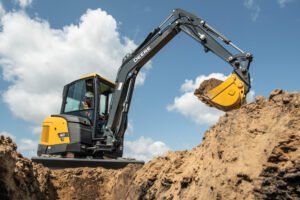
JCB has been developing a hydrogen combustion engine for its construction machines for several years, and in early 2025 the company was approved to sell its hydrogen combustion engines across Europe. JCB has tested the hydrogen engine extensively with customers, most notably in backhoe loaders and telehandlers.
Hybrid technology also significantly reduces fuel consumption and CO2 emissions, and hybrid excavators are well-proven. Komatsu has been a notable leader in this area since it introduced its first hybrid excavator in 2008. Komatsu’s hybrid excavators feature an electric swing motor/generator that captures and regenerates energy as the upper structure slows down. The stored energy is then used by the generator/motor to assist the engine. These machines excel at providing fuel-efficient, responsive truck loading.
Volvo CE takes a different approach with its hydraulic hybrid excavators. Its machines capture up-and-down boom motion. The energy generated by the boom down motion is captured by a hydraulic accumulator to assist with the boom up motion, which is where the most pressure and power is needed.
Battery-electric power is now well-proven for compact machines, including excavators, wheel loaders, and compaction equipment, in certain applications. It is here that Volvo has also excelled at delivering a range of solutions. The company started small with compact electric machines, which it demonstrated in real-world applications where the investment in the new technology makes sense and charging power can be readily available: in indoor environments, around animals, in ecologically sensitive areas, and in urban settings. Most major OEMs that manufacture compact equipment now offer electric machines, and larger equipment is now starting to get the electric treatment.
Drivetrain flexibility is also particularly notable and widely available for crushing equipment. Many of today’s crushers can be spec’d in hybrid or fully electric configurations. Hybrid crushers give equipment owners the most flexibility. When power is available, the machine can be plugged into the mains to run as a fully electric machine. But, should power not be available, the equipment can still run off of a diesel engine if needed.
The pursuit of job site sustainability
Job site sustainability is not a finish line, but an ongoing practice that can be improved by using any combination of the technologies and equipment solutions that we’ve discussed here. Most importantly, these solutions do not have to be adopted for sustainability’s sake — they can have very real and significant lasting benefits to your job site’s productivity and to the quality of your work.
Read the full article here