


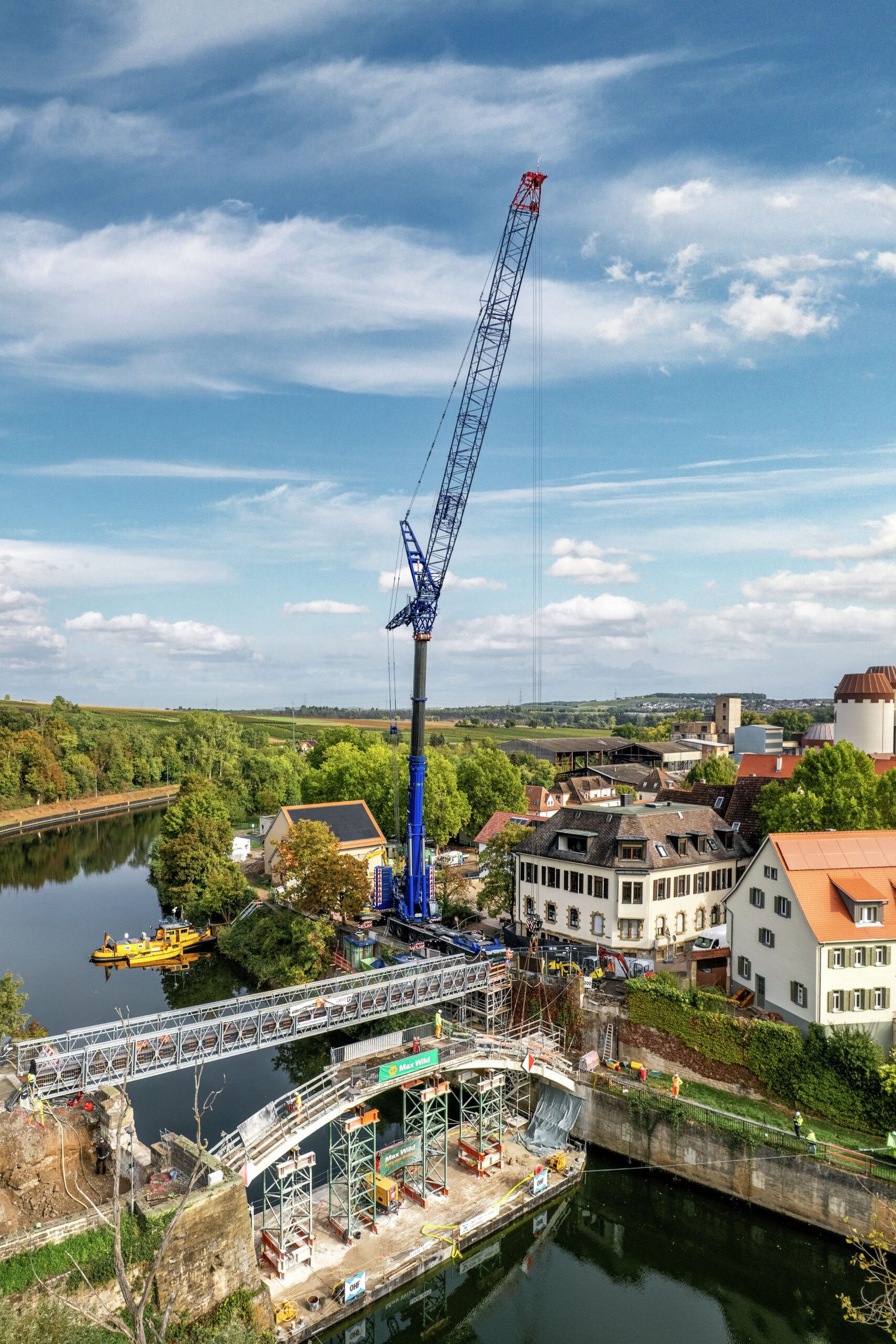
MSG Krandienst deployed the 700-tonne mobile crane to dismantle a 75-year-old canal bridge in Lauffen am Neckar, Germany. Limited working space, an unconventional outrigger setup and lifting radii of up to 50 metres made the operation particularly challenging.
Replacing an ageing bridge is not always a question of how much a crane can lift. Sometimes, the greater challenge is finding somewhere to position it. That was the case in Lauffen am Neckar, Germany, where MSG Krandienst deployed a Liebherr LTM 1650-8.1 to dismantle a 75-year-old canal bridge from a tightly constrained working area above the riverbank.
A Bridge Replacement with Little Room to Work
Built in 1951, the single-lane arch bridge connected the densely developed old town of Lauffen am Neckar with a small island across a canal. After decades of service, its load-bearing capacity no longer met structural requirements, making replacement necessary.
The location complicated the demolition plan. The canal was approximately 40 metres wide, while the surrounding buildings and sloping terrain left limited space for heavy lifting equipment. The company selected its Liebherr LTM 1650-8.1, an eight-axle mobile crane in the 700-tonne capacity class.
An Unusual Outrigger Setup Above the Riverbank
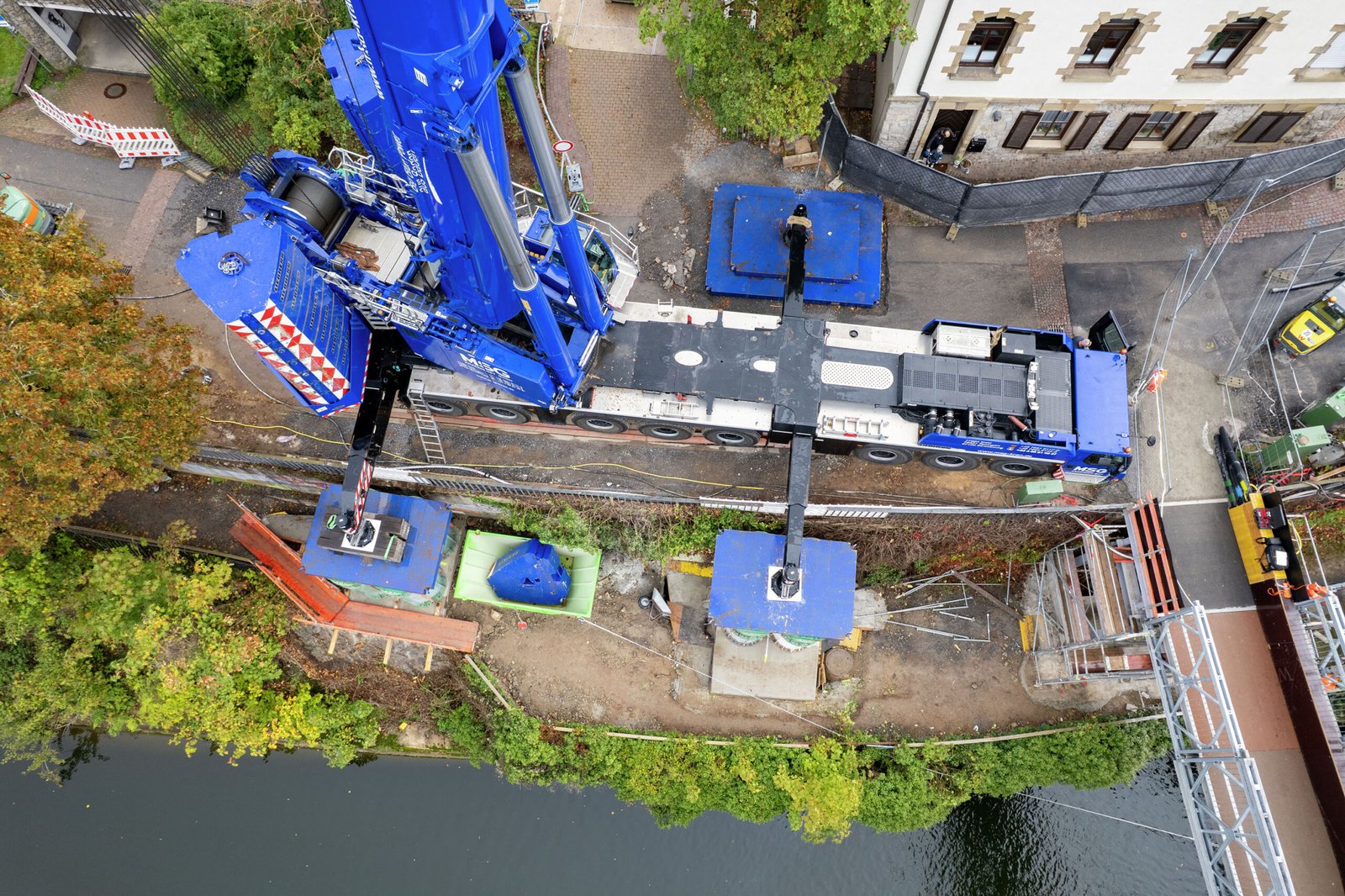
With insufficient room to accommodate the complete outrigger arrangement on the upper working level, the two outriggers facing the river had to extend beyond the available surface. They were supported on large steel cylinders connected to concrete foundations approximately four metres below the crane’s installation level.
This arrangement allowed the machine to operate from the restricted road area while transferring the outrigger forces to specially prepared support points. An auxiliary support cylinder beneath the rear of the vehicle also helped during assembly, particularly when positioning the rear outriggers on the sloping road.
“The topography on site severely restricted our options for setting up the mobile crane. Thanks to its compact design, the LTM 1650-8.1, with its high lifting capacities, was the perfect machine for this job.”
Explained Christian Spreuer, the engineer responsible for large crane project planning at MSG Krandienst.
From Temporary Access to Removing the Concrete Arch
The LTM 1650-8.1 was configured with a 35-metre luffing jib and 175 tonnes of counterweight to handle the different stages of the operation. Before demolition could begin, the crane installed a temporary pedestrian bridge across the canal, maintaining a crossing between the two sides. It also transferred construction machinery to the island, lowering the equipment onto the opposite bank at a lifting radius of 50 metres.
Once the preparatory work was completed, the demolition team removed the bridge deck and superstructure in individual sections. The main supporting arch was then cut into five segments using concrete saws. A pontoon positioned beneath the arch provided temporary support throughout this phase. Equipped with scaffolding piers, the floating platform could be raised or lowered by pumping water into or out of its chambers.
The heaviest individual lift involved the apex section of the concrete arch, which weighed just under 44 tonnes and had to be handled at a radius exceeding 36 metres.
Changing Lifting Radii Put Crane Configuration to the Test
Across the several-day operation, the crane worked at lifting radii ranging from 26 to 50 metres, with loads varying significantly between lifts.
The LTM 1650-8.1’s VarioBallast system allows the counterweight radius to be adjusted continuously, providing flexibility when working with changing lifting requirements and restricted space around the machine.
A Demolition Project Defined by Site Constraints
Based in Kehl, Germany, MSG Krandienst operates a fleet of 55 cranes, including two Liebherr LTM 1750-9.1 machines and another LTM 1650-8.1. Together with its French subsidiary MSG Levage, the company employs 175 people and provides crane rental and project logistics services.
The Lauffen am Neckar project shows how bridge demolition can require far more than lifting capacity alone. In this case, the combination of restricted access, complex crane positioning and carefully planned lifting operations shaped the entire dismantling process.
Read the full article here