



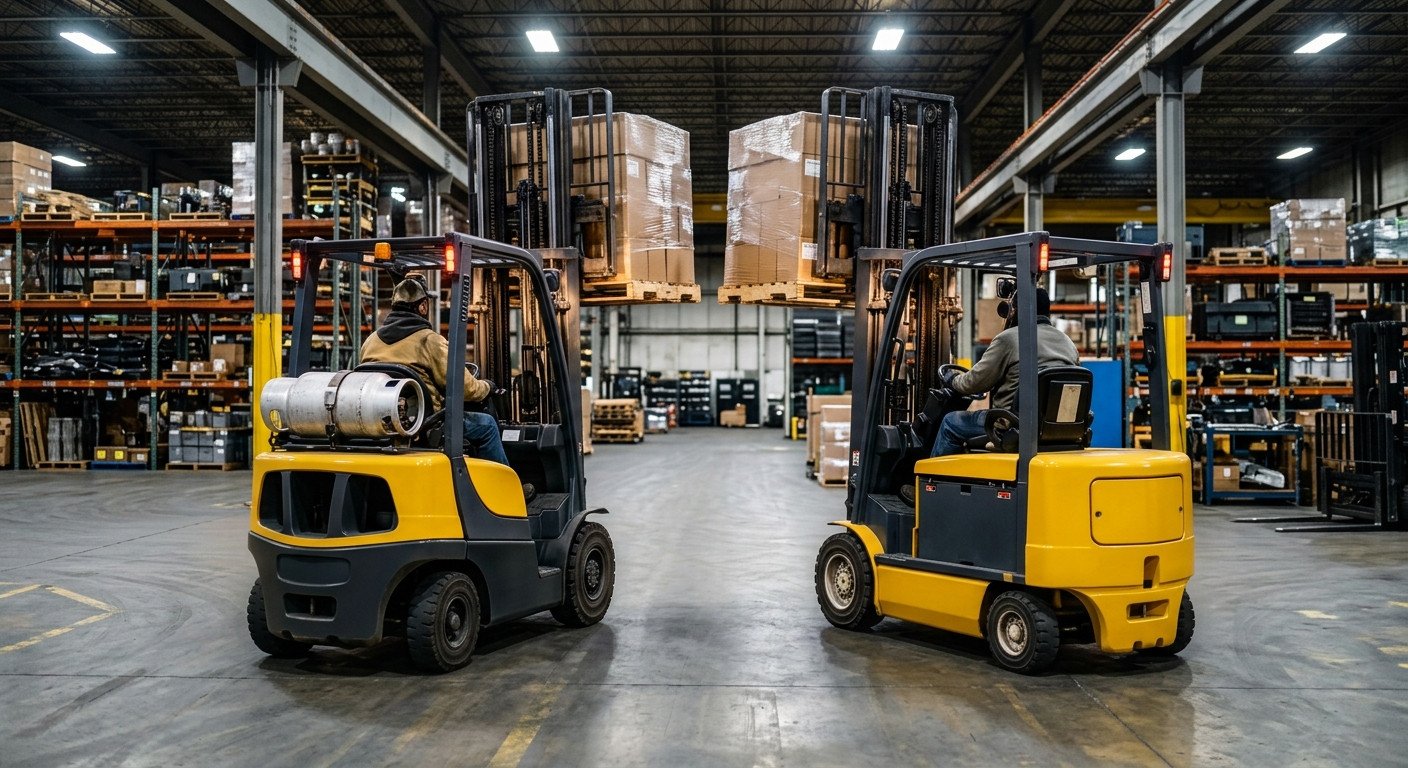
A CAN bus integration lets ENEROC’s LFP forklift batteries tell CTI chargers exactly how to charge them.
For forklift fleets moving from lead-acid to lithium, the battery is only half the decision. The charger installed on the wall often stays in service for years, and compatibility between brands is still negotiated case by case. ENEROC USA and Charging Technologies Inc. (CTI) have just removed that obstacle for their own customers.
The two companies have completed an integration between ENEROC’s LFP forklift batteries and CTI’s lithium-capable high-frequency chargers. When an ENEROC battery is plugged into a CTI charger fitted with the CAN bus option, the two recognise each other over a wired link and charging is controlled by data from the battery. Operators no longer need to select a charge profile manually.
How it works
At handshake, the ENEROC battery management system sends pack voltage and capacity. During charging, it continuously requests charge current and voltage, updating them as state of charge and cell temperature change, and reports cell balancing status and estimated time to full charge. If the BMS detects a fault or reaches a temperature limit, the charger stops or reduces current.
In practical terms, the charger follows the battery throughout the cycle, keeping current within what the cells can safely accept, whether the fleet opportunity-charges during breaks or runs a full overnight charge.
The integration covers CTI’s lithium-capable chargers with CAN bus communication. CTI’s Xtreme HF line spans 24 to 80 VDC in single-phase and three-phase versions, with a rated power factor of 95% and nominal efficiency of 94%. CTI designs and builds its chargers in Bridgeton, Missouri, while ENEROC builds its LFP packs on CATL cells.
Why fleets should care
For warehouse, rental and material handling fleets, the value lies in avoiding a parallel investment.
“Fleets that already run CTI chargers can move to ENEROC lithium batteries and keep the chargers they have. Once connected, the battery and charger recognise each other and manage the charge smoothly.”
Said Mark D’Amato, VP of Sales at ENEROC USA.
Reliability was a key consideration in selecting a battery partner.
“Our customers keep a charger in service for many years and count on it every shift, so reliability is the first thing we check in a battery partner,”
Said Jeff Franklin, Inside Sales Manager at CTI.
The broader picture is that charging protocols across the industry are still not unified, so integrations like this remain bilateral. Fleets and dealers can contact ENEROC USA or their local CTI Power Factor or Extreme Power dealer to confirm their charger configuration.
Read the full article here