

The new 10,000-ton bridge was installed in one piece.
Mammoet
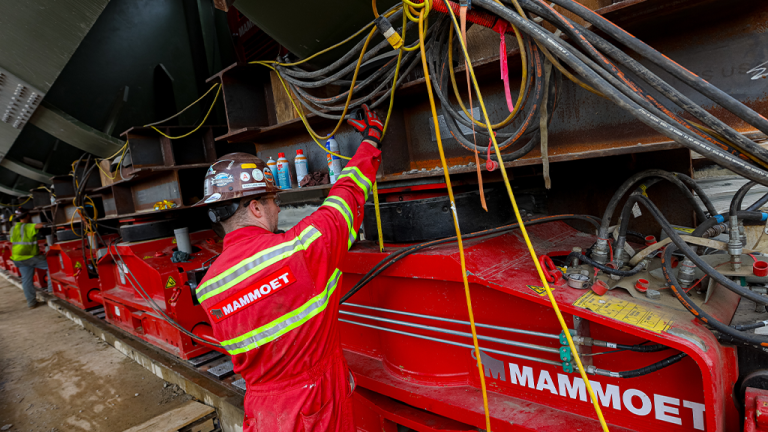
Mammoet relied on its skidding system to move the entire bridge into place
The new steel arched delta frame bridge was assembled just metres away from the old one. Only intermittent lane closures could happen to allow site preparations.
Mammoet worked with Fay, S&B USA Construction, the prime contractor responsible for building the new bridge and the demolition of the old bridge, which included conventional demolition methods and a controlled implosion. Mammoet’s scope was to plan, manage, and perform the skidding installation of the new 10,000t bridge once the old structure and all debris were removed.
“We moved the entire bridge structure whole — the deck and the main support structures”, explains Mark Lane, engineering team lead at Mammoet. “Our skidding system allowed for this type of solution to be feasible and provided the quickest means of replacing the bridge”.
The low height and high load capacity of the system are the key reasons it was chosen. Most skidding systems are likely to move laterally a little when they pick up a heavy load. However, this system can resist that transverse force and minimize stresses on the lifted load.
To provide additional protection against twisting forces, a temporary frame was erected between the bridge and the skid shoes, securing everything in place. The low height of the skid shoes gave the engineering team more room to make this frame strong enough without needing to make its foundations wider.
The skidding system has a newly revamped control system that gives operators unprecedented precision and oversight — from the stroke of the main cylinder to the skidding force. Each skid shoe can be operated independently, with the integrated hydraulic jack being used to lift the load from its temporary construction supports and set it down on its permanent bearings.
A total of 42 skid shoes were used for the installation. The shoes were spread across four primary support runs: two at the bridge piers and one at each of the abutments.
The team needed to ensure every section of the bridge moved at the exact same time, with only a one-inch tolerance from pier to abutment available (2.5 centimetres). They conducted a test slide to pick up and move the bridge five feet (1.5 metres) forward, checking deflections and ensuring everything behaved as normal before the final slide.
The final skidding distance was 102 feet (31.1 metres), which was performed in one continuous move. This was achieved in a single day shift.
Read the full article here