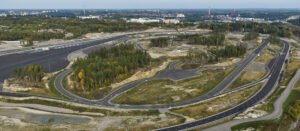



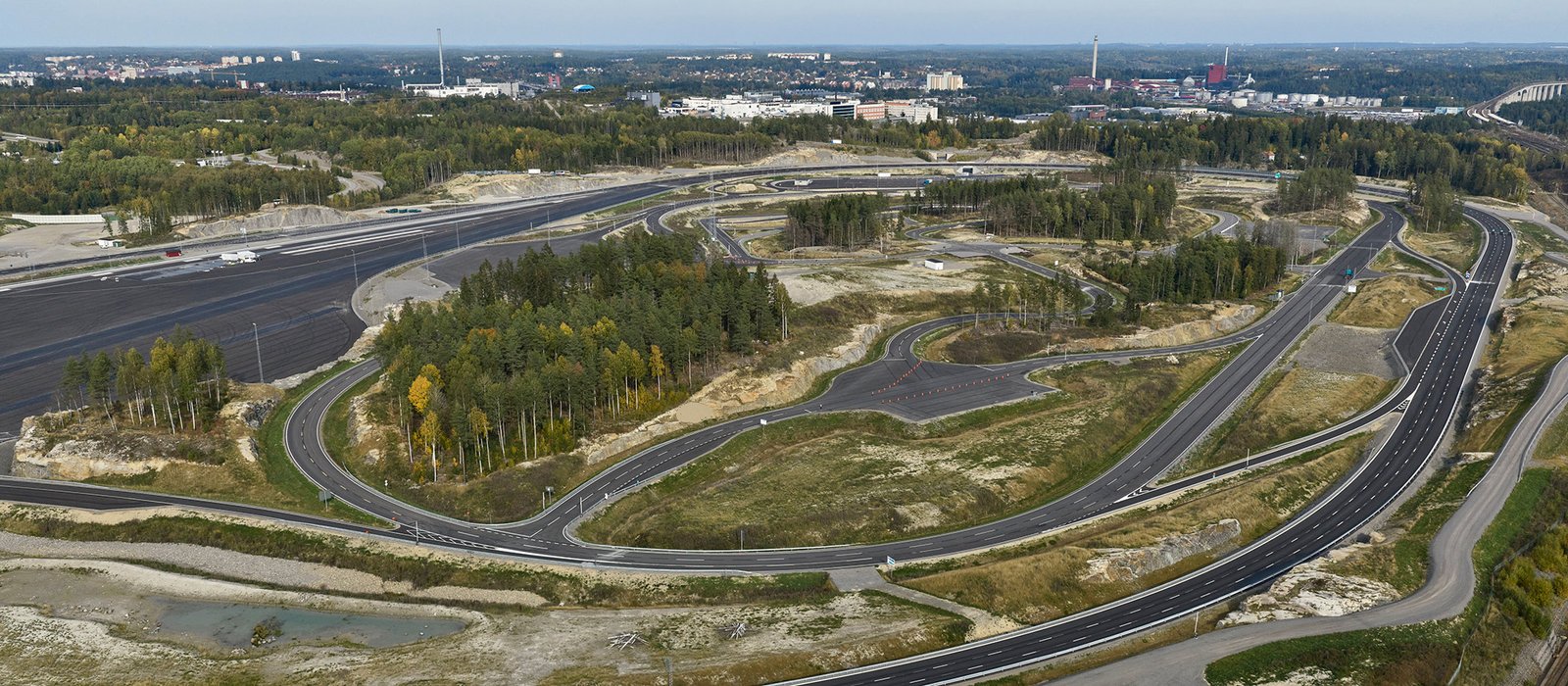
The 85-hectare site in Södertälje gives TRATON engineers dedicated tracks for electric, autonomous and safety testing that previously needed external facilities
Every new truck technology eventually has to prove itself on the road. Scania now has a much larger road of its own. On 19 October the company opened a new R&D proving ground in Södertälje, Sweden, an investment of around SEK 975 million that strengthens the testing capabilities of the whole TRATON GROUP.
The inauguration skipped the ribbon. Instead, a line of vehicles drove onto the track.
What the site offers
The facility covers about 85 hectares and adds 13 km of paved roads and 4 km of gravel roads, along with 230,000 m² of paved and 54,000 m² of gravel test surfaces. It is designed for electrification, autonomous systems, safety, vehicle dynamics and conventional technologies.
For safety development there are three irrigated braking tracks with different surfaces: asphalt, concrete and basalt tiles. Engineers can test braking with different grip on each side of the vehicle, and the basalt section includes a curve for braking while cornering. Dedicated areas can be set up to test driver assistance systems such as automatic emergency braking, lane support and blind-spot warning.
For autonomous transport, the site allows realistic traffic scenarios that can be made gradually more complex. The oval track uses banked curves with gradients of up to 22%, so drivers experience it as a straight road: in effect, an endless highway. The surface specification was chosen for long life and the evenness needed to compare tests over time.
Why it matters
Testing that previously required external facilities can now be done in-house, close to Scania’s main R&D centre. That shortens the loop between development and validation at a time when trucks are changing faster than at any point in decades.
“New technology only creates value when it performs in the real world,” said Sara Forsberg, CTO and head of brand identity development at Scania. “The R&D proving ground gives our engineers greater possibilities to test, learn and validate solutions under demanding conditions.”
For fleet operators, the payoff is indirect but real. Electric drivetrains, advanced safety systems and automated driving functions will reach customers only once they have been validated, and the speed of that process affects how quickly new models arrive.
“The transformation of transport requires us to continuously strengthen the way we develop and validate new technologies,” said Christian Levin, president and CEO of TRATON GROUP and Scania.
Scania says construction choices such as ECO asphalt and HVO100 for transport avoided around 30,900 tonnes of CO2e, and that nature and biodiversity were considered in the site design.
Read the full article here