

A single commercial re-roof can mean moving tens of thousands of pounds of TPO or EPDM rolls, insulation board, cover board, metal panel, and HVAC curbs from a ground-level staging area up to a roof deck that a crew can’t reach by ladder or hand truck. On a job that size, the machine chosen to do that lifting isn’t a footnote. It shapes the schedule, the labor cost, and how many workers are exposed to fall risk on any given day.
For fleet managers, rental companies, and contractors who plan these jobs, the telehandler-versus-crane question has become a real equipment-planning decision rather than a default. Rising rental penetration, tighter labor markets, and hard safety numbers from OSHA and the Bureau of Labor Statistics are all pushing that decision higher up the priority list.
Why Rooftop Material Handling Is a Fleet Decision, Not an Afterthought
Residential roofing crews have long relied on conveyors, ladder hoists, or a couple of workers passing bundles up a ladder. That approach doesn’t scale to a 40,000-square-foot commercial roof deck, where the volume of material and the height involved make mechanized lifting the only practical option. Rental companies have noticed the shift in demand. The American Rental Association projects combined U.S. construction and industrial equipment rental revenue will hit $83.5 billion in 2026, up 3.4% year over year, with the share of construction equipment that’s rented rather than owned climbing to an estimated 59% in 2026, up from about 53% in 2019, according to the American Rental Association’s forecast reported via Construction Equipment.
That means more telehandlers and mobile cranes are sitting in rental yards specifically because contractors need them for short-duration, material-intensive jobs like commercial roof replacements rather than owning the equipment outright.
A recent large-scale commercial re-roof handled by Mclean VA roof replacement crew StyleRoofing illustrates the kind of planning this requires. Moving pallets of insulation and membrane to a multi-story flat roof isn’t a job you improvise on-site; it requires deciding well in advance whether a telehandler’s reach and cost efficiency will cover the lift, or whether the job needs a crane’s capacity for heavier or longer picks. That upfront decision, made before the first truckload of material arrives, is what separates a smooth mobilization from a delayed one.
Telehandler vs. Crane: Matching the Machine to the Lift
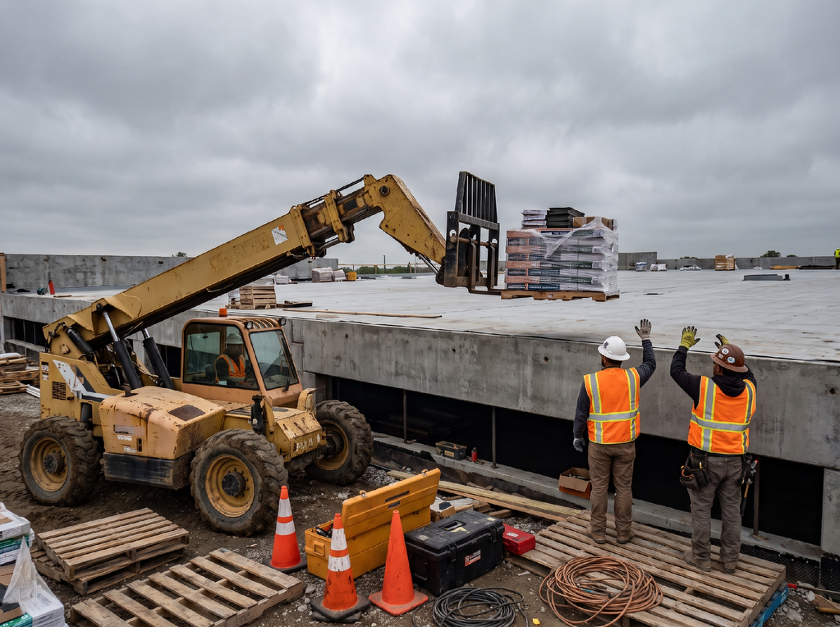
Telehandlers have become the default choice for a large share of commercial roofing logistics because they do double duty. A rotating or fixed-boom telehandler rated for 10,000-plus pounds can move pallets from a ground staging area directly to roof height, then reposition on-site to handle secondary tasks like moving dumpsters or staging tools. Cabs rated to ROPS/FOPS standards add rollover and falling-object protection, which matters on uneven commercial lay-down yards.
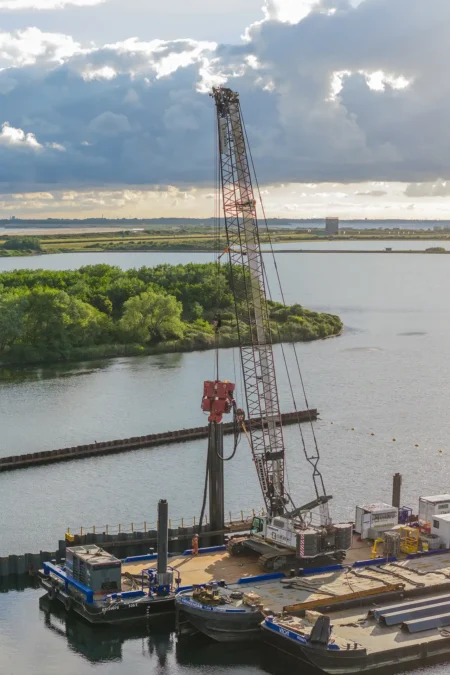
Cranes still win when the job calls for it. A mobile or knuckle-boom crane outperforms a telehandler on very high lifts, tight placement situations such as setting rooftop HVAC curbs precisely between existing equipment, or picks that exceed telehandler capacity entirely. Fleet planners increasingly frame the choice around lift charts and reach requirements rather than habit. Adding a rotating telehandler to a mixed fleet, something we covered in our breakdown of the different types of lifting equipment for smoother material handling, gives a contractor flexibility on the majority of mid-size commercial jobs while still leaving room to bring in a crane for the outliers.
The economics matter here too. Crane mobilization, operator certification, and daily rental rates run well above telehandler costs on most jobs, so contractors who default to a crane out of habit are often paying for capability they don’t need. Conversely, forcing a telehandler onto a lift it can’t safely handle creates its own risk. The right answer depends on load weight, reach, and how many picks the job requires, not on which machine happened to be available.
Jobsite Safety: Why Roofing Leads the Industry in Fall-Protection Citations
Equipment choice on a roofing job isn’t just a cost and schedule question. It’s tied directly to some of the worst safety numbers in construction. Federal OSHA inspected roofing contractors 3,629 times in fiscal year 2025 and issued a fall-protection citation in 86.5 of every 100 inspections, the highest rate of any construction trade, according to EDGE Fall Protection’s analysis of FY2025 OSHA data. Roofing and framing sit in a tier of their own at 83.5 citations per 100 inspections, far above siding at 43.6 and other trades in the 19 to 24 range.
The broader numbers back that up. Fall Protection – General Requirements under 29 CFR 1926.501 has been OSHA’s most-cited standard for 15 consecutive years, with 5,914 violations recorded, and falls, slips, and trips caused roughly 38% of the 1,034 total construction fatalities the Bureau of Labor Statistics recorded in 2024. Roofers specifically saw 104 fatal work injuries in 2024, a fatal-injury rate of 48.7 per 100,000 full-time-equivalent workers, according to the Bureau of Labor Statistics’ Census of Fatal Occupational Injuries. That’s roughly 14.8 times the all-occupations rate of 3.3.
Mechanized material handling doesn’t eliminate that risk, but it removes one contributing factor: the manual ladder-carrying and repeated roof-edge trips that come with hand-moving heavy bundles. A telehandler or crane pick replaces dozens of individual worker trips up and down a ladder with a single controlled lift, which cuts the number of times a worker is exposed to a roof-edge fall hazard during material staging. OSHA runs an annual National Safety Stand-Down to Prevent Falls in Construction partly for this reason, pushing crews to pause and review exactly this kind of exposure before it turns into a citation or a fatality.
Fleet Technology and Site Planning That Reduce Risk
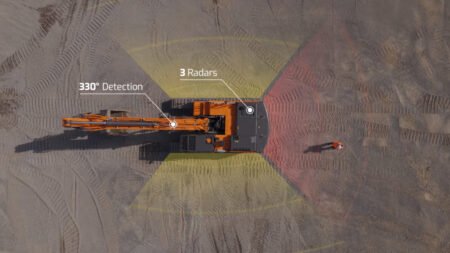
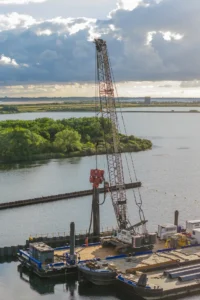
The equipment itself has also gotten smarter about managing that risk. Modern crane fleets increasingly run load and wind monitoring systems that track real-time conditions and flag a pick before it exceeds safe parameters, an approach we detailed in our coverage of Liebherr’s fleet-data management tools for crawler cranes. That kind of data isn’t just a nice-to-have; it’s becoming standard practice for fleet managers who need to document lift safety across dozens of active jobsites.
Site planning matters just as much as the machine spec sheet. Before a crane sets its outriggers or a telehandler stages on a roof-support slab, crews need to confirm what’s beneath the surface. Our piece on why subsurface verification belongs in every pre-construction plan covers the underground-utility damage risk that comes with staging heavy equipment on ground that hasn’t been checked, a step that’s easy to skip under schedule pressure but expensive to get wrong.
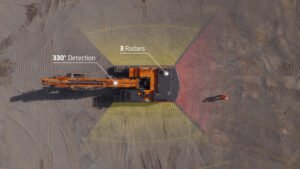
Spotter protocols, verified load charts, and a clear communication plan between the ground crew and the machine operator round out the basics. None of it is complicated. It just requires treating material handling as part of the safety plan rather than a logistics detail worked out the morning of the job.
The Takeaway for Fleet Managers and Contractors
Commercial roofing volumes aren’t shrinking, and rental penetration keeps climbing, so the telehandler-versus-crane decision isn’t going away either. Contractors and rental companies that build this choice into their pre-job planning, matching machine capacity to actual lift requirements instead of defaulting to whatever’s on the yard, get faster mobilizations and fewer surprises. Given how far roofing sits above every other trade in fall-protection citations, mechanized material handling isn’t optional anymore; it’s one of the most direct ways a crew can cut its own exposure on a job that’s already among the riskiest in construction.
Read the full article here