


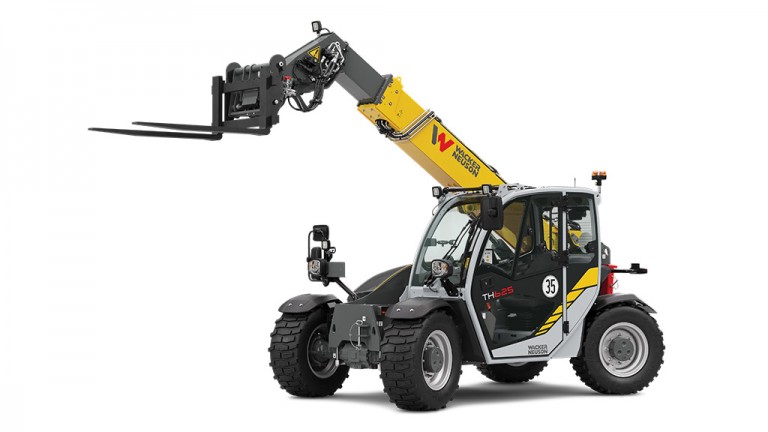
Operating like a forklift, the telehandler will automatically adjust the load closer to the body when descending and further away from the body upon ascent to maintain stability.
Wacker Neuson
Visibility, stability, and versatility in one machine
All models are equipped with comfortable cabs featuring enhanced ergonomics and all-round visibility, electronically controlled travel drive with various travel modes, a telescopic arm that allows a clear view of the attachment, a wide range of options, and a modern machine design. The transversely installed motor and the optimized arrangement of components ensure easy accessibility for maintenance.
Also, the TH625 includes an integrated driver assistance system. The Vertical Loading System (VLS) allows the operator to choose between two loading functions, bucket mode and fork mode. In bucket mode, the boom automatically retracts when the operator lowers in order to keep the load as close to the front axle as possible to minimize tipping situations. In fork mode, the boom extends and retracts automatically when the operator raises the arm in order to keep the load in a vertical plane, making this machine ideal for loading shelves. By operating similar to a forklift, the operator does not have to adjust the boom while loading.
With an extended lifting height of 18 feet 6 inches and a payload of 5,511 pounds, the TH625 is offered in three editions and two Perkins diesel engine configurations, offering the right solution for varied customer needs.
Basic model features include push-button pressure relief to easily depressurize attachment hoses and the machine couplers, as well as three steering modes – front wheel, all wheel, and crab steering. “Front wheel steering is great for road travel and applications where you may push or scrape material and don’t want the machine’s rear end to ‘kick out’ when steering,” says John Dotto, product application and training specialist. “All wheel steer is best in confined spaces, and when maximum maneuverability is the objective. Crab steer comes in handy for precise machine positioning at odd angles, or for parking a machine or ‘hugging’ up to structures or curbs.”
Read the full article here