

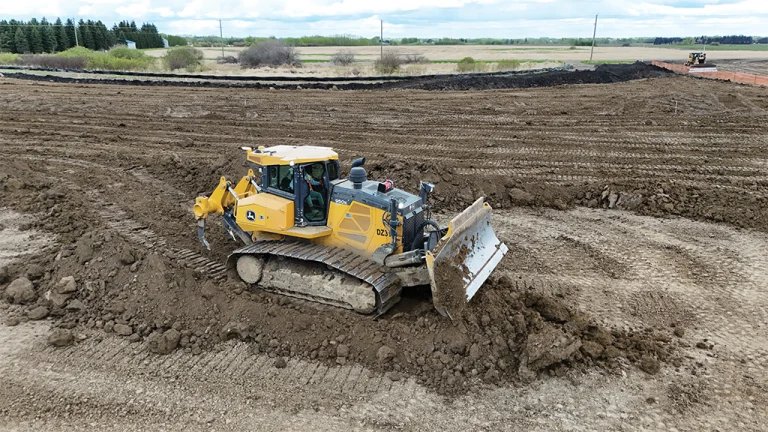
Machine control saves on survey costs, rework, materials, equipment hours, wear and tear on machines, and fuel cost.
Brandt
How machine control technology works
The process begins with satellites that triangulate to create a digital map of the construction site. GNSS antennas mounted on the machine receive signals from these satellites to determine the equipment’s exact position relative to the digital map with centimetre accuracy.
Contractors need a corrected GNSS signal, which is transmitted from a base station set up on site or a virtual network, which receives the GPS signals, corrects them to achieve survey-grade accuracy, and broadcasts them to the machine.
In the office, detailed 3D models are created to show the design surface, elevations, slopes, alignments, and any other project elements. The models are uploaded to the machine’s onboard computer to provide a complete digital blueprint of what needs to be built.
The 3D system compares the machine’s current position and the location of its attachment, such as a bucket or blade, to the target design surface stored in the 3D model. The system then displays visual guidance on the cab screen showing how much to cut or fill or automatically adjusts the attachment hydraulics to match the design grade exactly. Operators see real-time information that shows whether they’re on grade or if they’re cutting too deep or not deep enough. As the machine moves across the site, the system makes micro-adjustments constantly, ensuring the finished surface matches the engineered design specifications on the first pass.
“The 3D machine control puts the machine on grade every time,” says Hendriks. “The machine does the rough digging in manual mode, and then on the last pass, the machine takes control for absolute accuracy and brings it to grade down to the centimetre.”
Another benefit to using this technology is it records as-built elevations that accurately document the as-constructed project. These are useful for proof of completion, legal protection, maintenance, and future builds.
Junior operators achieve quality results
It’s no secret that the construction industry is facing a significant and growing shortage of skilled operators, a challenge that is reshaping how companies approach workforce planning and technology adoption. Fortunately, machine control technology can help.
“In Alberta, skilled, experienced operators are getting harder to find. Using machine control gives us the opportunity to get a more junior operator to run the equipment,” Kent says. “It also increases our efficiency and reduces costs, time on site, fuel, and machine wear.”
Liorti appreciates that machine control empowers Metric to maximize productivity. “With labour shortages and tighter schedules becoming the norm, we need to make the most of every hour on site. Machine control allows us to do more with the same crews while improving accuracy and consistency across our projects.”
There is also less dependence on surveyors with machine control technology, which allows companies to reallocate resources. “You get more out of your active fleet of workers. For an experienced operator it makes their job easier, and for a newer operator it makes them more productive,” says Hendriks. “It’s also safer to have the machine doing the work rather than having someone in a trench directing operations.”
It benefits the operators themselves. “Early adoption of technology allows our operators to grow their skill sets and gives us an advantage when bidding complex projects that demand accuracy and speed,” says Liorti.
And it helps with recruitment. “If you’re at the cutting edge of technology, you’re going to attract new workers much easier,” says Hendricks.
Read the full article here