

Snow Blades vs. Material Handling Buckets: How Wheel Loader Attachments Stack Up
The contemporary construction and maintenance sectors revolve around flexibility, and that is vividly illustrated through the adroit utilization of wheel loader attachments in this case. Machinery users who operate powerful equipments like the Typhon Machinery line or other top brands in the industry. The operational efficiency, fuel consumption as well as safety at work will be very much impacted by the choice between specific —specifically Snow Blades and Material Handling Buckets.
Thus reaping the benefit of enabling a single machine to switch from summer earthmoving to winter snow clearing- that is one of the main keys to their profits. Our recent article Top 6 Must-Have Roller Compactor Attachments in 2025 stressed that knowing how each tool is differently engineered is the first step towards getting the most out of your fleet. Basically, a bucket is the everyday tool for loading, while a snow blade with its specialized design could bring you more benefits in winter times.
This thorough comparison of the two discusses their technical differences, performance indicators as well as most appropriate scenarios for use and also helps you to make the right purchase decision.
The Engineering Behind Snow Blades
Snow blades are specialized wheel loader attachments that are made for one thing only: fast and efficient, high-volume snow removal. If you compare them to buckets, these are the tools that would scoop up and carry the load.
However, snow blades using a moldboard design roll the snow forward and to the side, thus momentum is preserved and less power is required from the engine to keep the same speed of the clearing machine. The operator can, therefore, clear continuously without having to stop and throw away snow which is normally the case when using buckets.
The high-grade snow blades come with features designed to be safe such as the trip-edge mechanism which allows the bottom edge of the blade to fold back once the blade hits an immovable object (e.g. manhole cover or curb).
Hence, the attachment as well as the loader’s hydraulic system get protected from shock damages and this is hardly seen in standard material handling buckets. Besides that, the separate “rolling” movement of a blade also keeps the snow from becoming a hard lump which is a common problem when wet snow is pushed by a static bucket.
- Optimized Geometry: The moldboard that is curved facilitates the snow’s rolling motion that is continuous, and this significantly contributes to the clearing speed as compared to the push-and-stop method of buckets.
- Safety Mechanisms: Built-in trip-edge or trip-moldboard systems soften the impact from hidden obstacles, thus protecting the operator and the machine’s structural integrity.
- Surface Preservation: A lot of snow blades are equipped with adjustable skid shoes or rubber cutting edges that run smoothly over the pavement, thus the gouging and scratching which are normally caused by bucket steel teeth are avoided.
The Versatility of Material Handling Buckets
Material Handling Buckets are called “Swiss Army Knife” of wheel loader attachments for their ability to deliver the utmost utility in every season and across all kinds of situations. They just don’t match the snow blade’s ability in terms of winter speed but then what they can do in scooping, lifting and stacking is almost without parallel in case of some other jobs especially during winter.
One can say that with a bucket snowpicks can be completely removed from the site whereas with a blade just pushing limits the snow to the periphery which becomes more significant in case of spatially constrained sites where piled snow will get in the way of the traffic or obstruct the visibility.
And besides the operational efficiency must you not forget that these buckets will still be able to take care of soil, gravel, and demolition debris quite competently thus your investment continues to work for you in the summer. In “Grapple Buckets and Wheel Loader Fork Attachments” articles, we have talked about how the all-purpose bucket can very well be the first attachment bought mainly because of this feature.
However, the thing with snow usage is that they are not able to hold as much as a blade does and thus “spillage trails” generally appear on both sides of the loader path and to make it perfectly clear you have to do the last run a couple of times.
- Vertical Stacking Capability: With buckets, operators are able to lift snow up to a considerable height and thereby pile it in a compact manner thus efficiently utilizing the limited space that is available in the lot or the city.
- Multi-Season Utility: Material handling buckets give an opportunity to the users for a continued return on investment as they are handling dirt, gravel, and mulch while snow blades are only used in winter and remain inactive during the rest of the year.
- Structural Robustness: Engineered for high breakout force, these buckets can break frozen ice banks and packed hard drifts that may be too harsh on a snow blade of lighter-duty.
Operational Efficiency: Speed vs. Precision
Placing these two wheel loader attachments in a line and seeing them defy each other, we find the main difference lies in their operation flow. Snow blades have the edge over buckets in “pass completion time.”
Because of its angled feature, a snow blade flake keeps the snow on the side with the windrow so the loader can keep moving at the same speed in a constant forward motion. The same clearing can be done in a large lot in a way that the loader works as a conveyor belt moving the snow from the center to the edge in the most efficient manner.
But material handling buckets don’t just “push and scoop”; you also have to include the lifter and dumper in the mix. This way of operation is much slower and there is the cost of higher fuel consumption since you constantly use the hydraulics for lifting and dumping heavy loads.
However, this bucket is a specialist in precision. To remove snow from a loading dock area specifically or a corner that is hardly accessible or to ferry snow out to a dump truck, the blade loses its efficiency. Bucket can exactly move snow whichever way you want though the speed is slower.
- Cycle Time Reduction: Thanks to the removal of the lift-and-dump cycle, snow blades can clean an open area up to 30% faster than buckets.
- Fuel Economy: The uninterrupted forward movement with a blade results in a better fuel efficiency compared to the high-RPM, stop-and-go nature of bucket use.
- Containment Issues: Material handling buckets lose a lot of the material off the sides during extended pushing due to spillover but, on the other hand, blades are able to tightly contain the material.
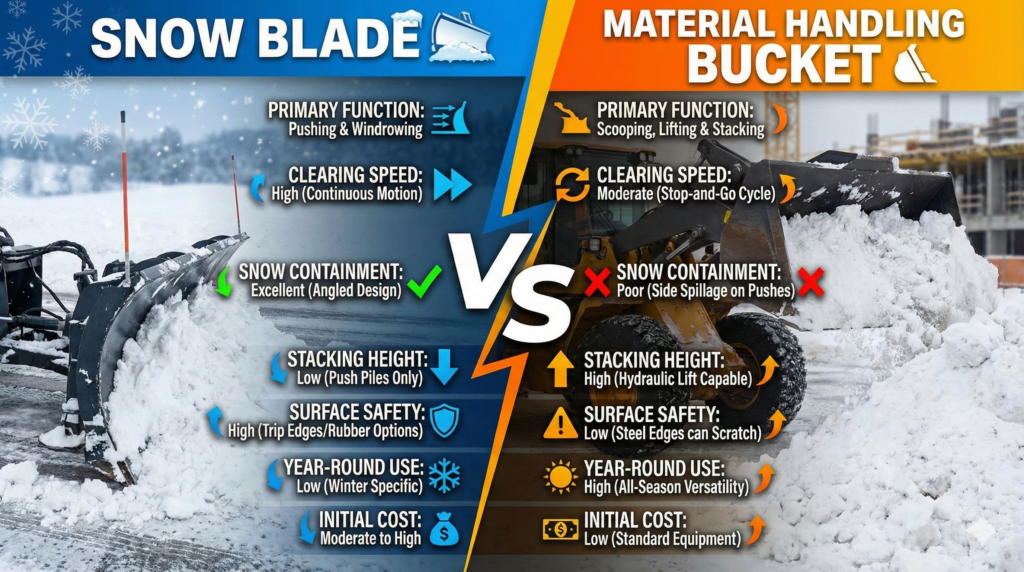
Comparative Analysis of Wheel Loader Attachments – Snow Blades vs. Material Handling Buckets
| Feature | Snow Blade | Material Handling Bucket |
| Primary Function | Pushing & Windrowing | Scooping, Lifting & Stacking |
| Clearing Speed | High (Continuous Motion) | Moderate (Stop-and-Go Cycle) |
| Snow Containment | Excellent (Angled Design) | Poor (Side Spillage on Pushes) |
| Stacking Height | Low (Push Piles Only) | High (Hydraulic Lift Capable) |
| Surface Safety | High (Trip Edges/Rubber Options) | Low (Steel Edges can Scratch) |
| Year-Round Use | Low (Winter Specific) | High (All-Season Versatility) |
| Initial Cost | Moderate to High | Low (Standard Equipment) |
Financial Considerations and ROI
When you acquire a special wheel loader attachments like a snow blade, you really make a significant investment which the extent of profitability has to be measured by how much work you actually do.
A contractor who has secured the commercial contracts for a huge parking lot or a long stretch of the road, will benefit from the saved time which in turn will correspond to the saved labor and increased number of contract-takings per snow event. Less shuttling of the bucket with its resultant wear and tear of the transmission will add another layer of savings to the total cost over time.
Nevertheless, for the small operators or even the seasonal ones that don’t deal with snow often enough, material handling bucket remains the viable and cheap solution in that it won’t compel you to purchase a new equipment and though it is slower, it gets the job done without demanding specialized maintenance.
A good quality bucket e.g. one that fits Typhon Machinery perfectly, can endure all the harshness of winter work as well as the winter abrasion and if it is used on asphalt, it might require more frequent cutting-edge change. In the end, the return on investment rests on the number of hours spent shoveling from the top of the mask; the high number of hours means a blade is necessary while the low number of hours makes the bucket versatile and therefore favorable.
- Maintenance Costs: Snow blades need to be maintained hydraulically (for angling) and their springs should also be changed from time to time, whereas buckets that have less components to move need less attention.
- Labor Savings: Blade’s faster speed can decrease the operator’s overtime hours drastically in case of major storms.
- Asset Utilization: A bucket can be considered a 12-month asset whereas a snow blade has to be seen as a 3-4 month asset, hence depreciation calculations have to be done carefully.
Site Conditions and Surface Damage Risks
The nature of the surface being cleared by far is the most important factor for deciding between these wheel loader attachments.
Snow blades are generally more compatible with smooth surfaces such as pavement as they can even be fitted with polyurethane or rubber cutting edges making them able to simply squeegee the surface without damaging seal coats or decorative pavers.
On the other hand, buckets often come with hardened steel cutting edges or teeth that are actually intended for digging the earth. However, when these steel edges go along the asphalt or concrete, the result is now significant gouging, scratch marks and joint sealant damage.
Conversely, for gravel surfaces, a bucket can be beneficial if the operator uses a “float” technique whereas a heavy blade might create such a huge dent in the ground that the displaced gravel would actually be thrown out onto the lawn. Advanced snow blades nowadays come with “float” positions and skid shoes to alleviate this problem, but the risk of surface damage is still greater with a standard digging bucket.
- Pavement Protection: Rubber-edged blades are crucial for commercial parking lots and decorative driveways that have to be protected from steel scratches.
- Obstacle Navigation: Trip edges on blades make it possible for the blade to clear uneven expansion joints, manholes, and curbs without shaking the operator, the loader, or the blade which would happen with a rigid bucket.
- Gravel Management: Buckets need to be operated carefully, or else the gravel will be stripped, whereas blades can be equipped with skid shoes and, thus, table over the top layer of the gravel.
Frequently Asked Questions – Snow Blades vs. Material Handling Buckets
Which one is better for gravel driveways: snow blade or bucket?
Generally speaking, a snow blade with adjustable skid shoes is the better choice for gravel driveways. The skid shoes lift the blade a bit, so it won’t gouge the loose stones. A bucket is more likely to take gravel with snow unless the operator is stepping up to “float” the bucket and keeping the bucket above the gravel surface.
Is it possible to use a material handling bucket for heavy snow removal?
Sure you can. Material handling bucket can be used, however, if you got it for a large area, it would be less efficient. Buckets are good for snowpiling or clearing tight spots where you have to lift and dump the snow. If you use a bucket for pushing snow on a large lot, there will be a lot of spillage and you have to do multiple passes.
What is the feature that primarily makes a snow pusher better than a standard bucket?
The major reason for using snow pushers (over a standard bucket) is their containment. Side panels that close off a snow pusher (or box plow) keep the snow from spilling out, therefore you can move much more snow in a single pass than a standard bucket.
Do snow blades cause damage to asphalt or concrete surfaces?
Generally, the usual steel edges are capable of scratching the surfaces, but nowadays, most snow blades come with rubber or polyurethane cutting edges which are specifically made to protect asphalt and concrete. Buckets, however, usually have steel edges for digging and thus the risk of causing surface damage is higher with them.
What does a “trip edge” feature do on a snow blade?
Basically, a trip edge allows a portion at the bottom of the blade to fold back against a spring mechanism when it hits a solid obstacle, say a curb or a manhole cover. This plays the role of impact absorber and thus the operator, the loader, and the attachment are all protected from damages in this way. Normally, buckets don’t have this kind of safety feature.
If I already have a bucket, is it still worth buying a snow blade?
If you do a lot of commercial space clearing and have big areas to take care of the investment will most probably pay off because of the time you save. A snow blade can clear up to 30-50% faster than a bucket. On the other hand, a standard bucket will most likely work fine for the house or the occasional use.
Am I able to create high snow piles with a snow blade?
The answer is no. Snow blades are meant for pushing only. However, you may push snow into a pile but you don’t have the ability to vertically stack high. If you wish to build up snow banks high or even load snow onto dump trucks, it would be a material handling bucket that would do the job.
Conclusion: Snow Blades vs. Material Handling Buckets
At the end of the day, the Snow Blades versus Material Handling Buckets discussion largely revolves around your specific job site condition as well as the business operational goals. So for the case where the commercial contract is basically moving a huge volume of snow quickly on a large open paved area while at the same time minimizing surface damage, the snow blade specialized features will win hands down.
It can not only windrow snow but also protect the substrate which makes it the professional’s choice for commercial snow management. On the other hand, the material handling bucket champions versatility and therefore could be your choice of equipment if you also need to do non-winter tasks like digging, stacking and loading all year-round.
An advanced fleet, say running on Typhon Machinery robust platforms, would ideally have both wheel loader attachments available to handle any winter challenge. In this way, heavy equipment can always run at its peak performance level no matter what is the weather, simply by playing smart with its strengths and weaknesses, as our guide on Maximizing Efficiency and Productivity reveals.