

Gravis Robotics has raised $200 million during its Series A funding round backed by SoftBank. The funding will accelerate Gravis’s mission in physical AI — scaling autonomous heavy machinery across job sites globally.
Global infrastructure is in the middle of a massive expansion. Scaling the energy networks and data centres required for the AI economy is driving unprecedented demand, and the need for housing, transit, and climate-resilient infrastructure is equally urgent. Across every sector, construction has become the primary bottleneck, and we cannot reshape the physical world fast enough to keep up with demand. That shortfall stems from a severe labour crisis, but fixing it isn’t just about hiring more people — it requires augmenting the workforce through automation. Heavy construction remains one of the least automated major industries in the world, still run largely on machines that operate similarly to how they did 50 years ago.
Building the future requires deep tech to solve a major challenge: translating advanced artificial intelligence into precise, real-world execution.
How Gravis Robotics’ autonomous equipment offers specialized solutions for construction
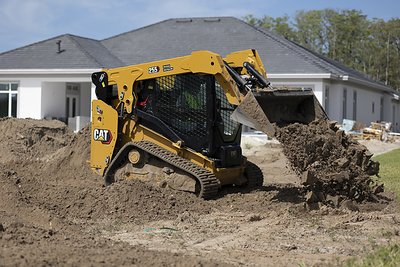
Most physical AI operates in static worlds. Self-driving cars steer around obstacles on smooth pavement, while humanoids and robotic arms move objects across fixed countertops or warehouse floors — leaving their surroundings completely undisturbed. But heavy equipment operates much differently. It often intentionally crashes into the environment, breaking apart soil with hidden rocks and reshaping the earth.
AI doesn’t just find a clear path through a static world; it actively takes that world apart and puts it back together. Gravis Robotics intends to solve this challenge with models enriched by vast simulated experiences and that efficiently bridge the sim-to-real gap.
This synthetic training lets Gravis Robotics move billions of cubic yards of virtual earth — from soft clay to rock-filled soil — and enables its software to bring factory-floor precision to historically unpredictable civil jobsites. Rather than simply imitating individual operators, its AI world model incorporates the distinct performance characteristics of a wide range of manufacturers, making it generalizable and adaptable in a way single-machine systems can’t match.
Dominic Jud, CTO and co-founder of Gravis Robotics, says that “Skilled operators read the earth through subtle physical feedback — listening to the engine strain, sensing the machine vibration, and reacting to hydraulic resistance. Our AI takes that same physical input and grounds it in machine telemetry, responding to varying subterranean forces and soil mechanics at microsecond speeds. We didn’t try to simplify the world for our software; we gave it the physical intuition to handle real job sites with precision that goes beyond what any human can feel from inside the cab”
Read the full article here