


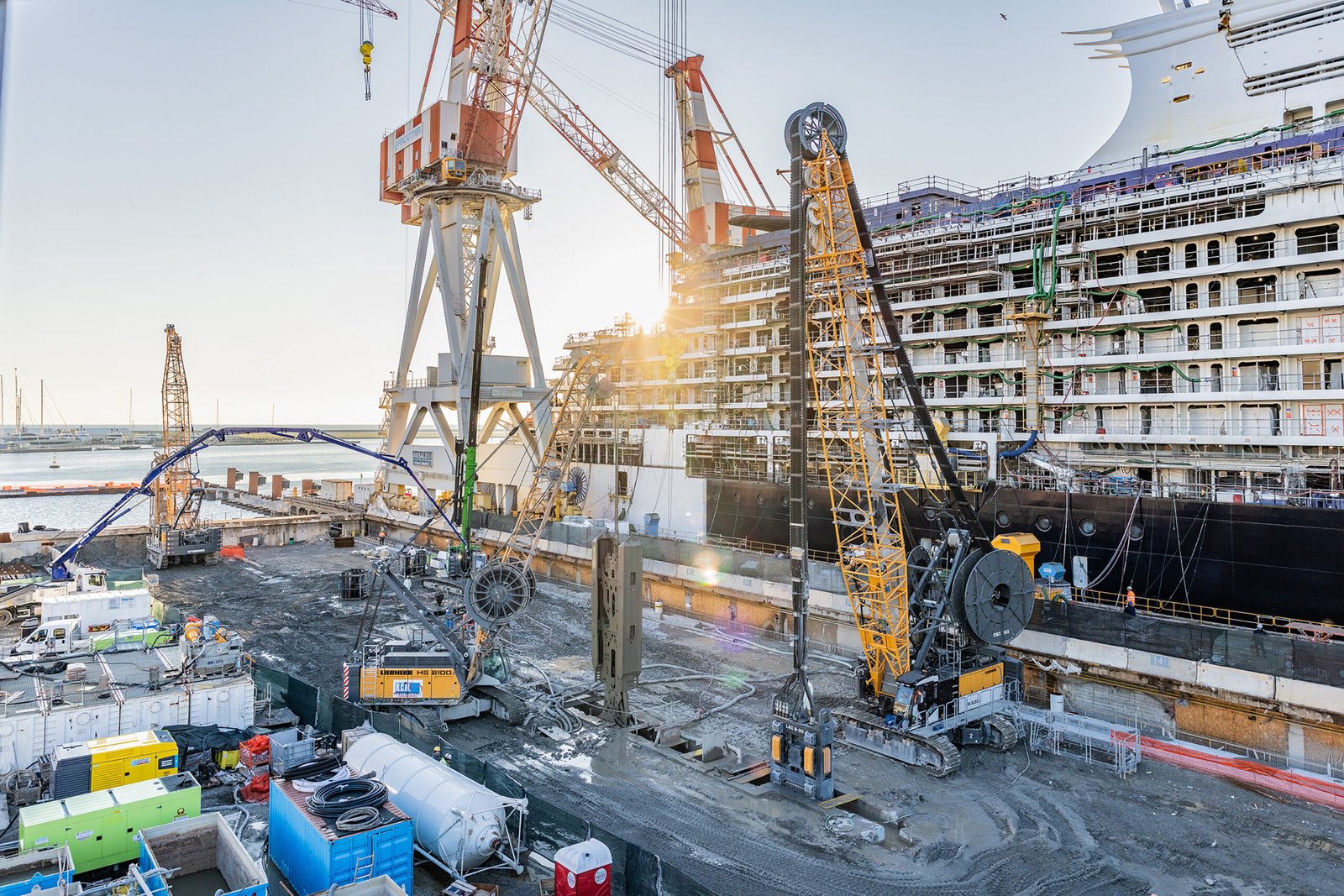
The construction of Genoa’s new large dry dock for cruise ships is one of Italy’s key maritime infrastructure projects. For the special foundation works, R.C.M. Costruzioni srl is using three Liebherr duty cycle crawler cranes to build slurry walls: one HS 8100.1 with an HSG 5-18 L hydraulic grab, and two HS 8130.1 units equipped respectively with a mechanical grab and an LSC 8-20 slurry wall cutter.
What makes the work particularly demanding is the presence of steel reinforcement inside the quay wall, an obstacle that puts the excavation capacity, precision and durability of the deep foundation machines to the test.
The maritime infrastructure project involves the construction of several slurry walls, with different characteristics depending on their structural function. Some elements will be load-bearing, others non-load-bearing, and will therefore vary in depth and width. However, they all share the same operational challenge: in the port area, the existing foundations are made of reinforced concrete and contain a significant amount of steel, making excavation particularly complex.
This makes it especially important for the Italian company R.C.M. Costruzioni srl to use powerful machines capable of penetrating these soil layers.
“We have been relying on Liebherr for many years. In this case, we are using a large-dimensioned slurry wall cutter to speed up the construction process,”
Said site manager Leoncio Fortunato.
In this context, the high torque of the cutter wheels becomes a decisive factor in overcoming the most severe excavation conditions. For the customer, an additional element of security is the possibility to test and verify the cutter’s performance in advance on the test stand at Liebherr’s plant in Nenzing.
R.C.M. Costruzioni srl is using the Liebherr LSC 8-20 cutter for work down to a depth of 10 metres. The model, presented to the market at Bauma, is finding its first operational application in Genoa.
“The slurry wall cutter is extremely powerful and reliable. It has a high cutting force and enables an even and efficient excavation without excessive loads,”
Explained Manuel Dazzi, operator of the cutting machine.
For the subsequent excavation phases, two duty cycle crawler cranes equipped with slurry wall grabs are also being used: the HS 8100.1 with the HSG 5-18 hydraulic grab and the HS 8130.1 with a mechanical grab. In this application, excavation reaches a depth of 34 metres, down to the stable clay layer required to ensure the proper anchoring of the slurry walls.
The Liebherr cutter and hydraulic grab feature a modular design, allowing them to be adapted to the different operational requirements of the jobsite. Their robust base body, high weight and low centre of gravity help improve verticality during excavation, a key parameter when constructing large slurry walls and working in complex geological conditions such as those found at the Genoa dry dock site.
Collaboration Between Liebherr and the Construction Company
The three Liebherr duty cycle crawler cranes provide continuity across different jobsite applications and in day-to-day operation by the machine operators. The machines share the same cab concept, with similar control levers and monitors. This makes it easier to switch from one machine to another, reduces familiarisation time and supports greater productivity across the various work phases.
“The decisive factors for choosing the machines were their high performance, reliability and comprehensive maintenance service, as well as the technical advice provided by Liebherr during the planning and realisation of the individual construction phases. This contributes significantly to the successful and timely realisation of the construction work on the quay,”
Said site manager Leoncio Fortunato.
R.C.M. Costruzioni srl started the work in 2023 and is expected to complete the project in 2026.
Read the full article here