

Mammoet has incorporated locally as Japan lines up offshore wind, nuclear and energy projects that need heavy lift capacity on the ground
Mammoet has worked in Japan for more than three decades. What it has not had until now is a Japanese company, and in a market where that distinction shapes who gets invited to bid, the difference is not administrative.
Mammoet Japan K.K. is a locally incorporated operating company, established in line with Japanese business practice and project requirements. It gives the Dutch heavy lift contractor a local structure for conducting business and delivering work while keeping access to the group’s global engineering and equipment fleet.
Why now
The timing follows the work. Japan is advancing offshore wind, nuclear power, energy and infrastructure projects at a scale that makes specialist lifting and transport capability a scheduling constraint rather than a procurement detail. Super heavy lift ring cranes, specialised transport, and high-capacity jacking and skidding systems are not equipment a contractor sources at short notice.
Under the new structure, customers in Japan reach those capabilities directly, with equipment mobilised from the global fleet according to what each project needs. That is the practical model for heavy lift: the entity is local, the iron travels.
The track record it builds on
Mammoet’s Japanese history runs through the expansion of the Showa Yokkaichi Oil Refinery, where the company provided a specialist gantry lifting solution for 1,100-tonne reactor vessels. More recent work includes engineering studies supporting Akita-Noshiro Offshore Wind, Japan’s first large-scale offshore wind farm, and deployment of the PTC 35 super heavy lift ring crane on a floating offshore wind demonstration project in Fukushima.
Floating offshore wind is the thread worth following. Japan’s waters get deep quickly, which pushes the country towards floating foundations rather than the fixed monopiles that dominate the North Sea. Floating changes the lifting problem: more assembly happens quayside, at heights and weights that put ring cranes and skidding systems at the centre of the schedule.
Who runs it
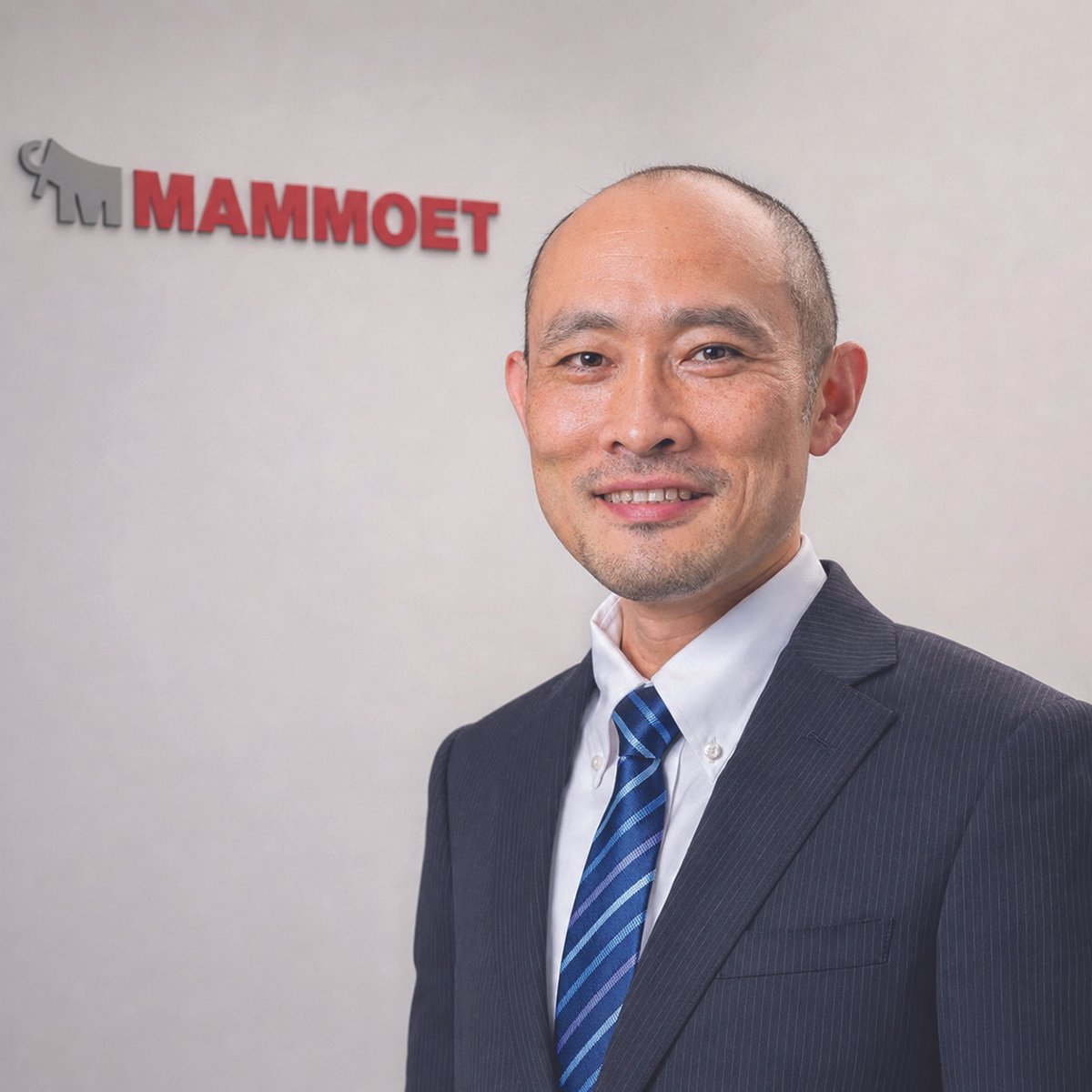
Mammoet Japan K.K. is led by Representative Director Yusuke Kakinuma, who brings more than 20 years of management, heavy lift engineering and project delivery experience gained in Japan and internationally.
“Our ambition is to build Mammoet Japan into a trusted local partner that contributes to the growth of Japan’s energy and industrial sectors,” said Kakinuma. “For customers, the new Japanese entity provides a stronger local execution platform with access to Mammoet’s full range of heavy lifting and transport capabilities. This will allow us to build local capacity, respond more effectively to project needs and reduce execution risk, while delivering work safely and in accordance with Japanese requirements.”
“Japan is an important long-term market for Mammoet,” said Jack van den Brink, Managing Director of Mammoet Projects AMEA. “Mammoet Japan K.K. reflects our commitment to building a lasting presence in the country and provides the foundation to grow alongside Japan’s offshore wind, nuclear, energy and infrastructure sectors.”
What it signals
For contractors and developers working in Japan, an international heavy lift specialist incorporating locally usually means it expects sustained work rather than project-by-project mobilisation. Building local capacity, as Kakinuma puts it, means hiring and training people in-country, which is a slower and more committed move than flying in a project team.
For the wider lifting market it is another data point in the same direction: the growth in super heavy lift is coming from energy transition infrastructure, and the contractors positioning for it are doing so where the projects are, not where their headquarters is.
Read the full article here