

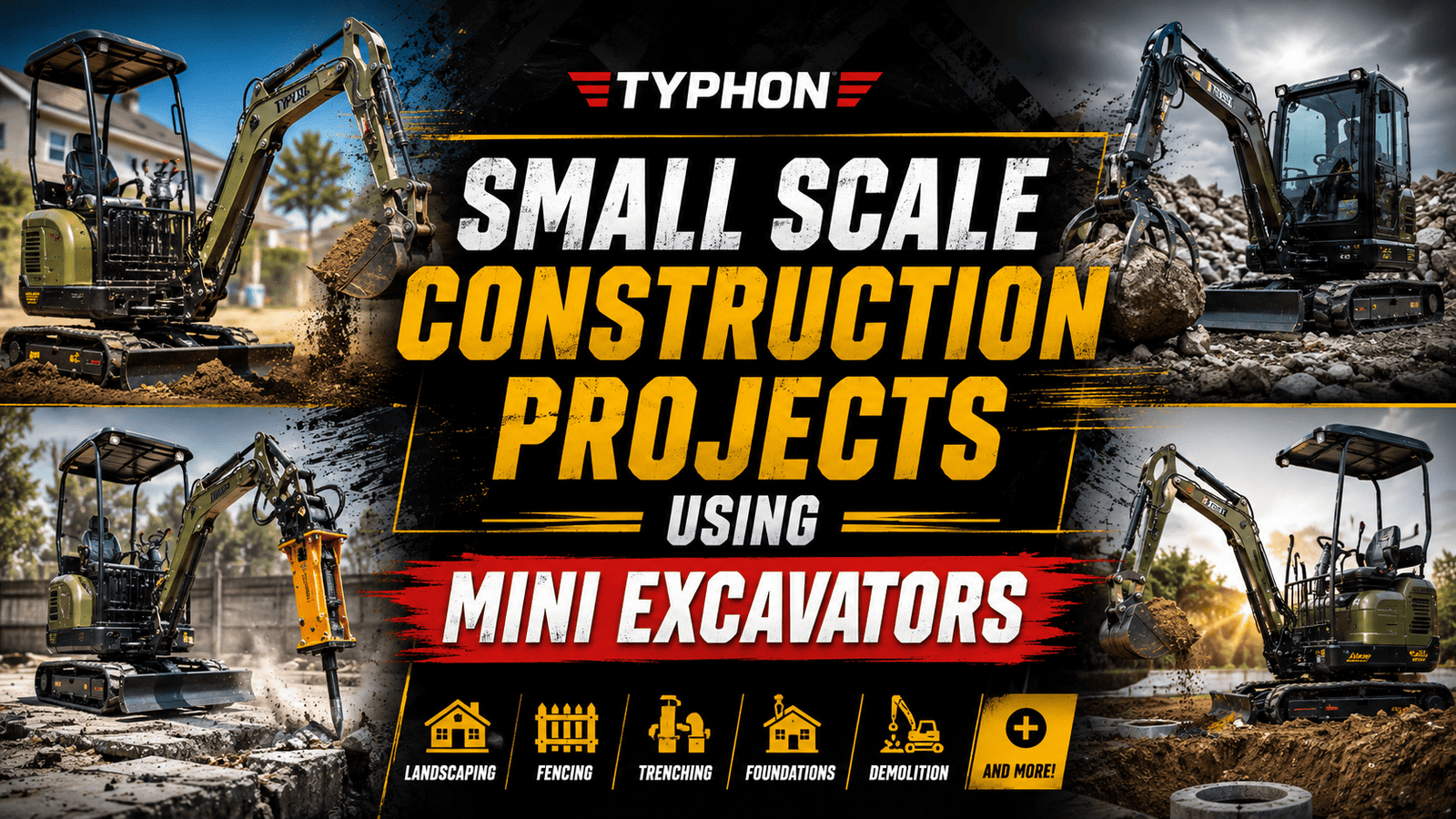
Small Scale Construction Projects Using Mini Excavators: The Complete Industry Guide
There’s a reason mini excavators are among the most popular pieces of equipment on job sites across the United States. Walk into any residential subdivision under development, any rural farm where irrigation lines are being laid, or any neighborhood utility corridor getting new waterline work—and you’ll almost certainly find a compact excavator doing the heavy lifting.
Small-scale construction projects using mini excavators have grown from a niche workaround into the standard operating procedure for thousands of contractors, landscapers, farmers, and municipal crews.
And honestly? It makes complete sense once you understand what these machines actually offer.
A full-size excavator is built for volume—moving massive quantities of earth as fast as mechanically possible. But most real-world projects don’t need that. What they need is controlled digging in a confined space, the ability to move from one small site to the next without a dedicated lowboy trailer, and a machine that won’t tear up a finished driveway or compact a lawn beyond recovery.
Mini excavators solve all of that without compromise. They’re fuel-efficient, attachment-versatile, operator-friendly, and—critically—small enough to fit through a standard gate opening.
This guide covers every major application category, every attachment worth knowing about, what to actually look for when choosing a machine, and how to keep it running reliably for years. Whether you’re a contractor evaluating your first purchase, an owner-operator looking to expand capabilities, or a farm manager trying to reduce hired equipment costs—everything you need is here.
Why Small-Scale Construction Projects Using Mini Excavators Just Makes Sense
Let’s set the context properly before diving into specific applications.
The compact excavator market has exploded over the past decade—and not by accident. Equipment manufacturers started responding to real demand from contractors who were tired of turning down smaller residential and utility jobs because their equipment was too large, too expensive to mobilize, and too risky to operate near existing structures. The mini excavator filled that gap perfectly.
What makes them uniquely suited to small-scale work:
- They weigh between 1 and 10 tons depending on class, meaning they can be transported on a standard bumper-pull trailer without special hauling permits
- Ground pressure from rubber tracks is low enough to avoid damaging finished concrete, pavers, or established turf
- Zero-tail-swing configurations allow full upper-body rotation in spaces where there’s literally no room to swing a counterweight
- Auxiliary hydraulic circuits support a broad range of attachments — from augers and breakers to grapples and tilting buckets
- Operating costs run significantly lower than larger machines on a per-hour basis
None of this means mini excavators are toys. A well-spec’d machine in the 5–8 ton class can dig to 13 feet, generate serious breakout force, and move through hundreds of tons of material in a single workday. The “mini” label is about physical footprint, not capability.
Industry Insight: According to rental industry data, mini excavators consistently rank as one of the top three most rented pieces of construction equipment in the U.S. — year after year. That demand isn’t coming from hobbyists. It’s coming from working contractors who need reliable compact performance on real job sites.
1. Residential Building Foundations
This is one of the most demanding and most rewarding applications for compact excavation equipment. Residential foundation work is time-sensitive, precision-dependent, and almost always performed in spaces where full-size machinery either can’t fit or can’t operate safely.
Site Preparation Before the First Dig
Before any trench gets cut or any soil gets moved, the site needs to be stripped, graded, and staged properly. For residential lots — especially in established neighborhoods or tight infill developments — that prep work involves clearing vegetation, pulling stumps, stripping topsoil, and establishing rough grade lines. Mini excavators handle this efficiently without the need for a separate bulldozer or skid steer on smaller sites.
The key advantage at this stage is maneuverability. On a 60-foot-wide residential lot with neighboring homes on both sides and a narrow street access point, a compact machine can set up and start working in less time than it takes to mobilize larger equipment to the property line.
Typical site prep tasks mini excavators handle:
- Topsoil stripping to a consistent depth
- Stump and root ball removal using the bucket or a grapple attachment
- Rough grading prior to layout
- Stockpiling material in designated spoil areas away from the dig zone
Foundation Trenching — Precision Where It Counts
Strip footings require straight, consistent trenches cut to exact dimensions. Over-digging means additional concrete, additional cost, and extra backfill and compaction work later. Under-digging means re-cutting — which wastes time and risks disturbing surrounding soil unnecessarily.
Experienced mini excavator operators can cut foundation trenches with a level of accuracy that genuinely reduces concrete overrun. Combined with a laser level or grade stakes, the machine can hold depth within an inch across long trench runs — which is exactly what residential builders need.
What to look for in a machine for foundation trenching:
- Digging depth of at least 10 feet to handle most residential footing requirements
- Strong bucket crowd force for clean cuts in compacted clay or mixed soils
- Boom offset capability for working parallel to existing structures
Basement Excavation in Tight Residential Spaces
Basement work is where compact excavators earn their keep the most dramatically. A full basement on a standard residential lot requires moving hundreds of cubic yards of soil — but it needs to happen within the footprint of the foundation walls, often with the neighboring home just feet away on either side.
Mini excavators in the 6–10 ton range are ideal for this. They can be driven into the excavation as it deepens, work in staged passes, and load material directly into trucks staged in the driveway. The reduced track width means they don’t require the kind of working room that larger machines demand.
Real-World Note: Many residential basement excavations in urban infill markets are now completed exclusively with compact equipment — not because contractors prefer it, but because it’s the only realistic option given site constraints and local ordinances around equipment size on residential streets.
Benefits Over Larger Machines for Residential Work
| Factor | Mini Excavator | Full-Size Excavator |
| Transport | Standard trailer, pickup truck | Lowboy, CDL driver, permits |
| Ground Pressure | Low — safe on turf and pavement | High — damages finished surfaces |
| Working Radius | Fits through 36-inch gates | Requires wide open access |
| Noise | Relatively low | Significantly louder |
| Fuel Cost | 2–5 gal/hr | 6–15 gal/hr |
| Setup Time | 15–30 minutes | 1–2+ hours |
2. Pool and Pond Construction
Backyard excavation for pools and decorative ponds is one of the fastest-growing mini excavator applications in the residential landscaping market. Homeowners are investing more in outdoor living spaces, and that means demand for precisely excavated water features is climbing steadily.
Backyard Pool Excavation — Efficiency Without the Damage
A standard residential pool — say a 16-by-32-foot rectangle with an attached spa — requires removing somewhere between 200 and 350 cubic yards of soil depending on depth. That’s real excavation volume. But it needs to happen in a typical suburban backyard where there’s usually a fence, a patio slab, existing landscaping, and a lawn the homeowner wants to preserve on three sides.
Mini excavators are ideal because:
- Access — most machines under 6 feet wide can fit through a standard double gate without fence removal
- Controlled digging — operators can work to the exact pool shell dimensions without over-excavating into areas where the soil structure matters
- Material handling — spoil can be loaded into mini dump trucks or conveyor systems that fit through the same gate opening, keeping the entire operation contained
Pond Shaping — Where Art Meets Engineering
Decorative pond excavation is a different challenge from pool work. Ponds need natural-looking contoured edges, variable depth zones, sloped banks that allow aquatic plantings, and transitions that blend with surrounding lawn and garden beds. None of that can be done effectively with a machine that doesn’t respond well to fine inputs.
This is where a well-calibrated mini excavator outperforms any alternative:
- Tilting bucket attachments allow operators to carve sloped banks at consistent angles without repositioning the machine
- The ability to feather the hydraulic controls in fine increments gives experienced operators the precision to shape curved edges that look organic rather than mechanically cut
- Reach geometry on most mini excavators allows the operator to work from the pond perimeter rather than from within the excavated area, protecting the shaped surfaces
Key tip for pond excavation contractors: Work from the perimeter inward and save the final shaping passes for last. Driving the machine across partially shaped pond bottoms compresses soil and creates uneven settling later — especially in clay-heavy soils.
Landscaping Integration After the Dig
Pool and pond projects almost never end at the waterline. The excavated spoil has to go somewhere useful — or be hauled off. In residential settings, contractors often use the spoil to build raised garden beds, create berms behind the pond feature, or backfill low areas in the surrounding lawn. Mini excavators with grading buckets can handle all of that material redistribution without bringing a second machine onto the property.
3. Utility and Pipeline Installation
If there’s one application where compact excavator projects generate consistent, repeatable demand for working contractors, it’s utility trenching. Water lines, sewer laterals, electrical conduit, fiber optic cables, gas distribution lines — all of them go underground, and virtually all of them in residential and light commercial settings get installed in trenches cut by compact equipment.
The Mechanics of a Good Utility Trench
A utility trench sounds simple — dig a ditch, lay the pipe, cover it up. In reality, the consistency of the trench directly affects the performance and longevity of whatever gets installed in it. A water line with inconsistent bedding depth will develop stress cracks at pressure differentials. An electrical conduit installed in a trench with variable depth may not meet local inspection requirements. Getting the trench right the first time matters.
Mini excavators produce better utility trenches than manual alternatives because:
- The bucket cuts a consistent width in a single pass
- Depth can be maintained more accurately using depth indicators or laser grade systems
- The spoil gets placed in a controlled pile beside the trench rather than scattered
- Backfilling and compaction happens faster because the machine handles material placement
Water Line Installation
Residential water service lines typically require trenches 18 to 48 inches deep, depending on local frost depth requirements and municipal code. Most mini excavators handle this range in a single bucket configuration with time to spare. Where the compact machine earns its cost is in the productivity rate — an experienced operator on a 3-ton machine can typically open 200 to 400 linear feet of water line trench per day in average soil conditions.
Compare that to manual trenching rates: even with dedicated trench digging crews, hand-cut trenches top out around 50 to 80 linear feet per day in similar conditions. The math on labor cost savings is immediate.
Electrical Conduit and Fiber Optic Runs
Electrical conduit installation through established residential neighborhoods requires working in close proximity to existing underground infrastructure — other utilities that may or may not be accurately located on as-built drawings. This is where mini excavator applications require careful, deliberate technique.
Best practices for working near existing utilities:
- Always call 811 and confirm utility locates before beginning
- Hand-expose any utility within 18 inches of the planned trench centerline before using mechanical equipment nearby
- Use a narrow bucket — 12 inches or less — when trenching in utility-congested corridors
- Maintain ground personnel alongside the machine when working in high-risk areas
Sewer Laterals and Storm Drainage Work
Sewer lateral replacement is one of the highest-demand utility jobs in aging residential markets. Older clay or cast iron laterals fail regularly, and replacing them means cutting through established landscaping, driveways, and yards with minimal additional damage. Mini excavators with vacuum excavation support (using a hydrovac unit working alongside the machine) can expose the existing sewer connection and cut the new trench in a single coordinated operation.
Storm drainage installation — channel drains, catch basins, French drain systems — follows similar logic. The compact machine opens the trench, the crew places the drainage components, and the machine handles backfilling. On a well-organized crew, this can be a remarkably fast operation.
Compact Access Advantage: In many urban and suburban utility projects, the deciding factor in equipment selection isn’t power or capacity — it’s whether the machine can physically access the work area. Mini excavators consistently win utility contracts in dense neighborhoods precisely because they fit where larger machines don’t.
4. Farm and Agricultural Projects
Mini excavators for farming have grown from a convenience into a near-essential tool on small and mid-size agricultural operations across the United States. The combination of compact size, attachment versatility, and transport simplicity makes a 3-to-6-ton machine genuinely useful across a wide range of farm maintenance and improvement tasks.
Irrigation Trenching — The Backbone of Farm Productivity
Irrigation infrastructure is what separates productive land from underperforming land on farms where rainfall is variable or seasonal. Installing mainline and lateral irrigation pipe is labor-intensive work — and doing it efficiently requires consistent trenches at precise depths over long distances.
A mini excavator fitted with a standard digging bucket or a dedicated trenching attachment can cover ground at rates that simply aren’t achievable with manual methods. On open agricultural land without the access constraints of residential projects, a skilled operator can trench 500 to 800 linear feet per day for mainline installation — sometimes more in lighter soils.
Typical irrigation trenching depths:
- Mainline pipe: 24 to 36 inches
- Lateral lines: 12 to 18 inches
- Frost-depth protection zones: up to 48 inches in northern climates
Fence Line Excavation and Post Installation
Fencing is a perpetual maintenance task on most farms — perimeter fences need posts replaced, cross-fencing gets added as grazing management practices change, and new fence lines get installed whenever land use shifts. Mini excavators paired with auger attachments make fence post installation dramatically faster than tractor-mounted or manual post-hole diggers.
Why mini excavators outperform tractor augers for fence work:
- Greater digging depth for large-diameter corner and gate posts
- Better torque management in rocky or root-riddled soils
- Ability to work on steeper terrain than tractor-mounted implements safely allow
- Easier repositioning between holes without the need to raise and lower a three-point hitch
Land Clearing for Agricultural Productivity
Small-scale land clearing — removing brush, clearing hedgerows, pulling fence posts and old infrastructure — is one of those tasks that tends to get postponed indefinitely when the only available tool is manual labor or an oversized machine. A mini excavator with a grapple attachment changes the economics of land clearing completely.
On a typical overgrown field edge or brushy fencerow, an operator with a grapple can clear, pile, and stage material for burning or chipping at a rate that makes economic sense even on relatively small acreages. The machine can also pull stumps in the 12-to-18-inch diameter range directly, removing them from the root zone rather than just cutting them flush.
Small Farm Drainage Systems
Standing water in farm fields is an agricultural productivity problem — it delays planting, drowns root systems, and compacts soils when equipment has to work in wet conditions. Mini excavators can install surface drainage swales, outlet channels, and French drain systems that address these issues systematically.
The process is straightforward: establish grade with a laser level, cut the drainage channel to proper depth and cross-section, install outlet structures where needed, and backfill. On small agricultural drainage projects — one to five acres — a mini excavator handles the entire scope without needing a dedicated drainage contractor or a larger grading machine.
5. Road and Path Maintenance
Rural road maintenance is a chronically underfunded and under-mechanized sector of infrastructure work in most parts of the country. Private road owners, rural counties, farm operations, and parks departments all deal with the same problem: roads and access paths deteriorate continuously, and full-size grading equipment is expensive to mobilize for what are often short, localized repairs.
Rural Road Repair — Right-Sizing the Equipment
The most common rural road maintenance tasks include:
- Ditch recutting — restoring drainage channels that have filled with sediment and vegetation
- Shoulder restoration — pulling material back onto the travel surface after erosion or freeze-thaw displacement
- Culvert cleaning and replacement — removing debris from existing culverts and replacing failed ones
- Surface regrading — addressing rutting, potholes, and surface irregularities in gravel-surfaced roads
A mini excavator can handle all four of these tasks with appropriate attachments and bucket configurations. The machine’s compact maneuverability means it can work from the road shoulder without occupying the full travel lane — an important operational advantage on roads where full closures aren’t practical.
Drainage Ditch Work — The Most Important Maintenance Task Nobody Does Enough Of
Here’s a truth that any rural road engineer or county highway superintendent will confirm: most rural road failures start with drainage failure. When roadside ditches fill with sediment and stop draining properly, water migrates under the road surface and begins undermining the base. The road that looked fine in spring has potholes by fall — not because the surface failed, but because the drainage failed six months earlier.
Mini excavators with cleanup buckets are ideally suited for ditch maintenance work because:
- The cleanup bucket’s flat profile can reestablish the trapezoidal ditch cross-section accurately
- The machine can work continuously along a ditch line without repositioning as frequently as a larger machine would
- Spoil from ditch cleaning can be placed in the road shoulder and leveled in the same operation
- The cost of mobilizing a compact machine for ditch maintenance is low enough that annual or biennial maintenance becomes economically justifiable — rather than deferred until the road fails
Gravel Path Maintenance for Residential and Commercial Properties
Beyond public roads, there’s a substantial market for compact equipment on private gravel driveways, estate access roads, equestrian facility paths, and park walkways. These are all surfaces that require periodic maintenance — regrading, drainage repair, material addition — but rarely justify the mobilization cost of full-size grading equipment.
A mini excavator with a grading bucket or a dedicated blade attachment can reestablish crown, recut edge drainage channels, and dress surface material on a 500-foot private driveway in a few hours. For property owners who have dealt with the cost of calling in a road grader for that kind of work, the value proposition of compact equipment is immediately clear.
The Full Benefits Picture: Why Compact Equipment Wins on Small Projects
It’s worth pausing to look at the complete value picture rather than just the application-specific advantages. The case for mini excavators on small-scale construction isn’t built on any single benefit — it’s built on the combination.
Fuel Efficiency That Actually Moves the Needle
A mini excavator in the 3-to-6-ton range typically burns 2 to 4 gallons of diesel per hour under normal working conditions. A comparable full-size excavator in the 20-ton class burns 8 to 14 gallons per hour. On a 10-hour workday, that’s a fuel cost difference of $80 to $200 — every single day. Over a 20-week working season, that difference compounds into thousands of dollars in operating cost savings that go straight to the bottom line.
Transport That Doesn’t Require a Logistics Operation
One of the most underrated advantages of compact construction machinery is the transport simplicity. Machines under 6 tons can typically travel on a tandem-axle bumper-pull trailer towed by a 3/4-ton pickup truck. No CDL required. No oversize load permit. No pilot car. No advance planning call to the state DOT.
For a contractor handling multiple small jobs per week — moving between residential sites, utility work, and small agricultural projects — that transport flexibility translates directly into more billable hours and lower overhead per job.
Reduced Labor Costs on Every Project
The productivity gap between mechanized excavation and manual labor is enormous — and it shows up on every project invoice. One operator on a compact excavator replaces three to six laborers performing the same work manually. On utility trenching, on foundation work, on drainage installation — the math consistently favors the machine.
Approximate productivity comparison:
- Manual trenching: 50–80 linear feet per day (average conditions)
- Mini excavator trenching: 200–600 linear feet per day (varies by soil and depth)
- Manual post-hole digging: 15–25 holes per day
- Mini excavator with auger: 60–120 holes per day
Lower Operating Costs Over the Machine’s Useful Life
Purchase price is one cost. Operating cost — fuel, maintenance, wear parts, operator time — is the cost that matters over a 5-to-10-year ownership period. Mini excavators are designed for straightforward maintenance. Service intervals are predictable, filters and fluids are standardized, and wear parts like bucket teeth and track components are widely stocked by equipment dealers across the country.
The total cost of ownership for a well-maintained compact excavator, amortized over its useful life, is substantially lower than maintaining an equivalent productive capacity through rental equipment or hired subcontractors.
Attachment Versatility — One Machine, Many Jobs
This is arguably the single most powerful advantage mini excavators bring to small construction businesses. With the right attachment lineup, a single compact machine functions as:
- An excavator (standard bucket)
- A post-hole driller (auger)
- A demolition tool (hydraulic breaker)
- A material handler (grapple)
- A dedicated trencher (trenching attachment)
- A grading machine (grading/cleanup bucket)
That versatility compresses what would otherwise require multiple machines — and multiple mobilization costs — into a single asset that moves with the operator from job to job.
Best Mini Excavator Attachments for Small-Scale Construction Projects
No mini excavator is fully equipped without the right attachments for the work it’s doing. Here’s what actually matters in the field.
Digging and Grading Buckets
The standard digging bucket comes with the machine, but most contractors benefit from having at least two bucket configurations:
Standard digging bucket — for general excavation, trench cutting, and material loading. Select the width based on your most common trench specification — 12-inch, 18-inch, and 24-inch are the most useful widths for utility and foundation work.
Cleanup/grading bucket — wider, flat-bottomed profile for establishing grade, cleaning up trench floors, shaping swales, and backfilling. Every contractor doing foundation or drainage work should have one.
Tilting bucket — hydraulically controlled tilt axis allows the bucket face to rotate independently of the boom. Invaluable for slope work, pond shaping, and drainage channel grading.
Hydraulic Augers
Probably the most impactful attachment investment after a second bucket. An auger converts your excavator into a precision post-hole driller and pier installer. Available in diameters from 4 inches to 36 inches, with extensions for greater depth.
Match auger torque rating to your machine’s auxiliary hydraulic output — an undersized auger on a high-flow machine will be destroyed quickly; an oversized auger on a low-flow machine won’t turn in hard soil.
Hydraulic Breakers
For rock, concrete, heavily compacted caliche, or frozen ground — no other attachment solves the problem as effectively as a hydraulic breaker. A properly matched breaker (matched to the machine’s hydraulic flow and weight class) can fracture material that would otherwise require blasting or specialized subcontract work.
Critical matching note: Breakers must be matched to the excavator’s hydraulic system specifications. An improperly matched breaker can damage the machine’s hydraulic pump in a relatively short operating period. Always confirm compatibility with your equipment dealer before purchase.
Grapples
A hydraulic grapple attachment transforms a mini excavator into a capable material handler for land clearing, brush removal, debris handling, and log management. The ability to grab, sort, and place material without a bucket gives operators significantly more control over material handling operations.
For agricultural and land-clearing applications in particular, a grapple often delivers more value per hour than any other single attachment.
Dedicated Trenching Attachments
While a narrow digging bucket can cut a serviceable trench, a dedicated chain trencher attachment cuts cleaner, narrower trenches at greater consistency over long runs. For utility contractors installing thousands of linear feet of conduit or pipe per year, the investment in a trenching attachment pays back in trench quality and productivity.
Rippers
A single-shank ripper loosens compacted subsoil, fractured rock, and hardpan ahead of bucket work. Running a ripper pass before excavating in difficult soils significantly reduces cycle times and protects bucket edges from premature wear.
How to Choose the Right Mini Excavator for Your Work
There’s no universal right answer here — the right machine depends entirely on what you’re actually doing. Here’s how to think through the decision.
Start With Weight Class
Weight class drives most of the other specs. Here’s a practical breakdown:
Under 2 tons — maximum access flexibility, fits through single gate openings, minimal site disturbance. Best for: landscaping, small utility work, pond shaping, sites with severe access restrictions. Limitation: limited digging force and reach for deeper excavation.
2 to 4 tons — the most versatile range for small contractors. Handles most residential, utility, and agricultural applications. Transportable on a light-duty trailer. Good balance of capability and access flexibility.
4 to 6 tons — stronger digging force, better attachment performance, suitable for more demanding soil conditions. Still transportable without a CDL in most configurations. Best for: residential basement work, deeper utility trenching, heavier land clearing.
6 to 10 tons — approaching full mini excavator capability. Best for: basement excavation, pool projects with significant volume, demanding agricultural work. Requires a heavier-duty trailer and tow vehicle.
Digging Depth Requirements
Don’t buy more reach than you need — but don’t buy less than your deepest common application either. If 90% of your work is 8-to-10-foot utility trenching and foundation work, a machine with 10-to-12-foot dig depth covers your needs with room to spare. If you’re regularly doing basement work to 13 or 14 feet, spec accordingly.
Hydraulic Flow and Attachment Compatibility
This is the specification that most first-time buyers underestimate. Every hydraulic attachment has a required flow rate (measured in gallons per minute) and pressure rating. If your machine’s auxiliary circuit doesn’t deliver the required flow, attachments like augers and breakers will underperform — or fail prematurely.
Before finalizing a machine purchase, list every attachment you intend to run and confirm that the machine’s auxiliary hydraulic system can support the most demanding one on that list.
Tail Swing Configuration
Standard tail swing—counterweight extends beyond the track width when rotating. Requires more clearance for safe operation near obstacles.
Zero tail swing (ZTS) — counterweight stays within or barely outside the track footprint. Allows full rotation in extremely confined spaces. The counterbalance is slightly reduced compared to the standard configuration.
Reduced tail swing — a middle-ground option that minimizes counterweight overhang without the full engineering trade-offs of true ZTS.
For residential and urban utility work, zero or reduced tail swing is almost always worth the small premium.
Job Site Surface Conditions
Rubber tracks—standard for residential and mixed-surface work. Protect finished concrete, pavers, and asphalt. Better for working on or near completed surfaces. Less aggressive traction in soft, muddy conditions.
Steel tracks—better traction in muddy agricultural fields, rocky terrain, and heavily vegetated land clearing sites. Will damage finished surfaces. Required for some heavy-duty excavation work.
Some machines support interchangeable track systems — an investment worth considering if your work spans both paved residential sites and open agricultural land.
Safety and Maintenance — Keeping the Machine and the Crew Safe
No productivity advantage matters if someone gets hurt or if the machine goes down in the middle of a project. These aren’t optional considerations.
Pre-Operation Safety Habits That Prevent Incidents
Walk-around inspection every morning, without exception. This takes 10 minutes and catches the issues that cause accidents and breakdowns — a loose track, a leaking hydraulic hose, a damaged bucket pin, a cracked windshield that obstructs operator visibility.
Swing radius awareness is the most frequently overlooked safety discipline on compact excavation equipment. Because mini excavators are small and feel non-threatening, bystanders — including crew members — tend to get closer than they should. The upper structure of a 5-ton excavator rotating at speed represents a serious crush hazard. Establish and enforce a swing radius exclusion zone on every job site.
Slope operation limits vary by machine — know yours. Operating on grades steeper than the manufacturer’s rating risks tipping, and compact excavators are more susceptible to instability on slopes when the boom is extended fully away from the machine.
Daily Inspection Checklist
Before starting the machine each day, operators should check:
- Engine oil level
- Hydraulic fluid level and reservoir condition
- Coolant level
- Fuel level (obvious, but fuel-related shutdowns cost real money)
- Track tension on both sides
- All visible hydraulic hoses for wear, cracking, or abrasion damage
- Bucket teeth and cutting edges for wear
- All safety systems and gauges for proper function
Hydraulic System Maintenance — The Heart of the Machine
The hydraulic system is simultaneously the most critical and the most commonly neglected system on compact excavation equipment. A few non-negotiable maintenance habits:
Follow the filter replacement schedule in the manual — not close to it, not “approximately” — follow it exactly. Contaminated hydraulic fluid is the leading cause of pump, motor, and valve failure on compact equipment. Replacement filters are inexpensive. Hydraulic component rebuilds or replacements are not.
Monitor fluid condition — fresh hydraulic fluid is amber-colored and clear. Milky fluid indicates water contamination. Dark, opaque fluid that smells burned indicates oxidation and overheating. Either condition requires immediate investigation before continued operation.
Keep the hydraulic tank clean at the fill point — dirt introduced at the filler cap bypasses the filter entirely and causes accelerated wear throughout the system.
Track Inspection and Tension
Track tension affects both undercarriage wear life and operational stability. A track that’s too loose causes the pads to slap against the rollers and sprockets, accelerating wear on expensive undercarriage components. A track that’s too tight creates excessive tension on the sprocket and idler, also shortening component life.
Check tension weekly in normal operation and after any extended work in clay, mud, or wet conditions — material packed into the undercarriage can dramatically affect track tension.
Safe Excavation Practices Near Existing Infrastructure
- Call 811 before every dig — not before some digs. Every dig.
- Maintain a copy of the utility locate marks in your site folder throughout the project
- In soils where trench walls are unstable, use shoring or slope the walls before anyone enters the trench
- Never allow crew members to stand in or near an open excavation while the machine is operating
- Keep spoil piles at least 24 inches from the edge of any open trench to prevent surcharge-related cave-in
Why Contractors Choose Typhon Machinery for Small-Scale Construction Projects
There’s a difference between equipment that works under ideal conditions and equipment that performs reliably under the actual conditions of a working job site — wet ground, abrasive soils, back-to-back shift cycles, and the kind of demanding attachment work that pushes hydraulic systems hard. That difference is what separates acceptable equipment from equipment professionals trust with their livelihoods.
[ecwid widgets=”productbrowser” default_category_id=”167967260″ default_product_id=”0″ minicart_layout=”MiniAttachToProductBrowser”]
Typhon Machinery has built its presence in the U.S. compact equipment market by understanding that distinction. The contractors, landscapers, utility crews, agricultural operations, and small construction businesses that rely on Typhon machinery aren’t running it occasionally — they’re running it daily, in the full range of conditions that small-scale construction projects using mini excavators encounter across American job sites.
What working professionals look for — and what Typhon delivers:
Hydraulic performance under sustained load — attachment work like hydraulic breaking, auger drilling, and grapple operation demands consistent auxiliary flow without pressure drop or overheating. Equipment designed for occasional light use doesn’t hold up under the continuous attachment operation that real contractors depend on.
Operator comfort across full shifts — a fatigued operator makes mistakes, works more slowly, and makes poor decisions about ground conditions and machine limits. Typhon’s equipment is designed with cab ergonomics, visibility, and control response in mind — because operator performance directly affects project productivity and safety.
Compact maneuverability without sacrificing capability — the machines are designed to fit through the access points, work within the clearances, and transport within the logistics realities of small-scale construction across residential, agricultural, and utility applications. That means true zero-tail-swing configurations, optimized track widths, and transport-ready dimensions.
Durability in demanding conditions — from residential foundation trenching in wet clay soils to agricultural land clearing in rocky terrain to road maintenance in abrasive gravel conditions, Typhon’s equipment is built for real-world wear rates, not showroom floor specifications.
Attachment compatibility across the working range — because contractors running small-scale work need to run multiple attachments on a single machine, Typhon’s auxiliary hydraulic systems are engineered to support the full attachment spectrum: buckets, augers, breakers, grapples, trenchers, and rippers — with appropriate flow and pressure across all configurations.
Whether the application is residential foundation work in the Mid-Atlantic, pool excavation in the Southwest, utility trenching in the Midwest, irrigation system installation on farms in the Great Plains, or road drainage maintenance in the rural South — Typhon Machinery offers equipment solutions designed for the specific demands of small-scale construction across the United States.
For contractors and operators evaluating compact equipment for their next project or next purchase, exploring Typhon Machinery’s mini excavator lineup and attachment options is a practical step toward matching the right machine to the real requirements of your work.
Frequently Asked Questions
What are mini excavators most commonly used for in small construction?
The most common applications are residential foundation trenching, backyard pool and pond excavation, utility line installation (water, sewer, electrical conduit), agricultural irrigation trenching, fence post installation, land clearing, and rural road drainage maintenance. Their combination of compact size and attachment versatility makes them the default choice for any small-scale construction project where access is limited or surface protection matters.
How deep can a mini excavator typically dig?
Most machines in the 1-to-6-ton class dig to depths between 8 and 12 feet. Larger compact models in the 8-to-10-ton range reach 13 to 14 feet. For the vast majority of residential, utility, and agricultural applications, a 10-to-12-foot dig depth covers everything comfortably. If your work regularly involves depths beyond 14 feet, you’re likely looking at a mid-size excavator rather than compact equipment.
Can a mini excavator handle residential basement excavation?
Yes — machines in the 6-to-10-ton class are well-suited for residential basement work. They can be driven into the excavation as it deepens, load material directly into trucks, and work within the tight lateral clearances typical of urban and suburban infill development. Many residential basement excavations in dense neighborhoods now use only compact equipment because larger machines can’t physically access the site.
What size machine do I need for a backyard pool excavation?
For a standard residential pool in the 12-by-24 to 16-by-32-foot range, a 3-to-5-ton machine is usually sufficient. Larger pools with attached spa areas or complex geometry benefit from a 5-to-7-ton machine for better productivity. The deciding factor for most residential pool projects isn’t really digging capacity — it’s whether the machine can fit through the available gate or access point and move within the available working area.
How fuel-efficient are mini excavators compared to larger machines?
Significantly more efficient. A mini excavator in the 3-to-6-ton range burns 2 to 4 gallons of diesel per hour under normal working loads. A 20-ton excavator burns 8 to 14 gallons per hour. On a 10-hour workday, that’s $80 to $200 in fuel cost difference — every day. For owner-operators working more than 200 days a year, that difference results in thousands of dollars in annual operating cost savings.
What attachments give the most value on a mini excavator for small construction work?
For most contractors doing residential and utility work, the priority attachment lineup is: a grading/cleanup bucket (essential for finish work), a hydraulic auger (immediate productivity gains on post and pier work), and a hydraulic breaker (handles rock and concrete that buckets can’t penetrate). After those three, a grapple adds significant value for land clearing and material handling. The attachment investment typically returns its cost quickly through reduced rental costs and expanded job scope.
Is a zero-tail-swing mini excavator worth the extra cost?
For contractors working primarily in residential or urban utility environments—yes, almost always. The ability to fully rotate the upper structure without swinging the counterweight beyond the track width is a genuine operational advantage when working within a few feet of structures, fences, utility pedestals, or other obstacles. The slight premium over a standard tail-swing machine pays back in avoided repositioning time and the ability to safely take jobs in tight spaces that competitors can’t handle.
How do I safely operate a mini excavator near underground utilities?
Start by calling 811 before any dig—that’s a legal requirement in all 50 states, not optional. Confirm that utility locate marks are current and visible before beginning work. Within 18 inches of any marked utility, switch to hand digging to safely expose the utility before using mechanical equipment nearby. Never assume that the locate is perfectly accurate — ground movement, historical relocation, and marking error all contribute to locate inaccuracies. The safest approach is to treat every locate as approximate and verify with hand digging in the final approach zone.
What’s a realistic total operating cost per hour for a mini excavator?
Total operating costs — fuel, scheduled maintenance, wear parts (tracks, bucket teeth, cutting edges, filters), and operator time — typically run between $35 and $75 per hour for mini excavators, depending on machine size, application intensity, and local fuel prices. That figure compares favorably to daily rental rates for comparable equipment and dramatically favorably to the labor cost of manual methods producing equivalent output.
Can mini excavators work effectively in agricultural settings?
Absolutely — and demand in this segment is growing steadily. Farm operations use compact excavators for irrigation trenching, fence post installation, drainage system installation, culvert replacement, land clearing, and general earthmoving. The transport simplicity is particularly valuable on farm operations that need to move equipment between multiple fields or properties without heavy hauling logistics. A 3-to-5-ton machine on a farm is often more productive per dollar invested than significantly larger and more expensive alternatives.
Conclusion: Getting the Most Out of Small-Scale Construction Projects Using Mini Excavators
The growth of mini excavators across residential construction, agricultural operations, utility installation, landscaping, and road maintenance isn’t a trend — it’s a structural shift in how small-scale construction work gets done. These machines have earned their place not through marketing but through actual performance: they go where larger machines can’t, they cost less to operate, they transport without a logistics headache, and — with the right attachment lineup — they handle an enormous range of work that previously required multiple pieces of equipment or large manual labor crews.
Small-scale construction projects using mini excavators succeed because the equipment is well-suited to the actual work conditions: tight access, surface-sensitive environments, variable task requirements, and the constant pressure to keep mobilization costs low and billable hours high.
For contractors considering their first compact excavator purchase, the starting point is matching the machine’s weight class and dig depth to your most common applications—not your most ambitious ones. For owner-operators already running compact equipment, the biggest untapped gains are usually in the attachment lineup: adding a second bucket configuration, a hydraulic auger, or a breaker often expands billable scope more cost-effectively than adding another machine to the fleet.
Choosing the right mini excavator and maintaining it properly isn’t just an equipment decision — it’s a business decision that compounds over years of reliable service, lower operating costs, and the ability to take on work that competitors without the right compact equipment have to turn away.
If you are a contractor, landscaper, utility crew, or agricultural operation looking to evaluate compact excavation equipment for real job site conditions across the United States, exploring the mini excavator solutions and attachment options offered by Typhon Machinery is a practical next step toward equipping your operation for long-term productivity and project success.