


When Chinese manufacturer Sanha Machinery Tech (SWT) set out to expand into the Americas, the initial plan was to start selling high-quality excavator attachments immediately. But early resistance made it clear that success would require more than a good product. It would take market trust, built through performance, patience, and dealer buy-in.
“Our mentality was that we knew we had a great product, so we thought Canadians would know [that too],” says Jose Villalba, director of business development Americas for SWT. “But . . . then we started hitting some walls.”
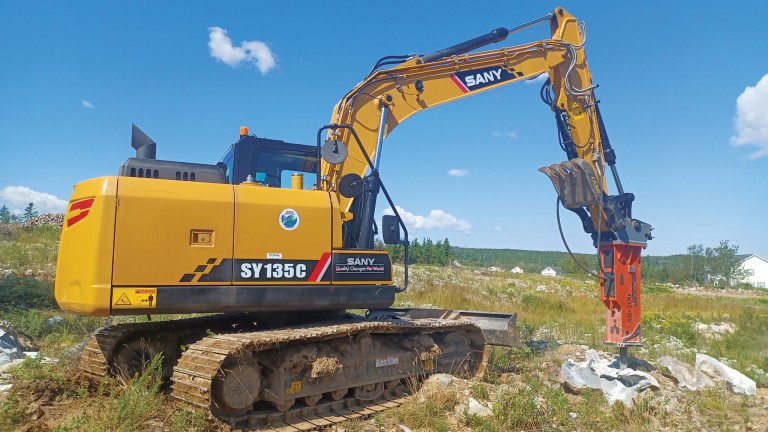
What followed was a deliberate, data-driven, multi-country process to validate SWT’s hydraulic power hammers and other attachments in three different markets, Canada, Mexico, and Uruguay, before attempting full-scale dealer expansion.
Establishing trust in new markets
SWT initially approached the Americas with the assumption that product quality and competitive pricing alone would drive sales. But early pushback uncovered a disconnect between that belief and what buyers in the Americas actually needed: trust, service, and proof. Villalba advocated for shifting the company’s approach to be more focused on building this brand in a way that was tailored to meet local expectations.
Step One: Prove the product
“Before we looked for more dealers or tried to expand quickly, I said to the factory, ‘We need to know what [users] really need,'” says Villalba. “There’s a lot of competition in different price ranges. We need to manufacture based on customer use, not assumptions.”
Villalba led a three-year testing phase, placing SWT hammers in the field across varying climates, applications, and operational intensities. In Canada, the attachments were left outdoors through winter and tested in the bedrock of Halifax. In Mexico, the hammers ran for 2,000 hours annually in high-use environments. Uruguay served as a smaller-scale test market representing conditions in Latin America.
“The product was tested across three different landscapes for three years,” he says. “In that time, we didn’t have a single warranty claim.”
The results confirmed what Villalba believed from the start: SWT’s hammers could stand up to the demands of the Americas, but proving it in the field was essential to earning buyer confidence.
Step Two: Calculate ROI and deliver value
With technical validation complete, SWT focused on the business case for its target market segment: small and mid-sized contractors. The company introduced a two-year warranty and collected real-world performance data to support ROI estimates.
“In Canada, we determined you can get return on investment in seven months,” says Villalba. “And you have a warranty for two years.”
To reinforce that message, SWT is preparing to launch an online ROI calculator that lets contractors enter project data, such as machine make/model, attachment type, usage hours, and pricing, to get a payback estimate. The tool also helps match hammers to excavators and supports both purchase and rental scenarios.
“They can see the hammer, how much they’re going to make in revenue, the profit, and the payback,” Villalba explains. “It helps [our customers] feel confident.”
Step Three: Establish the dealer model
SWT’s go-to-market strategy now centres on selective dealer development, starting with Tidal Tractor in Atlantic Canada. Early lessons taught Villalba not to assume that dealer principals alone could drive momentum.
“You have to convince not only management, but the salespeople and the technicians as well,” says Villalba. “They need to know that what we are making is a really good product, and that’s what we promise.”
SWT has invested in training and service support, including flying in a highly experienced service technician from Mexico to help on-board Canadian partners.
“We even have a WhatsApp channel for service,” he adds. “We’ve been able to deal on site and on time with issues in Canada, Mexico, and worldwide.”
That service-first mindset is critical in North America, where customers expect parts availability, install support, and warranty fulfillment — not just a low purchase price.
“In China, they didn’t understand why someone in Canada wouldn’t just look at the product and know it’s good,” Villalba says. “But you have to explain the cost of doing business here. It’s not just the product, it’s everything [supporting] it.”
Read the full article here