

Vibration involves downward impact force. Oscillation involves tangential kneading.
SAKAI America, Inc.
How soil compactors work
Modern soil compactors primarily rely on three dynamic methods to achieve density: vibration, impact, and oscillation (dynamic kneading). However, compaction can also be done under static loading and/or by manipulation (kneading). Understanding the difference between these is essential for selecting the right tool for the job.
Vibratory compactors
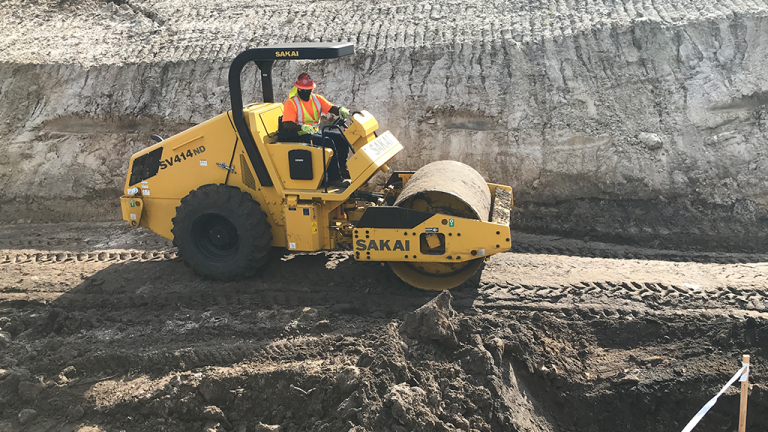
A vibratory compactor is the most common workhorse. An eccentric shaft with unbalanced weights inside the drum rotates at high speed, generating an eccentric force. This force vibrates the entire drum, pounding the ground like a hammer and compacting deep into the soil layers.
This dynamic force, combined with the drum’s static load, makes vibratory rollers exceptionally efficient. They are the go-to choice for compacting granular, cohesive, and mixed-material soils, quickly achieving the required density deep into the base layer.
Impact compactor
Impact rollers, rammers, and drop weights apply significantly greater impact loads in a short time at much lower frequencies and larger amplitudes than vibratory rollers, compacting deep layers.
Oscillatory (dynamic kneading) compactors
The oscillatory compactor offers a more delicate and versatile approach. Instead of a strong vertical vibration or impact, it employs a tangential, forward-and-backward motion that gently kneads the material.
This makes oscillation the ideal solution for compacting thinner layers or working in sensitive areas. These include sites with underground utilities, proximity to existing historical structures, or near residential areas where deep vibratory forces could potentially cause damage.
Static compactors
Compaction using static rollers is an old technique that dates to ancient Rome. Early rollers were horse/oxen-drawn, and the method evolved to steam power in the 18th century before being replaced with diesel power. However, the introduction of vibratory compactors around 1960 offered superior performance and led to the gradual decline of static variants.
However, static compaction is still used today for surface finishing work. This is because sites involving brittle materials or those with no-vibe requirements necessitate rollers with higher static linear pressure than that of vibratory compactors with the vibration simply switched off. Large static soil compactors with tamping drums are also employed on large embankment sites containing cohesive soils and for compacting core (clay) materials in rock-fill dams.
Pneumatic tire rollers
Static pneumatic tire rollers were revolutionary in the 1950s by allowing adjustment of wheel load and tire pressure; however, their need for heavy ballast made them cumbersome. They declined after the advent of more efficient vibratory rollers. Today, 8- to 25-ton models are used for final surface finishing (leveraging their static kneading effect), especially where vibration is prohibited. Modern advancements include uniquely vibrating the tires, such as on the SAKAI GW754, for deeper compaction and enhanced surface density.
Read the full article here