

Finding new ways to connect, use, and maximize existing technology for data sharing can transform workflows and save valuable time.
Trimble
Transforming field-to-office communication
Before joining Amrize, Prendergast led a surveying team on Canada’s largest civil infrastructure project, the Site C dam and hydroelectric generating station on the Peace River in northeast British Columbia. The project began in 2016 and will provide power for 450,000 homes when completed. The volume of earthwork, tunnelling, and concrete required to complete the project is staggering, testing surveyors’ planning, communication, and data management skills and compounding the value of technology-driven efficiencies and cost savings.
Across a footprint of eight square miles, crews on the Site C project will move just shy of 20 million cubic yards of 17 different material types and pour more than 1.6 million cubic yards of concrete. According to Prendergast, the drafting department will turn out close to 4,000 designs over the course of the project.
“Immediately, I saw that we needed a faster communication stream,” says Prendergast. “Surveyors completed scans, exported them to a USB stick, and then drove them back to the office. Because we were working on an expansive job site with a river running through it, getting around the site took half an hour. Hand delivering the file was the biggest and most time-consuming aspect of our work.”
Prendergast envisioned a future state of better data sharing between the office and the field, coupled with connected machine control and guidance, to minimize downtime and increase efficiency. He started by adding SIM cards to the Windows-based controllers so surveyors could immediately transmit scan data to the office. “They would let me know over WhatsApp when they were complete, and I would then process the scan,” he said. “Using Trimble Business Center, I would isolate the high spots and upload the excavation design with cosmetic changes, so the operators could quickly address the area and move to the next excavation. This new workflow radically reduced turnaround time from 90 minutes to 10 to 15 minutes.”
Although this simple improvement significantly improved the field-to-office collaboration, it was just the beginning of data sharing and communication.
Connected machine control
The project also required the underwater excavation of a 600- by 200-metre area to a minimum line that would ensure a smooth release from the spillway. The excess raw material removed from the river bottom was also essential to building the dam buttresses.
Prendergast noticed communication barriers were impacting progress and preventing operators from getting the information needed to do their work efficiently. “We had to confirm the minimum line of excavation, but we also didn’t want to waste each excavator’s time across the day and night shifts,” he explains. “Each operator needed to know where the previous excavator had excavated.”
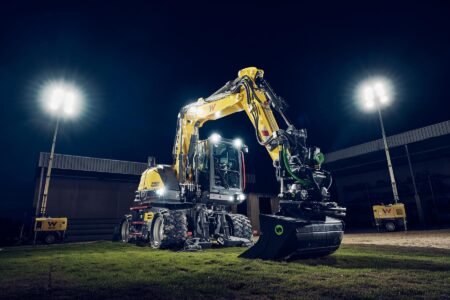
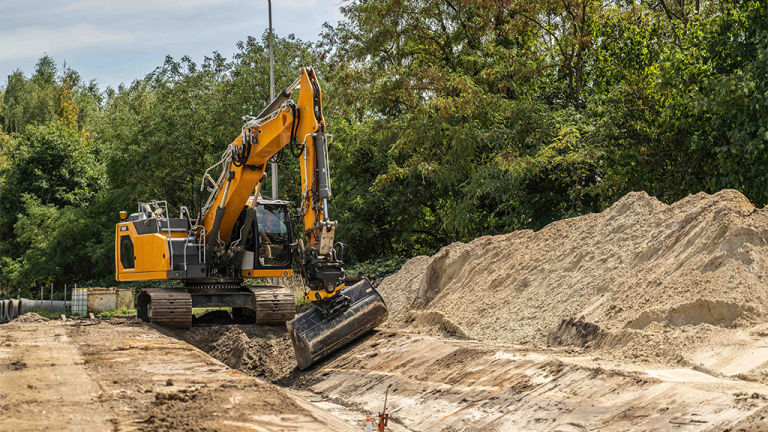
Each excavator was equipped with Trimble grade control technology, allowing operators to gather data, much like surveyors. “Even with grade control technology on the machines, we were limited to manual data transfer with USB sticks, but WorksManager streamlined that process very quickly,” he says.
Trimble WorksManager is a cloud-based platform that streamlines communication and data management between the office and the field. “The operators manually recorded positions throughout the day,” Prendergast explains. “At the end of the day, I logged directly into the machine grade control using Works- Manager, downloaded the data as point files (.PNT) and dropped it into Trimble Business Center, which is Trimble’s constructable modelling, earthwork, and survey software. Each day, I compared the completed work to the 3D model to confirm it was below grade tolerance with the defined safety factor. I sent an updated perimeter model to the operators each morning through WorksManager. I adjusted the perimeter to include the previous day’s excavation, so when the day shift started, they were not reworking an area that had already been excavated to grade.”
With clear information on where to work, operators were confident they could work without stops and starts. “It completely revolutionized the job,” Prendergast says. “We could concentrate on actual survey work rather than overseeing operators and driving around designs from machine to machine.”
Read the full article here