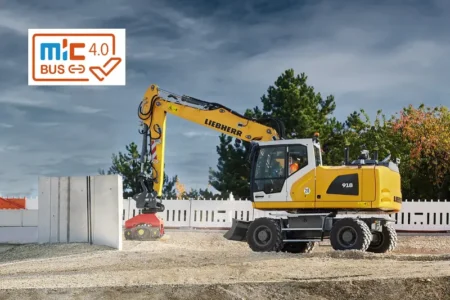



The Solidlink quick coupler attachment can be used on excavators, wheel loaders, material handlers, and large cranes.
Liebherr
Solidlink compatibility has expanded over the past quarter century
Over the past 25 years, Solidlink has been continuously developed and adapted to meet new requirements. What was originally designed for hydraulic excavators is now used in a wide range of machines and applications. Solidlink sizes 33, 48, 66, and 77 are available for wheeled and crawler excavators, as well as material handlers. The current range also includes the latest models, the Solidlink 33-9 and Solidlink 48-10, which enable additional hydraulic, lubrication, and signal connections, thereby supporting the use of even more complex attachments.
Today, Solidlink enables fully automatic attachment change not only on hydraulic and demolition excavators, but also on wheel loaders. For the latter, the system is available for a wide range of models, including the L 504 to L 508 compact loaders, the L 507 and L 509 stereoloaders, the L 526 to L 546 mid-sized wheel loaders, and the L 550 XPower to L 580 XPower wheel loaders. A second Solidlink coupling block is available as an option for the compact and stereoloaders. This allows an additional hydraulic circuit to be connected for operating attachments such as a vibrating plate and a snow plough.
For industrial machinery, the MH 40 Solidlink and MH 110 Solidlink suspended quick coupling systems have been developed as specialised solutions that enable the fully automatic changing of hydraulic and electric attachments. Within the Liebherr Group, the technology is now being used in numerous other product areas. For example, Solidlink is also compatible with the large Liebherr mobile cranes manufactured at the Liebherr plant in Ehingen, as well as with Liebherr rotary drilling rigs manufactured at the Nenzing factory site. Furthermore, Solidlink is used outside the group of companies.
Increasing demands for safety, efficiency, and digitalization provide a solid base for the system’s ongoing development. The modular architecture provides the basis for future functions and interfaces, helping the system meet the requirements of future generations of machines.
Read the full article here