



Hybrid technology has been around for more than a century in the auto industry — the first hybrid car was introduced in 1899 by Porsche. The introduction of Ford’s automobile assembly line in the early 1900s led to an increase in the production of gas-powered vehicles, making hybrids basically obsolete for several decades. But a resurgence in the 1970s brought them back, and now hybrid technology is taking hold in the construction industry.
For passenger vehicles, “hybrid” typically refers to powering the movement of the vehicle. But hybrid technology in construction equipment — specifically, excavators — is about powering the hydraulics.
So what is a hydraulic hybrid excavator? And in which applications do they make the most sense?
What does “hydraulic hybrid” mean?
The word “hybrid” might make you think of a complicated system that takes hours of operator training, extra components to monitor and replace, and so on. But that isn’t the case.
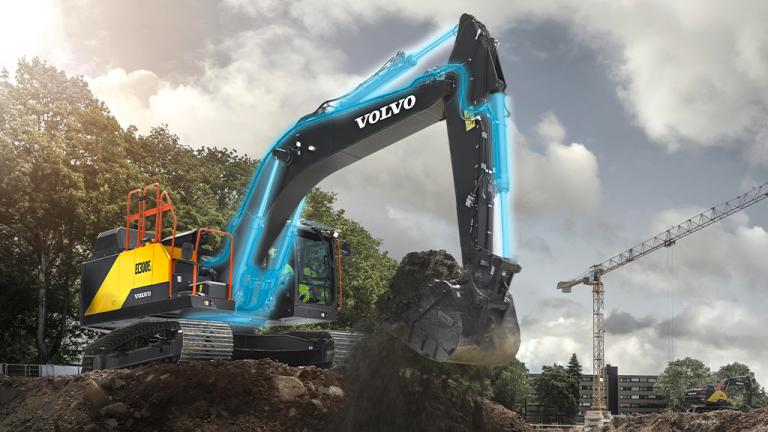
While most construction equipment manufacturers with hybrid technology use the swing motion to capture energy for the hydraulics, Volvo CE is doing it a little differently, capitalizing on the upand- down motion of the boom instead.
This is accomplished by mounting a hydraulic accumulator just behind the boom, so as the boom goes down, the high-pressure oil used to slow that movement goes into the accumulator instead of the tank. This charge is then routed through assist motors and pushed back into the cylinders on the upswing.
The best part for the operator? The entire process is controlled automatically. They simply see a symbol on the dash that indicates when the accumulator is charging and discharging. Using the energy generated by the boom-down motion to assist the boomup motion makes sense because that is where you need most of the pressure and power during operation.
In 2020, Volvo CE launched its first hydraulic hybrid excavator, the 30-ton EC300E Hybrid. Today, they offer five hydraulic hybrid excavators ranging from 26 to 50 tons. The newest models deliver up to 20 percent better fuel efficiency than their internal combustion engine (ICE) equivalents and a 10 to 15 percent reduction in CO2 emissions, all without sacrificing performance specs.
Read the full article here